Wednesday, September 10, 2014

Honda CB750

When Motorcyclist Magazine celebrated their 100th anniversary in 2012, they thought it would be appropriate to choose a "Motorcycle of the Century." They chose the 1969 Honda CB750. They called it "the bike that changed everything."

There are lots of memorable motorcycles that created waves over the years, many people have their own favorites, but it was the Honda CB750 that rearranged the entire motorcycle market as soon as it came out. Honda offered comfort, reliability, and performance, all combined into a single package at a great price. Competitors stood there, slack-jawed, as they watched their own product mix get stale overnight.

As one motorcycle journalist described it referring to the then new Harley Sportster released the previous year and the holder of the title "superbike" prior to Honda's announcement: "The Sportster went from performance king to non functional bar hopper in just over a year. It hardly changed at all, really, but the world around it changed dramatically. It would have been interesting if Harley Davidson had taken up the challenge and pushed performance, at least in the Sportster line, instead of falling back on tradition and image. What might have been?"

British bikes, already struggling with problems started a steady decline. Kawasaki responded with the Z1 in 1971. A four cylinder, four-stroke, 750 cc bike was going through top-secret development prior to the release by Honda. The success of Honda's four caused Kawasaki to postpone the Z1's release until its displacement could be upped to 903 cc and sold as a 1000 cc-class machine. As the saying goes, "the rest is history," and the motorcycle market took off, never to be the same, but it was the CB750 that made it happen.

Honda's transition from the 1958 Super Cub to the 1969 "super bike" included a 250 cc and a 305 cc bikes called "Dreams." Although they resembled motorcycles from Harley and British manufacturers, they shared the front suspension and pressed steel frame from the Cub.

The most traditional bike in Honda's early product line was the 305 Super Hawk. The Honda CB77, or Super Hawk, was a 305 cc (18.6 cu in) vertical twin motorcycle produced from 1961 until 1967. It is remembered today as Honda's first sport bike. It is a landmark model in Honda's advances in Western motorcycle markets of the 1960s, for its speed and power as well as its reliability, and is regarded as one of the bikes that set the paradigm for modern motorcycles.

Robert M. Pirsig rode a CB77 Super Hawk on the trip he made with his son and their friends in 1968 on a two month journey from their home in St. Paul, Minnesota to Petaluma, California and back, which became the basis for the novel Zen and the Art of Motorcycle Maintenance: An Inquiry into Values. The novel never mentions the make or model of Pirsig's motorcycle, focusing more on his companion riders' BMW. Pirsig was, as of 2007, still the owner of his Super Hawk.

The Honda CB450 "Black Bomber" was the first truly "big" Honda motorcycle with a 444 cc parallel twin, dual overhead cam engine producing 43-45 horsepower (by extension, that is more than 100 hp per liter (1,000 cc) of displacement, another engineering milestone.

Appearing first in 1965 with a four-speed K0 model, and progressing through a series of models with various improvements and styling changes, notably a redesigned fuel tank and 5 speed transmission in the 1968 K1 model.

Honda (UK) planned a publicity event by entering Mike Hailwood as one of the riders in the Motor Cycle 500 mile production race at Brands Hatch during July 1966. Instead, Hailwood completed demonstration laps on a CB450 before racing began as it was unable to compete in the 500cc category, the FIM deeming it was not classified as a production machine as it had two overhead camshafts.

The basic CB450 engine was modified and installed in the Honda N360 car and the exported N600, the precursor to the Honda Civic.

Honda updated their product line in 1968 with the CB350, a 325.6 ccc (19.87 cu in) OHC parallel twin cylinder, four-stroke motorcycle produced through 1973. With its reliable motor and dual Keihin carburetors, it became Honda's best-selling model. More than 250,000 were sold in five years, with 67,180 sold in 1972 alone. In 1968 it was the best-selling motorcycle worldwide. The CB350 evolved during its production run with cosmetic changes and improvements to the suspension and brakes.

These early twins set the stage for the 1969 Honda unveiling of the CB750 at the Tokyo Motor Show in late ’68, although it didn’t hit the market until early the next year. It is impossible to overstate the impact this bike made, as the first modern mass-market four, and the first volume production bike to come with a disc brake.

Honda triggered a speedy evolution of motorcycle technology with its pioneering of the four-cylinder layout. It brought a reliable ride that many riders had not yet experienced in 1969.

The Honda CB750 is a motorcycle built in several model series between 1969 and 2003, and also in 2007. It is recognized as a milestone in Honda's successful introduction of the transverse, overhead camshaft inline four-cylinder engine that, ever since, has been the dominant sport bike configuration. Though MV Agusta had sold such a model in 1965, and it had been used in racing engines before World War II, the CB750 is recognized as the four-cylinder sport bike that had a lasting impact and is often called the first superbike. The model is included in the AMA Motorcycle Hall of Fame Classic Bikes.

Cycle magazine called the CB750 "the most sophisticated production bike ever" upon its introduction. Cycle World called it a masterpiece, highlighting Honda's painstaking durability testing, the bike's 120 mph top speed, the fade-free performance of the braking, the comfortable ride, and excellent instrumentation.

The CB750 was the first modern four-cylinder machine from a mainstream manufacturer, and the term superbike was coined to describe it. The bike offered other important features that added to its compelling value: electric starter, kill switch, dual mirrors, flashing turn signals, easily maintained valves, and overall smoothness and freedom from vibration both underway and at a stand still; later models (1991 on) included maintenance-free hydraulic valves.

Unable to gauge demand for the new bike accurately, Honda limited its initial investment in the production dies for the CB750 by using a technique called permanent mold casting (often erroneously referred to as sand-casting) rather than die-casting for the engines. Exceeding expectations, the bike remained in the Honda lineup for ten years, with sales totaling over 400,000 in its life span.

Until well into 1970, CB750s were made without die-cast engine cases. In truth, die-cast cases were lighter, stronger, and more oil tight. But it’s the early, "temporary-cast" models that are prized by collectors.

The venerable four spawned many copies, both larger displacement and some refined smaller versions such as Honda's own CB500 and CB550 fours. It was on the back of a CB550 Four that I made a journey from Colorado to Lewistown in the summer of 1976. I remember sitting in a bar with my friend Jack Barney … a member of the local county mounties. Just then his radio spoke up that there was a suspicious motorcycle parked outside with Colorado plates. Jack replied to the voice that he was questioning the suspect at that time.

Although that smaller Honda Four was a jewel around town, I have to admit it was a bit small for the long ride up I-25 through the Wyoming wind and the Montana hills. On my return trip a week later I recall intensely wishing it had a windshield.

Even though single and twin cylinder powered motorcycles are still most common, four-cylinder and even six-cylinder bikes are now spotted regularly on the highways and Interstates. The history of motorcycles included engines with more than two cylinders in the early days, but the two-cylinder models had dominated production up to this point. Both racing and street riding changed after the Honda four came out.

To quote from an SAE (Society of Automotive Engineers) technical paper written in 1969, "Combustion engines with up to 48 cyl have been built. It is shown that this is neither accident nor fanciness when high specific power output is involved. As is demonstrated on hand of equations [sic], the subdivision of a certain displacement into larger numbers of smaller cylinders brings about a substantial increase in power."

So the engineers agree. The manufacturers agree. The racers agree. The riders agree. I agree. Twins are cool, but "more is beter." It's a philosophy I've always tried to live with … that and "the one who dies with the most toys wins!"

Tuesday, September 9, 2014

Honda Super Cub

The Honda Super Cub, in its various versions: C100, C50, C70, C90, C100EX, C70 Pass-port and more, is a Honda underbone motorcycle with a four stroke single cylinder engine ranging in displacement from 49 to 109 cc (3.0 to 6.7 cu in).

An underbone motorcycle uses structural tube framing with an overlay of plastic or non-structural body panels in contrast with monocoque or unibody designs where pressed steel or tubular steel serves both as the vehicle's structure and bodywork.

Underbone may also refer to a class of small light motorcycles that use the construction type, known variously as step-throughs or scooters.

An underbone cycle may share its fuel tank position and tube framing, along with fitted bodywork and splash guards with a scooter while the wheel size, engine position, and power transmission are like those of larger motorcycles. Underbones are popular worldwide, especially in the developing world.

Although the Super Cub was a step-through design with a small engine, I wouldn’t call it a “scooter” since the rider put his or her feet on pegs rather than a floorboard and the tires were much larger than most scooters. I always called them “motorbikes” to differentiate the Cub from a larger motorcycle.

The Super Cub has been in continuous manufacture since 1958, with production surpassing 60 million in 2008. That makes the Super Cub the most produced motor vehicle in history.

The Super Cub's US advertising campaign, "You meet the nicest people on a Honda," had a lasting impact on Honda's image and on American attitudes about motorcycling, and is considered a classic case study in marketing.

The idea for a new 50 cc (3.1 cu in) motorcycle was conceived in 1956, when Honda Motor's Soichiro Honda and Takeo Fujisawa toured Germany and witnessed the popularity of mopeds and lightweight motorcycles. Soichiro Honda was primarily the engineering and production leader of the company, always with an eye towards winning on the racetrack, while his close partner Fujisawa was the man of finance and business, heading up sales and formulating strategies intended to dominate markets and utterly destroy Honda Motor's competitors.

Fujisawa had been thinking about a long term expansion strategy, and, unlike other Japanese companies, did not want to simply boost production to cash in on the recent economic boom in Japan. A small, high performance motorcycle was central to his plans. Upwardly mobile consumers in postwar Europe typically went from a bicycle to a clip on engine, then bought a scooter, then a bubble car, and then a small car and onwards. Fujisawa saw that a motorcycle did not fit in this pattern for the average person, and he saw an opportunity to change that. Soichiro Honda was at the time tired of listening to Fujisawa talk about his new motorcycle idea; Honda came to Europe to win the Isle of Man TT race and wanted to think about little else.

Fujisawa and Honda visited Kreidler and Lambretta showrooms, as well as others, researching the kind of motorcycle Fujisawa had in mind. Fujisawa said the designs had "no future" and would not sell well. His concept was a two wheeler for everyman, one that would appeal to both developed and developing countries, urban and rural. The new motorcycle needed to be technologically simple to survive in places without up-to-date know-how and access to advanced tools or reliable spare parts supplies. The common consumer complaints of noise, poor reliability, especially in the electrics, and general difficulty of use would have to be addressed.

Because Honda was a large company growing larger, it need a mass appeal product that could be produced on an enormous scale. The design had to be sorted out before production began, because it would be too costly to fix problems in the vast numbers that were to be manufactured. This philosophy was quite the opposite from motorcycle companies in the US and Great Britain where incremental improvement on basic designs several decades old were the norm. Many of these companies operated with a process not much beyond hand-built and mass production was often not at the front of their thinking.

My personal experience with Japanese engineering in the 70’s and 80’s emphasized this fact. While IBM was big on small improvements and engineering changes, the Japanese tended to create a product from a carefully implemented process, and then not change it. Often these little changes would have unintended consequences, and I think the Japanese often had the right idea … do it right the first time and then don't "fiddle" with it.

The scooter type nearly fitted the bill for the Honda corporation, but was too complex for developing countries to maintain, and the small wheels did poorly on badly maintained or nonexistent roads. Another of Fujusawa's requirements was that it could be ridden with one hand while carrying a tray of soba noodles, saying to Honda, "If you can design a small motorcycle, say 50 cc with a cover to hide the engine and hoses and wires inside, I can sell it. I don't know how many soba noodle shops there are in Japan, but I bet you that every shop will want one for deliveries." That may have been a key motivation for the Super Cub's centrifugal clutch and foot shift which freed the left hand.

Once interested, Soichiro Honda began developing the Super Cub on his return to Japan.The following year Honda displayed a mockup to Fujisawa that finally matched what he had in mind, Fujisawa declaring the annual sales would be 30,000 per month, half again as many as the entire monthly two-wheeler market in Japan. His goal was export on a scale yet unseen in the economic disorder of postwar Japan, when most companies' halting trade efforts were handled through foreign trading companies. Honda would have to establish its own overseas subsidiary to provide the necessary service and spare parts distribution in a large country like the United States. To this end American Honda Motor Company was founded in 1959. In 1961 a sales network was established in Germany, then in Belgium and the UK in 1962, and then France in 1964.

The Honda Juno had been the first scooter to use polyester resin, or fiberglass reinforced plastic (FRP), bodywork, and even though production of the Juno had stopped in 1954 as a result of Honda Motor's financial and labor problems at the time, Fujisawa continued to encourage research in polyester resin casting techniques, and these efforts bore fruit for the Super Cub.

The new motorcycle's fairing would be polyethylene, the most widely used plastic, which reduced weight over FRP, but Honda's supplier had never made such a large die cast before, so the die had to be provided by Honda. The Super Cub was the first motorcycle ever to use a plastic fairing. Motorcycling historian Clement Salvadori wrote that the plastic front fender and leg shields were, "perhaps the Cub's greatest contribution; plastic did the job just as well as metal at considerably lower cost."

The technology developed in the Isle of Man TT racing program was equally vital to the new lightweight motorcycle, making possible 4.5 hp from a 50 cc four-stroke Honda engine, where the first engine the company built a decade earlier, a "fairly exact copy" of the 50 cc two stroke war-surplus Tohatsu engine Honda had been selling as motorized bicycle auxiliary engine, had only a 0.5–1 hp output. Certainly my first 50 cc bike, a Puch MoPed sold by Sears, got a fraction of the power that Honda could wring from the same displacement. Honda’s first four stroke, the 1951 E-type, had just a little more power than the Super Cub, 5 bhp, with nearly triple the displacement, 146 cc (8.9 cu in). So the Super Cub engine was a marvel of power for such a small size and a leap forward foretelling things to come.

To make the new motorcycle, Honda built a new ¥10 billion factory in Suzuka, Mie to manufacture 30,000, and with two shifts, 50,000, Super Cubs per month. The factory was modeled on the Volkswagen Beetle production line in Wolfsburg, Germany.

Until then, Honda's top models had sold only 2,000 to 3,000 per month, and observers thought the cost of the new plant too risky an expenditure. Edward Turner of BSA went to Japan to see the motorcycle industry in September 1960, and said that investments the size of the Suzuka plant were "extremely dangerous" because he considered the US motorcycle market already saturated.

When completed in 1960, the Suzuka Factory was the largest motorcycle factory in the world, and was a model for Honda's mass production facilities of the future. The economies of scale achieved at Suzuka cut 18% from the cost of producing each Super Cub when Suzuka could be run at full capacity, but in the short term Honda faced excess inventory problems when the new factory went into operation before the full sales and distribution network was in place.

The pushrod overhead valve (OHV) air-cooled four stroke single cylinder, 49 cc engine could produce 4.5 hp @ 9,500 rpm, for maximum speed of 43 mph, under favorable conditions. The low compression ratio meant the engine could consume inexpensive and commonly available low octane fuel, as well as minimizing the effort to kick start the engine, making the extra weight and expense of an electric starter an unnecessary creature comfort.

Though some of the many Super Cub variations came with both kick and electric start, the majority sold well without it, and even the 2011 model year Japanese domestic market Super Cub 50 and Super Cub 110 versions, using up to date technology like Honda's Programmed fuel injection (PGM-FI) and convenience features like a fuel gauge, were not offered with an electric start option.

The sequential shifting three speed gearbox was manually shifted, but clutchless, without the need for a clutch lever control, using instead a centrifugal clutch along with a plate clutch slaved to the foot-change lever to engage and disengage the gearbox from the engine. While not intuitive to learn, once the rider got used to it, the semi-automatic transmission, took the terror out of motorcycling for novice riders. Unlike many scooter transmissions, the centrifugal clutch made it possible to push start the Super Cub, a useful advantage if the need arose. Owners quickly learned you could hold down the foot shifter and rev the engine before releasing the shifter to get a fast start equal to a hand clutch. My MoPed was shifted by pulling in the left-hand clutch lever and then rotating the grip from first to second. The Honda design was obviously superior, especially for a small bike.

The early Super Cubs used a simple 6 volt ignition magneto mounted on the flywheel, with a battery to help maintain power to the lights, while later ones were upgraded to capacitor discharge ignition (CDI) systems. The lubrication system did not use an oil pump or oil filter, but was a primitive splash-fed system for both the crankcase and gearbox, with a non-consumable screen strainer to collected debris in the engine oil. Both the front and rear brakes were drums, and the front and rear wheels were 17" wire spoke with full-width hubs just like a "real" motorcycle.

Honda recommended daily checks of the lights, horn, tire pressure, brakes, fuel and oil level, and a weekly check of the battery electrolyte level. The new engine break in maintenance was done at 200 miles, requiring adjustment of the valve tappets and contact breaker points, and an oil change. Every 1,000 miles the spark plug needed cleaning, and the chain adjustment checked, and every 2,000 miles an oil change, breaker point check, and valve adjustment was due. At 5,000 miles major maintenance was performed, requiring the removal and cleaning of the carburetor, drive chain, exhaust silencer, and wheel bearings. The rider closed a manual choke to aid in starting at cold temperatures. By the standards of the day, this was an extremely simple motorcycle, with minimal maintenance demands, and it earned a reputation for high reliability.

C110

The C110 Sports Cub debuted in October 1960. The C110 was more like a traditional motorcycle that the rider had to straddle, not a step-through. It had a different frame, with the fuel tank in the on top of the frame and in front of the seat, and the frame's steel tube spine ran horizontally from the head tube to the seat. It had a hand clutch and a foot shifter more like larger bikes, but shared the same basic engine with the C100. It had a bit more power, increased from 4.5 to 5 bhp @ 9,500 rpm. An on- and off-road version of the step-through Super Cub came out in 1961. It would be classed as a dual-sport motorcycle today, but Honda called it a trail bike, the CA100T Trail 50.

Such was the success of the Super Cub motorbike in the US and all over the world that many riders today will tell fondly of their first bike, a Honda Super Cub. These bikes hit my hometown in the early ‘60s and seemed like everyone had one. I was envious of the 110 which looked more like a classic motorcycle and it wasn’t long before I owned a 150 cc Honda “Benly Super Sport” twin (CB92). Sharing much of the frame and front shock design with its little brother Sports Cub, this was my first taste of a “real” motorcycle. I actually raced that bike and won a trophy for first place at the Lewistown (King Kam Dragway) Quarter Mile Races. Don’t let the fact that I was the only entry in the 150 cc class tarnish this accomplishment. Now where did I put that trophy?

My brother, Dale, had the 305 cc "Dream." A white one and definitely a respectable ride upon which you would meet the nicest people.

In the end both Soichiro Honda and Takeo Fujisawa were satisfied. Honda got the racing platform and success he yearned and Fujisawa saw the motorcycle trade grow his company into the world leading transportation empire it is today.

I’ll bet they were singing along with the Beach Boys:

It's not a big motorcycle
Just a groovy little motorbike
It's more fun that a barrel of monkeys
That two wheel bike
We'll ride on out of the town
To any place I know you like

It climbs the hills like a Matchless
Cause my Honda's built really light
When I go into the turns
Lean with me and hang on tight
I better turn on the lights
So we can ride my Honda tonight

First gear (Honda Honda) it's alright (faster faster)
Second gear (little Honda Honda) I lean right (faster faster)
Third gear (Honda Honda) hang on tight (faster faster)
Faster it's alright

Monday, September 8, 2014

Moto Guzzi

Moto Guzzi is Europe's oldest continuously operating motorcycle manufac-turer, founded in 1921 on the shores of Lake Como in the village of Mandello del Lario, Italy, where the motor-cycles are still manufactured today. The company is noted for its historic role in Italy's motorcycling manufacture, its prominence worldwide in motorcycle racing, and industry innovations — including the first motorcycle center stand, wind tunnel design, and eight-cylinder engine.

Moto Guzzi won a great many racing championships in its early history, yet none since the late ‘50s. Their final attempt met with ultimate failure and they withdrew from racing, primarily for economic reasons.

Carlo Guzzi's initial engine design was a horizontal single that dominated the first 45 years of the company's history in various configurations. Through 1934, each engine bore the signature of the mechanic who built it. As originally envisioned, the company used racing to promote the brand. In the 1935 Isle of Man TT, Moto Guzzi factory rider Stanley Woods performed an impressive double victory with wins in the Lightweight TT as well as the Senior TT.

Until the mid-1940s, the traditional horizontal four-stroke single-cylinder 500 cc engines outfitted with one overhead and one side valve (also known as IOE, “inlet over exhaust” or F-head) were the highest performance engines Moto Guzzi sold to the general public. By contrast, the company supplied the official racing team and private racers with higher performance racing machines with varying overhead cam, multi-valve configurations, and cylinder designs.

In the 1950s, Moto Guzzi, along with the Italian factories of Gilera and Mondial, led the world of Grand Prix motorcycle racing. With durable and lightweight 250 cc and 350 cc bikes designed by Giulio Carcano, the firm dominated the middleweight classes. The factory won five consecutive 350 cc world championships between 1953 and 1957. In realizing that low weight alone might not continue to win races for the company, Carcano designed the V8 500 cc GP race bike — whose design was to become one of the most complex engines of its time.

Despite these bikes leading many races and frequently posting the fastest lap time, it often failed to complete races because of mechanical problems. Ultimately, the V8 was not developed further as Moto Guzzi withdrew (together with the main competitors Gilera and Mondial) from racing after the 1957 season citing escalating costs and diminishing motorcycle sales. By the time of its pull out from Grand Prix racing, Moto Guzzi had won 3,329 official races, 8 World Championships, 6 Constructor's Championships, and 11 Isle of Man TT victories.

This Moto Guzzi Grand Prix V8, introduced in 1955, was a 500 cc racing motorcycle fitted with a V8 engine using dual overhead camshafts (DOHC). The engine was conceived by Giulio Carcano, Enrico Cantoni, Umberto Todero, Ken Kavanagh and Fergus Anderson just after the 1954 Monza Grand Prix and designed by Dr. Carcano. Power was in the region of 80 bhp at 12,000 rpm, approximately 10–15 bhp more than the rival 4-cylinder MV Agustas and Gileras.

The engine and the bike were unprecedented. The motorcycle proved capable of achieving 172 mph — thirty years before the speed was reached again in Grand Prix motorcycle racing. However, the "Otto Cilindri" (eight cylinder) proved difficult to ride, as well as complex and expensive to build and maintain — bikes suffered broken crankshafts, overheating, and seizing — all in addition to the danger the bike posed to the racers themselves. By 1957 there were two bikes available and no one willing to race the bike without further development and the bike was withdrawn.

A greater success has been their large V-twin machines sold in the US as well as Europe. The Moto Guzzi California (a.k.a. "Cali") is a motorcycle manufactured by Moto Guzzi since 1971, bringing together the company's heritage, their iconic air-cooled 90° V-twin engines, and styling that evokes the classic American Cruiser motorcycle.

The first California was designed with the direct input of the Los Angeles Police Department Traffic Division to be the department's new model of choice. Original features included a left-foot gearshift, a bulletproof Lexan windshield, and a sprung sidestand, along with the requisite siren, radio, extra police lights, and ability to complete a standing quarter mile in 16 seconds or less. The success of the model led to other police departments ordering their own, including the California Highway Patrol.

The company was legally based in Genoa, Italy, with its headquarters in Mandello. The very earliest motorcycles bore the name G.P. (Guzzi-Parodi), though the marque quickly changed to Moto Guzzi. As the only actual shareholders, the Parodi's wanted to shield their shipping fortunes by avoiding confusion of name G.P. with Giorgio Parodi's initials. Carlo Guzzi initially received royalties for each motorcycle produced, holding no ownership in the company that bore his name. In 1946 Moto Guzzi formally incorporated as Moto Guzzi S.p.A. with Giorgio Parodi as chairman.

The period after World War II was as difficult in Mandello del Lario as it was elsewhere in post-war Europe. The solution was production of inexpensive, lighter cycles. The 1946 "Motoleggera", a 65 cc lightweight motorcycle became very popular in post-war Italy. A four-stroke 175 cc scooter known as the "Galletto" also sold well. Though modest cycles for the company, the lighter bikes continue to feature Guzzi's innovation and commitment to quality. The step-through Galletto initially featured a manual, foot-shifted three-speed (160 cc) configuration then later a four-speed (175 cc) set-up by the end of 1952. The displacement was increased to 192 cc in 1954 and electric start was added in 1961.

Moto Guzzi was limited in its endeavors to penetrate the important scooter market as motorcycle popularity waned after WWII. Italian scooter competitors would not tolerate an incursion from Moto Guzzi. By innovating the first large-wheeled scooter, Guzzi competed less directly with manufacturers of small-wheeled scooters such as Piaggio (Vespa) and Lambretta.

To illustrate the delicate balance within the Italian post-war motorcycle and scooter markets, when Guzzi developed their own prototype for a small-wheeled scooter, Lambretta retaliated with a prototype for a small V-twin motorcycle threatening to directly compete on Moto Guzzi's turf. The two companies compromised: Guzzi never produced their small-wheeled scooter and Lambretta never manufactured the motorcycle. The drive train that Lambretta made in their 1953 motorcycle prototype remarkably resembles the V-twin plus drive shaft arrangement that Guzzi developed more than ten years later, ultimately to become iconic of the company.

By 1964, the company was in full financial crisis. Emanuele Parodi and his son Giorgio had died, Carlo Guzzi had retired to private life, and direction passed to Enrico Parodi, Giorgio's brother. Carlo Guzzi died in 1964.

Though Moto Guzzi has employed engines of myriad configurations, none has come to symbolize the company more than the air-cooled, 90 degree V-twin with a longitudinal crankshaft orientation and the engine's transverse cylinder heads projecting prominently on either side of the bike. Unlike the in-line V-twin of Harley and others, the Guzzi engine is mounted horizontally with the angled cylinders sticking out on both sides below the gas tank. Not as wide as the horizontal engines of a large BMW, this configuration contributed to better cooling than an in-line design and still gave ample ground clearance for tight cornering and room for the rider’s feet.

The original V-twin was created in the early 1960s by engineer Giulio Cesare Carcano, designer of the DOHC V8 Grand Prix racer. The air-cooled, longitudinal crankshaft, transverse cylinder, pushrod V-twin began life with 700 cc displacement and 45 hp — designed to win a competition sponsored by the Italian government for a new police bike.

The sturdy shaft-drive, air-cooled V-twin won, giving Moto Guzzi renewed competitiveness. This 1967 Moto Guzzi V7 with the original Carcano engine has been continuously developed into the 1,200 cc, 80 hp versions offered today. Lino Tonti redesigned the motor for the 1971 Moto Guzzi V7 Sport. This engine is the basis of the currently used 750 cc, 1,100 cc and 1,200 cc Guzzi engines. On the negative side, the longitudinal crankshaft and orientation of the engine creates a slight gyroscope effect, with a slightly asymmetrical behavior in turns.

Back in 1928, long-distance motorcycle travel was limited by the lack of an effective rear suspension design. Until then, alternative designs sacrificed torsional rigidity — gaining comfort but severely compromising handling. Carlo Guzzi and his brother Giuseppe designed an elastic frame using a sheet-steel box enclosing four springs, together with a swingarm in tubes and sheet metal.

The first Moto Guzzi bike to employ the suspension was named the G.T. (for Gran Turismo, Grand Touring), and to prove the suspension — and gain publicity for Moto Guzzi — the brothers conceived a challenging 4,000-mile journey from Mandello del Lario to Capo Nord in northern Norway. Despite the very poor condition of European roads at that time, Giuseppe Guzzi reached the Arctic Circle in four weeks. The elastic frame rear suspension was immediately introduced to production machines, transforming the usability of the motorcycle as an everyday form of transportation. In 2006, Moto Guzzi retraced the 'raid' of 1928 to introduce the Norge 1200. The word "Norge" is Norwegian for “Norway".

Another problem solved by Moto Guzzi is that, above a certain power level, the competing forces of drive-shaft arrangements can severely disrupt the suspension of a motorcycle (especially when rolling on the throttle), a phenomenon called "shaft jacking". Moto Guzzi introduced its first anti-jacking system with the Daytona in 1993 and evolved that design though the 2005 V11 Sport. Guzzi later introduced their CARC system, emulating the BMW Paralever design and serving the same function. Kawasaki introduced its Tetra-lever system for similar reasons on the Kawasaki Concours 14 (also known as the 1400 GTR). Arturo Magni (1925–2005) had sold "parallelogrammo" rear suspension kit in the early 1980s to resolve similar anti-torque issues.

Moto Guzzi's current Breva 750, Nevada 750, and California Vintage fall below the power threshold that requires an anti-jacking drive-shaft system.

To quote from their current Web advertisements:

“Since 1921, Moto Guzzi motorcycles have defined innovation and design that is as legendary as the people who ride them. Timeless character, uncompromising craftsmanship, and an independent spirit — this is the soul of a Moto Guzzi Original.“

“The elements of this tradition are one hundred percent Italian: including exotic, eye-catching style, unique technology, and a spirit and character that is impossible to imitate. From the first bike we ever made to today's latest models, every Moto Guzzi motorcycle is and always will be a classic.”

Well said. Long live timeless style, character, and the Italian spirit.

Sunday, September 7, 2014

BMW Motorrad (Motorcycle)

BMW's history began in 1921 when the company commenced manufacturing engines for other enterprises. For nearly 100 years they have produced motorcycles, automobiles, airplane engines, and were involved in the development of the first jet engines during the war.

BMW corporation (Bayerische Motoren Werke AG) introduced the first motorcycle under its name, the R32 with a flat-twin engine, in 1923. Motorcycle manufacturing now operates under the BMW Motorrad brand. "Motorrad" is German for "Motorcycle."

A flat engine is an internal combustion motor with multiple pistons that move in a horizontal plane. Typically, the layout has cylinders arranged in two banks on either side of a single crankshaft and is sometimes known as the boxer, or horizontally opposed engine. The concept was patented in 1896 by engineer Karl Benz (of Daimler-Benz and Mercedes-Benz fame), who called it the "contra engine."

This design was also popular in many German automobiles including Volkswagen. Other notable uses were in the Chevrolet Corvair, the French Citroën, and Subaru offers a boxer turbodiesel. The Toyota Sports 800 was Toyota's first sports car and contained a two-cylinder Boxer engine, the 2U. Although many of these implementations are air cooled, there are also water-cooled examples including the flat-six engines in the Porsche Boxster, Cayman, and later 911 models. Honda's top-of-the-line Goldwing motorcycle is a boxer engine design, also water cooled.

Boxer engines got their name because each pair of pistons moves simultaneously in and out rather than alternately, like boxers clashing their gloved fists together before a fight. Boxer engines have proved to be highly successful with up to twelve cylinders in automobiles and up to six cylinders in motorcycles, and they continue to be popular for light aircraft engines.

In the last decade, BMW Motorrad produced around 100,000 motorcycles annually. In May 2011, the 2,000,000th motorcycle produced by BMW Motorrad was a R1200GS, their current best selling model. It appears that, after the invasion of the US by Japanese motorcycles led to the downfall and collapse of many other brands, that BMW has found a stable and profitable market in the modern world. My unscientific count of bikes on the road, after eliminating Harley's and Japanese iron, I find BMW the most common bike encountered.

The end of World War II found BMW in ruins. Its plant outside of Munich was destroyed by Allied bombing. The Eisenach facility, while badly damaged, was not totally destroyed, and tooling and machinery had been stored safely nearby. After the war, most of BMW's engineers were taken to the US or the Soviet Union to continue the work they had done on jet engines with BMW during the war. I've visited the modern Munich BMW factory. It is across the road from the 1972 Munich Olympics site.

The terms of Germany's surrender initially forbade BMW from manufacturing motorcycles. In 1947, when BMW received permission to restart motorcycle production from US authorities in Bavaria, BMW had to start from scratch. There were no plans, blueprints, or schematic drawings because they were all in Eisenach, part of the Soviet dominated Eastern Germany. Company engineers in Munich had to use surviving pre-war motorcycles to copy the bikes. The first post-war BMW motorcycle in Western Germany, a 250 cc R24, was produced in 1948. The R24 was reverse-engineered from the pre-war R23 with some improvements over the R23, and was the only postwar West German BMW without rear suspension. In 1949, BMW produced 9,200 units and by 1950 production surpassed 17,000 units.

As the 1950s progressed, motorcycle sales plummeted. In 1957, three of BMW's major German competitors went out of business. In 1954, BMW produced 30,000 motorcycles. By 1957, that number was less than 5,500. In 1955, BMW began introducing a new range of motorcycles with Earles forks and enclosed drive shafts. These were the 26 hp 500 cc R50, the 30 hp 600 cc R60, and the 35 hp sporting 600 cc R69.

On June 8, 1959, John Penton rode a BMW R69 from New York to Los Angeles in 53 hours and 11 minutes, slashing over 24 hours from the previous record of 77 hours and 53 minutes set by Earl Robinson on a 45 cubic inch (740 cc) Harley-Davidson. This established BMW as a quality touring bike and a worthy competitor to the large US motorcycle brand.

Although U.S. sales of BMW motorcycles were strong, BMW was in financial trouble. Through the combination of selling off its aircraft engine division and obtaining financing, BMW was able to survive. The turnaround was thanks in part to the increasing success of BMW's automotive division. Most of BMW's offerings were still designed to be used with sidecars. However, by the early ‘60s sidecars were no longer a consideration of most riders; people were interested in sportier motorcycles.

While stationed in Norfolk, VA, during my Navy times, I tried out a BMW with a Steib sidecar. I don't recall exactly; it was probably something like an R60. I have driven Harley trikes, so I was experienced with riding a bike with more than two wheels. However, it is an odd feeling to actually "steer" around corners rather than to "counter-steer" and let the body lean the bike. Riding a bike with a sidecar is a different kind of experience from a solo bike.

For the 1968 and 1969 model years only, BMW exported into the United States three "US" models. These were the R50US, the R60US, and the R69US. On these motorcycles, there were no sidecar lugs attached to the frame and the front forks were telescopic forks, which were later used worldwide on the slash-5 series of 1970 through 1973. Earles-fork models were sold simultaneously in the United States as buyers had their choice of front suspensions.

In 1970, BMW introduced an entirely revamped product line. The engines were a complete redesign. The roller and ball-bearings in the bottom end had been replaced by shell-type journal bearings similar to those used in modern car engines. The camshaft, which had been at the top of the engine, was placed under the crankshaft, giving better ground clearance under the cylinders while retaining the low centre of gravity of the flat-twin layout. The new engine had an electric starter, although the traditional gearbox-mounted kick starter was retained. The styling of the first models included chrome-plated side panels and a restyled tank. The /5 series was given a longer rear swingarm, resulting in a longer wheelbase. This improved the handling and allowed a larger battery to be installed.

It was during this period that BMW in the US fully established themselves as a quality leader, lacking the dripping oil, vibration, and chain maintenance of the British and US brands. The 1974 publication by Montana author Robert M Pirsig of Zen and the Art of Motorcycle Maintenance contrasted a Harley and a BMW on a cross country trip. The book described more than the difference between the two bikes, but also the difference between the riders with the BMW driver described as a very organized individual who knew exactly where in his skillfully packed motorcycle one could find a pair of diagonal cutters. These were required to cut a bit of fence wire to repair a part on the Harley.

Although the book is less about motorcycles and much more about epistemology, ethical emotivism, and the philosophy of science, I highly recommend it to readers with bikes and without, regardless of the "highfalutin" words I use to describe it.

In 1977, the product line moved on to the "/7" models. The R80/7 was added to the line. The R90 (898 cc) models, "/6" and R90S models were replaced by updated versions with a new 1,000 cc; engine, the R100/7, the R100S and the new super sport model the R100RS with a full fairing. This sleek model, designed through wind-tunnel testing, produced 70 hp and had a top speed of 124 mph. The R100RS had a shorter rear end ratio to overcome the higher wind resistance of the full fairing.

In 1978, the R100RT was introduced into the lineup for the 1979 model year, as BMW's first "full-dress" tourer. The RS and RT fairings were very similar in appearance; however, the RS fairing was essentially a lightweight streamlining/protective shell and windscreen with no other functions, while the RT shell was heavier and had two "glove box" lockable compartments, ventilation louvres and an adjustable windscreen. The RT fairing was widely used for police motorcycles, with radio equipment in the fairing compartments.

The next year the R60 was replaced with the 650 cc R65. BMW added a variant in 1982: the R65LS, a "sportier" model with a one-fourth fairing, double front disc brakes, stiffer suspension, and different carburetors that added 5 hp. In early 1983, BMW introduced a 987 cc, in-line four-cylinder, water-cooled fuel injected engine to the European market, the K100. The K series comes with a simplified and unique rear suspension, a single-sided swingarm. This rear suspension give all BMWs a distinctive appearance reminiscent to high performance motocross bikes. A close mounted rear fender protects the rider when the "tire to top fender" distance is high.

In 1985, BMW introduced a 750 cc three-cylinder version, this one smoothed with another first, a counterbalance shaft. In 1986, BMW introduced an electrically adjustable windshield on the K100LT. In 1988, BMW introduced Automatic Breaking Systems (ABS) on its motorcycles. ABS became standard on all BMW K models. In 1993 ABS was first introduced on BMW's boxer (horizontally opposed cylinders) line on the R1100RS. It has since become available as an option on the rest of BMW's motorcycle range. In 1989, BMW introduced its version of a full-fairing sport bike, the K1. It was based upon the K100 engine, but now with four valves per cylinder. Output was near 100 hp.

As these examples and "firsts" demonstrate, BMW has always been an engineering driven company and did many things differently than most the competition. Known for their shaft drive rather than the much messier and adjustment requiring chain drive, many modern road bikes such as the Honda Goldwing have copied that basic design point. There are a few other bikes well known for shaft drive, such as the Moto Guzzi, but I think first of BMW any time shaft drive is mentioned. The lack of chain continues inside of the BMW engine with no secondary chain, but direct gear drive.

Going back to 1935, BMW fitted the first mass-produced hydraulically damped telescopic fork to their motorcycles. BMW still uses telescopic forks today on its F-series, G-series and HP motorcycles. But other front suspensions have also been a trademark of BMW. The R-series and K-series use the Telelever and the Duolever front suspensions.

Englishman Ernest Earles designed a unique triangulated fork that, unlike telescopic forks, resists the side-forces introduced by sidecars. BMW fitted the Earles fork to all its models for 14 years from 1955. Coincidently, 1955 was the year that use of sidecars peaked and quickly fell off in most European markets, but the Earles fork system was well liked by solo riders too. It causes the front end of the motorcycle to rise under braking — the reverse of the action of a telescopic fork. The mechanical strength of this design sometimes proved to be a weakness to the rest of the motorcycle, since it transfers impact pressure to the frame where damage is more difficult and expensive to correct.

The Telelever system was developed by Saxon-Motodd in Britain in the early 1980s. The Telelever is a unique front fork, where the shock absorber is located between and behind the two primary tubes attached to a telelever arm.

This system both lowers unsprung weight as well as decouples wheel placement function of the forks from the shock absorption function — eliminating brake dive and providing superior traction during hard-braking situations. This system improves comfort and stability considerably while providing excellent and sporty handling.

In 1930 BMW set the international speed record at 137.58 mph on a supercharged WR750 with a 735 cc engine. They improved on the record in ’32, ’34, ’35, and ’36 with the final at a speed just short of 169 mph on a 500cc bike. In 1937 they upped the record to 173.68 mph, again with a 500cc motorcycle. This was the final speed competition before the start of the Second World War.

In 2004, BMW announced the K1200S, incorporating a new front suspension based upon a design by Norman Hossack. BMW recognized this fact but paid Hossack no royalties. BMW named its new front suspension the Duolever. As of 2009, the Duolever is on the K1300S, K1300R and K1300GT.

The BMW K1200S with a top speed of 174 mph is considered the eighth fastest motorcycle in current production. It’s using 16 valves with 4 cylinders. The engine is DOHC, horizontal in-line, and liquid cooled. You can expect this motorcycle to produce 165 horsepower @ 10250 RPM. The transmission used by this fast motorcycle is 6 speed manual transmission. So, if you see one on the German Autobahn, think deeply before challenging to a race.

Another innovation, single-side rear suspension, was developed to simplify changing the rear tire. The first BMW monolever suspensions appeared in 1980 on the then-new R80G/S range. It had a single universal joint immediately behind the engine/gear-box unit. This system was later included on updated versions of the K & R Series.

The BMW 1200GS is, in my opinion, one of the finest road/off-road (dual sports) bikes made; equally at home on pavement and dirt with the comfort and power to ride the Interstate, while still easy enough to handle around town. It is one of the BMW GS family of dual sport motorcycles, featuring a 1,170 cc, 2-cylinder boxer engine with 4-valves per cylinder.

The K1300S with an in-line four cylinder water cooled mill is one of the most stylish road bikes available with an attractive and dynamic faring. That is the bike shown in the picture at the top of this article. This bike turns heads when spotted on the open road. You do have to spot it with your eyes, however, because, like most all BMWs, they are nearly silent. Although the roar of motorcycle pipes are music to many people’s ears, the soft whisper of a BMW reduces fatigue on those 400-500 mile days. Yet the 1300 cc engine produces 175 hp, so you won’t have any problem passing every other vehicle on the road, but watch out for smokey.

Although many large road bikes now have the reliability and comfort of BMWs, and the Honda Goldwing and related Japanese products might be considered as doing the German engineering one better, BMW is still thought of a something between a Cadillac and a Rolls Royce. Maybe a better analogy would be that a BMW is the Mercedes Benz of motorcycles … or make that the “BMW” of motorcycles.

Saturday, September 6, 2014

Vincent

I really enjoy motorcycle engineering. Mechanical engineering is always an interesting subject as the nebulous topics of physics and chemistry and metallurgy take real, solid form. Besides that, I like to hear a nice set of motorcycle pipes.

Motorcycle engineering is much more pure than automotive because of the smaller size and weight and the fact that everything: gas, electrics, engine, brakes, suspension, are all right there for your inspection. Issues that are minor in an automotive engine such as wet sump vs. dry sump oil system or the configuration of the cylinders becomes essential design choices on a bike. Engine width and height and cooling and carburetion are all much more important on the slim body of a motorcycle. The old adage of “KISS,” Keep It Simple … is so important, especially in the early days when engineering and technology were less sophisticated and much less reliable.

Even the multiple-cylinder configuration and angle between the cylinders is key to performance because you have to be able to straddle the engine. Small displacement bikes are often single cylinder or small twins, but, as the engine displacement increases, just what way you put these large cylinders matters. Of course, as you increase engine size, you can just add more cylinders. Cars followed that route going from twins to four-, six-, and eight-cylinders — including more crazy counts such as 12 and even 16 pistons. Bikes went that route too, although not often past 6 or 8. But finding room for all that iron between the rider’s legs was always an issue and a design choice.

For a small motorcycle engine, one or two cylinders worked best and there were many different ways to arrange the engine. But, as displacement grew toward 100 cubic inches, pistons got bigger and bigger and configuration becomes very important. Keeping it simple with only two cylinders led to V-twin designs. That keeps the overall height of the engine down from a vertical design and, by installing the V in line with the tires, gives a narrow engine.

Harley Davidson took this to the extreme by placing the cylinders directly in-line. They connect the pistons to a single crank pin on the crankshaft/flywheel using “fork and knife” piston rods. While this produced a very narrow engine, it had the adverse effect of hiding the second cylinder behind the first, a problem in an air cooled engine as the second cylinder didn’t get as much of a breeze while rolling down the highway and ran hotter. Harley further complicated things by using a single carburetor located between the cylinders and other simplifications that treated both cylinders the same regardless of the significant difference in running temperature.

Over the years Harley improved their engine designs significantly, but remain with this fundamental issue (although the Revolution engine from Harley addresses this to some extent by adding some water cooling).

But, as Marc Anthony said in paraphrase, "I came to praise Harley not bury him.” And I will be writing about the venerable American motorcycle and its engine evolution (get it, EVO). But that’s a story for another time.

Now days to tell the story of motorcycles, you have to discuss the Japanese invasion of bikes that began in the 60s. They changed everything by building bikes as complicated as a swiss watch, yet still reliable as a rock. But, again, that’s a tale for another time and was not a factor in the '50s.

What I want to talk about in this article is a large British V-twin that I always thought was a superior design to the Harley’s basic V-twin. By the simple step of offsetting the rear cylinder, Vincent was able to balance the two parts of the engine thermally and they added dual carburetors and matched exhaust to produce what was the fastest production motorcycle in the early fifties.

This article is about that British V-twin. Even with superior engineering and plenty of speed records, the company went broke. However, the Vincent is not quite extinct. Besides the few surviving models sold at extravagant prices in the world's classic cycle auctions, there are several modern re-creations of the famous brand and design, although most copy cats have lived and died in a shorter lifetime than the original they attempt to emulate.

Vincent Motorcycles was a British manufacturer of motorcycles from 1928 to 1955. Their 1948 Black Shadow was, at the time, the world's fastest production motorcycle. In 1955 the company discontinued motorcycle production after experiencing heavy financial losses. But, in the 1940s and the early ‘50s, the Vincent was a phenomenal bike, known for its speed and durability. It was the most popular bike of its time, and today it's a highly sought after collector's bike.

HRD was founded by the British Royal Flying Corps (RFC) pilot, Howard Raymond Davies, who was shot down and captured by the Germans in 1917. Legend has it that it was while a prisoner of war that he conceived the idea of building his own motorcycle, and contemplated how he might achieve that. It was not until 1924 that Davies entered into partnership with E J Massey, trading as HRD Motors. Various models were produced, generally powered by J.A.P. engines.

Unfortunately, although HRD motorcycles won races, the company ran at a loss. In January 1928 it went into voluntary liquidation. The company was initially bought by Ernest Humphries of OK-Supreme Motors for the factory space, and the HRD name, jigs, tools, patterns, and remaining components were subsequently offered for sale again.

Philip Vincent began building motorcycles in 1927. In 1928 he registered a patent for a cantilever rear suspension of his own design. With the backing of his family wealth from cattle ranching in Argentina, Vincent acquired the trademark, goodwill, and remaining components of HRD from Humphries for £450 in May of 1928 and the Vincent brand was born.

The company was renamed as Vincent HRD Co., Ltd and production moved to Stevenage, England. The new trademark had The Vincent in very small letters above the large "HRD." After World War II Britain had an export drive to repay its war debts, and the USA was the largest market for motorcycles. In 1950 the "HRD" was dropped from the name to avoid any confusion with the "HD" of Harley Davidson, and the motorcycle became “The Vincent.”

Vincent produced the Meteor and the Comet, and, by 1936, the Rapide. Eventually the factory began to produce the Vincent "Black Shadow," a hand-built motorcycle produced by Vincent HRD from 1948. The series “C,” which was introduced in 1949, had a 998 cc (60.9 cu in) 50 degree OHV V-twin engine running a 7.3:1 compression ratio.

The reason for its name "Black" Shadow was that the entire bike (including the engine) was colored black including baked enamel on crank-case and covers. The reason for the black on the crankcases is still disputed to this day. Some claim that the black color was for looks, others claim that it had something to do with heat transfer and dissipation. Whatever the original reason behind the painting of the engine, it was very different from anything else at a time when everything was polished and chromed. There were a small number (about 16) of White Shadows, machines made to Shadow specification but with the plain aluminum finish of the Rapide. Fewer than 1,700 Vincent Black Shadows were made, all hand-assembled.

Journalist Hunter S. Thompson wrote that, "If you rode the Black Shadow at top speed for any length of time, you would almost certainly die." and praised the model in his 1971 novel, Fear and Loathing in Las Vegas. I assume that the gonzo journalist meant die of exuberance … definitely with a smile upon your face.

The "Black Lightning" was a Vincent motorcycle designed and built in September 1948 at the Vincent works in Great North Road,Stevenage, Hertfordshire, UK, and produced from 1948 to 1952. At the time the Black Lightning was the fastest production motorcycle in the world.

Available to order, a standard Black Lightning was supplied in racing trim with magnesium alloy components, special racing tires on alloy rims, rear-set foot controls, a solo seat and aluminum fenders. This reduced the Lightning's weight to 380 lb. The 998 cc (60.9 cu in) air-cooled OHV pushrod V-twin specifications were always based on standard parts but upgraded with higher performance racing equipment. The Black Lightning had higher strength connecting rods, larger inlet ports, polished rocker gear, steel idler gears, racing carburetors, a manual-advance magneto, and it was available with compression ratios between 6.8:1 and 12.5:1. This resulted in 70 bhp and a top speed of 150 mph.

(For comparison, The Shadow had roughly the same bhp as the Kawasaki 750cc Triple introduced in 1969 and possibly the first crotch rocket!) Only 31 Black Lightnings were ever built before production ended in 1952 because of Vincent's financial problems. Check those numbers. Around 1700 hand built Black Shadows and only 31 Black Lightnings, the "production" bike. For that reason, there are often debates if a given classic Vincent is a "Shadow" or a "Lightning." Especially if they've been modified after leaving the factory.

On the morning of September 13, 1948, Rollie Free raised the American motorcycle speed record by riding the very first Vincent HRD (it is debated as to whether it was a Black Lightning or Black Shadow), owned by the California sportsman John Edgar and sponsored by Mobil Oil, to a speed of 150.313 mph. However, in Europe and elsewhere, it was the officially sanctioned Fédération Internationale de Motocyclisme (FIM) record that mattered.

In 1949 The Motor Cycle magazine offered a trophy and £500 prize (£20,000 in today's money) for the first successful all-British attempt on the World Speed Record, held since 1937 by BMW at 173.54 mph. Reg Dearden, a motorcycle dealer at Chorlton-cum-Hardy in Manchester fitted a supercharger to a brand new Black Lightning and made extensive modifications including strengthening and lengthening the frame by about 6 inches. Phil Vincent personally supervised the work, which took months to complete.

The supercharged Vincent changed hands several times but never made a record attempt. In 1999 journalist Mick Duckworth had a test ride and wrote a feature article for Classic Bike magazine. In October 2008, the supercharged Vincent Black Lightning was sold for £221,500 at the Stafford Motorcycle Show, setting a record as the most expensive motorcycle ever sold at auction in the UK. So Vincent ended up with a record after all, but it, like all the other records, may be beat in the future.

After the Second World War, the German NSU factory (originally named Neckarsulm Strickmaschinen Union in its knitting machine days and later a bicycle manufacturer) battled English machines (Vincent and Triumph) for top speed honors through the 1960s. NSU increased the World Record to 180.29 mph in 1951, and in 1953 the 500 cc World Champion Les Graham was to make an attempt for the UK but was killed in a crash in the 1953 Senior Isle of Man TT.

The 1951 NSU, FIM record of 180 mph was finally bested by Vincent in 1955 (184 mph) by rider Russell Wright in New Zealand. That was beat by Triumph in '56 establishing the Bonneville Salt Flats in Utah as the place to race. In 1956, NSU recovered the title followed by three advances by Triumph brand to 245 mph ten years later before Yamaha took over in 1970 at 271 and change.

(Think for a moment on the irony that a German company, later bought by Volkswagen, and named for Knitting Machines was in the running for the fastest bike in the world. There's a strange connection for you James Burke — look him up if you don't get the reference.)

Yamaha finally broke the 300 mph barrier in 1975. After 1970 the Bonneville Salt Flats and speed records were dominated by various Japanese brands and Harley. The current record of 376 mph was established on a custom bike with twin Suzuki motors in 2010. This year, sadly, the Salt Flats were too wet and the usual activities had to be canceled.

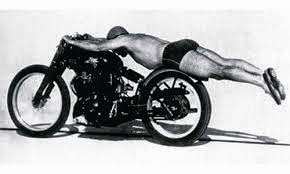
Vincent motorcycle land speed record holder Rollie Free featured in one of the most iconic photographs in motorcycling history wearing a bathing suite at the Bonneville Salt Flats.
At a Vincent Owners' Club dinner in the summer of 1955, Phil Vincent announced that the company could no longer continue in the face of heavy losses and that production of motorcycles would cease almost immediately.In 1955, one week before Christmas, the last Vincent came off the production line and was promptly labeled "The Last”.

Fritz Egli, a specialist frame manufacturer based in Switzerland, produced an Egli-Vincent, and around 100 were produced between 1967 and 1972. Egli-Vincents were subsequently built under license in France by Patrick Godet. JMC Classics also produce new Egli framed Vincents in the UK.

John Mossey, one of the key engineers and designers at JMC Classics, has built up an unparalleled reputation over the last 20 years for his expertise in the restoration of classic motorcycles and development of the new build JMC Egli-Vincents and JMC Norvins.

(JMC Classics was formed in October 2008. Its business goals are “to provide an unparalleled service for the restoration of classic motorcycles and specialist new build projects of the JMC Egli-Vincent and JMC Norvin.” The Norvin looks to me like a Norton Manx with a Vincent engine, but this becomes a bit of a rabbit trail in an article about the '40s and '50s.)

In 1996, a new motorcycle company was formed by three individuals, Rodney Brown (a metallurgical engineer), Terry Prince (a Vincent enthusiast and specialist), and Ron Slender. Brown provided the financial start and along with Prince were the founding directors, with Slender specializing with business development post-production. The company was named after the three, RTV Motorcycles. Its ambition was to produce a modern day classic Vincent motorcycle that could be marketed, in reasonable volumes, worldwide. RTV used a redesigned and modernized version of the Vincent engine, engineered by Prince, with an increased capacity and in an Egli-style frame. The motorcycles were to be built individually by hand. The first factory prototype RTV was built in 1998, other RTV prototypes were in various stages before the company went into voluntary liquidation towards the end of that year.

Vincent Motors USA founder and president, Bernard Li, acquired the Vincent trademark in 1994 and formally launched Vincent Motors USA in 1998, spending about $2 million building prototypes that resemble the original Vincent but utilized modern components like the Honda RC51 V-twin engine. Vincent Motors was based in San Diego. A resurrection of the Vincent name by this organization is now unlikely as the RC51 engine is out of production, and Li was killed in a motorcycle accident in Arizona in 2008.

There’s also a motorcycle produced in Australia bearing the Vincent name. However, the multiple attempts at restoration of the Vincent name have not enjoyed the success of the resuscitated Indian brand, but only time will tell the final chapter.

Until the name is restored, you can always enjoy Richard Thompson, OBE (Order of the British Empire), British songwriter and guitarist's "1952 Vincent Black Lightning” on his 1991 album Rumor and Sigh. Thompson later said, "When I was a kid, that was always the exotic bike, … the one that you went 'ooh, wow.'”

Wow indeed!

Friday, September 5, 2014

Brough SS100

George Brough boldly called his creation the Rolls Royces of motor-cycles. After touring his factory, the car manufacturer agreed the bikes deserved the title and allowed the phrase in advertisements. Brough SS100s were very expensive and guaranteed they would exceed 100 miles per hour — a major feat in that day.

Brough Motorcycles was started by William E. Brough in Nottingham, England in 1902, after some earlier experimentation with motorized tricycles. The Brough Superior company was a separate company created by his son, George Brough. He branched out on his own after World War One, a move that eventually led to the 1938 Brough Superior SS100 motorcycle. George Brough was a racer, designer, and showman.

The first Brough motorcycle had a single cylinder engine hung from the downtube. By 1908 there were a range of models with 2.5 hp and 3.5 hp single cylinder and 5 hp V-twin engines all made by Brough. In 1913 William Brough developed a flat-twin engine in-line with the frame. This 497cc engine had overhead valves and a 2-speed gearbox. By the end of 1914 Brough had replaced all other engines in their bikes, and used the new engine for the models that were planned for 1915.

Originally William Brough's son, George Brough, was a partner in his father's company, but he split from it in 1919 and started his own factory, also in Nottingham. He named his motorcycles "Brough Superior.” Upon hearing the name of the new motorcycle company, his father made the comment, "I suppose that makes mine the Brough Inferior.” William Brough continued to produce motorcycles under the original "Brough" marque until 1926.

Brough Superior motorcycles were expensive, well-finished machines constructed largely from proprietary components, most notably a 60-cubic-inch J.A.P. V-twin engine. Brough Superior motorcycles have always been rare and expensive. Prices for these motorcycles ranged from £130 to £180 in the 1920s and '30s. Since the average weekly salary during that time was £3 per week, only the wealthy were able to afford them.

All Brough Superior motorcycles were high performance and superior quality. Most were custom-built to the customer's needs, and rarely were any two of the same configuration. Each motorcycle was assembled twice. The first assembly was to fit all components. Then the motorcycle was disassembled and all parts painted or plated as needed. Finally, the finished parts were assembled a second time. Every motorcycle was test ridden to ensure that it performed to specification, and was personally certified by George Brough.

An early example was called the SS80, so named for its guaranteed top speed of 80 mph. Switching from flathead to overhead-valve engines led to the SS100 in 1924.

The exemplary engineering and construction for which Brough Superiors were famous can be seen in the leading-link front suspension with driver-adjustable damping, nickel-plated side panels on the fuel tank, foot-operated gearshift, contoured saddlebags, and plunger rear suspension. Though renowned primarily for their fine craftsmanship, Brough Superiors also held many speed records during the 1920s and '30s, culminating in a 1937 run of nearly 170 mph on a modified version.

The Brough Superior SS100 was designed and built by George Brough in 1924. Although every bike was designed to meet specific customer requirements—even the handlebars were individually shaped—sixty-nine SS100s were produced in 1925 and at £170 were advertised by Brough as the "Rolls Royce of Motorcycles". The term was coined by magazine road tester in his review of the bike, and Brough eventually obtained explicit permission to use it after a Rolls-Royce executive toured the Brough Superior factory. All bikes had a guarantee that they were capable of 100 mph. The SS100 (Super Sports) was the first custom motorcycle with components chosen from many different suppliers. The first engine (from 1924 to 1936) was the twin-cam KTOR J.A.P. (made by J. A. Prestwich) V twin and upgraded to a Matchless engine after 1936. Gearboxes were the 4-stud 3-speed from Sturmey-Archer. Brough studied the features of the Harley-Davidson forks and produced his own version to combine light weight with strength that was to become a feature of the SS100 handling.

T. E. Lawrence (known as “Lawrence of Arabia”) bought one of the first SS100s in 1925 having previously owned three Brough SS80’s. He owned a total of eight Brough Superior motorcycles with a ninth on order at the point of his death. The crash that would end Lawrence's life came while riding an SS100 on a narrow road near his cottage by Wareham in 1935. The accident happened because a dip in the road obstructed his view of two boys on bicycles. Swerving to avoid them, Lawrence lost control and was thrown over the handlebars.

He was not wearing a helmet and suffered serious head injuries that left him in a coma; he died after six days in hospital. One of the doctors attending him was the neurosurgeon, Hugh Cairns. He consequently began a long study of what he saw as the unnecessary loss of life by motorcycle dispatch riders through head injuries and his research led to the use of crash helmets by both military and civilian motorcyclists. As a consequence of treating Lawrence, Sir Hugh Cairns ultimately saved the lives of many motorcyclists.

Brough Superior produced many other experimental, show, and racing models. The final model was the “Pendine.” These were built in the early 1930s and had a guaranteed top speed of 110 mph. They were based on the SS100 model but with higher performance modifications to the engine.

A well known racer, Barry Baragwanath, installed a supercharger on one, and it is now known as "Barry's Big Blown Brough." Noel Pope bought the motorcycle and in 1939 set two lap record with it at Brooklands: 106 mph with sidecar, and 124 mph in solo configuration, which exceeded the previous record set in 1935 by Eric Fernihough also on a Brough Superior.

Brough Superior also manufactured sidecars. The sidecars had coach-built bodies, and some carried a spare tire, while others offered two seats for occasional use. The fit and finish of these sidecars were of the highest standard, as were the motorcycles. These sidecars all offered good protection from the elements. Many of the earlier sidecars were built to Brough Superior specification, while later sidecar frames were manufactured in the Brough Superior factory.

Later sidecars were unique in the fact that the frame of the sidecar held fuel. The sidecar frame looped over the top of the sidecar body and had a filler cap at the topmost position. Fuel was pressurized by a hand pump that transferred fuel from the sidecar to the petrol tank on the motorcycle.

George Brough made approximately 85 cars named Brough Superior. Built between 1935 and 1939, they were powered by Hudson engines and had a Hudson chassis. Three models were made, but only two reached production. Early cars did not carry Brough Superior badges as Brough thought the cars sufficiently distinctive in themselves.

During 22 years of production, Brough Superior produced a total of 2,476 motorcycles at a rate of about 100 to just short of 200 a year from 1922 to 1939. In ’39 the factory produced 118, but only 10 in its last year of production, 1940, when production stopped due to the war.

Manufacturing of bikes never resumed after WW II. George Brough was known for his dedication to his vehicles and customers. He, and later Albert Wallis, continued to service Brough Superiors after production ceased, making parts until 1969. In 2013 Brough Superior said it would return to Grand Prix motorcycle racing with a prototype machine for the Moto2 World Championships called the Carbon2, a motorcycle made by California builders "Taylormade" and rebranded as a Brough Superior

"Moto2" is a class in Grand Prix motorcyle racing. "Road Racing World Championship Grand Prix" is the premier championship of motorcycle road racing. It is currently divided into three classes: MotoGP, Moto2, and Moto3. All three classes currently use four-stroke engines. In 2010, 250 cc two-strokes were replaced by the new Moto2 600 cc four-stroke class. In 2012, 125 cc two-strokes were replaced by the Moto3 250 cc four-stroke class with a weight limit of 65 kg with fuel, and the engine capacity for MotoGP increased from 800 cc to 1,000 cc.

Sunday, August 31, 2014

Multiple Dimensions

String theory assumes that all atomic particles at their fundamental core are just vibrating strings. Those strings, sort of like two person jump ropes or the strings on a guitar or violin are vibrating in a standing wave and it is the way they oscillate that determines the characteristics of the particles that we sense. Of course, these strings are very, very small. Much smaller than the tiny atomic particles they produce. So small, in fact, that they have never been observed or measured, only hypothesized.

However, in order for the equations to work out requires more than three dimensions for the strings to vibrate in. Some theories have as many as 11 dimensions to allow all the required degrees of freedom for the strings to produce the essential characteristics. Yet our experience is limited to only three spatial dimensions. (We aren’t counting the time dimension of relativity, just spatial dimensions like up/down, left/right, and in/out.)

Although mathematics has no problem dealing with higher dimensions and the math has been worked out for years to calculate the volume of, say, a six dimensional sphere or 6-ball. But, if there are more than three dimensions, why aren’t we directly aware of them?

One answer is that they are all rolled up in that same tiny area that these strings operate. It is called “Compactification.” Although some very famous and smart scientists such as my hero, Richard Feynman and Roger Penrose have rejected String Theory, largely due to the complete lack of experimental confirmation, others such as Stephen Hawking and my professor, Leonard Susskind, believe String Theory to be an elegant solution to the merging of quantum physics and relativity and a route to unification of the four forces of the universe including gravity which is not included in modern quantum mechanics.

So think back to your high school math classes, especially geometry. Remember that you were taught that a “point” is an object with no dimension and a “line” is an object with only one dimension. Basically a line was what you got when you moved a point. Now imagine a straight line stretched between two points. It has only one dimension: left and right, or East and West, or x and minus x. You can only move in two directions on this line. Sort of like a tight rope stretched between two poles. You can only move East or West, assuming that’s the direction of the line. You can’t move North or South without falling off the line.

From a distance the rope looks like a simple line, but you know that up close it has three dimensions. It is probably like a circle in the N/S and up/down dimensions. Now imagine that, instead of the tight rope walker, you were a tiny ant on the rope. Of course you could go East or West down the rope, but you could also turn ninety degrees and walk North or South. You would wrap around the diameter of the rope and come back to where you started. Fortunately, as an ant, you can walk upside down and make that journey.

Well that’s what Compactification is. It may appear to us in our universe of miles and inches and even tiny areas like the size of an atom or the size of a proton or neutron that the line (tight rope) is one dimensional, but at the tiny, tiny size scale of strings, like the ant, we know the line has other dimensions. Of course, my analogy sticks to three dimensions since that’s all our brains can normally imagine, you go by analogy showing how one dimension can expand to three if you look close enough or magnify it enough or you’re small enough like the ant on the tight rope. So it’s the same idea to reach 6 or 9 or 11 dimensions. We can’t sense them because they are just so small or “compact.”

Don't worry that the ant travels around the rope and comes back to the same place. In theory, if the rope was stretched clear to infinity on both ends, it, too, would just wrap around. Sort of like the surface of the earth. It is a three dimensional sphere, but we experience it as a two dimensional plane. If you travel North or South, East or West, if you go long enough or far enough you'll wrap back around to the same place you started. Most physicist believe the three dimensional universe is the same. Travel far enough in a straight line and you end up back where you started. Mind boggling … isn't it?

That's the essence of String Theory and Supersymmetry. The extra dimensions allow extra modes of vibration that we sense at our higher size as physical properties such as mass or charge or momentum. Although the math is crazy difficult, it is still doable. Getting your mind to imagine more than three dimensions … that is a much tougher issue. Maybe you don’t need to have a mental image as long as the math works. Frankly, I struggle with both.