Saturday, September 6, 2014

Vincent

I really enjoy motorcycle engineering. Mechanical engineering is always an interesting subject as the nebulous topics of physics and chemistry and metallurgy take real, solid form. Besides that, I like to hear a nice set of motorcycle pipes.

Motorcycle engineering is much more pure than automotive because of the smaller size and weight and the fact that everything: gas, electrics, engine, brakes, suspension, are all right there for your inspection. Issues that are minor in an automotive engine such as wet sump vs. dry sump oil system or the configuration of the cylinders becomes essential design choices on a bike. Engine width and height and cooling and carburetion are all much more important on the slim body of a motorcycle. The old adage of “KISS,” Keep It Simple … is so important, especially in the early days when engineering and technology were less sophisticated and much less reliable.

Even the multiple-cylinder configuration and angle between the cylinders is key to performance because you have to be able to straddle the engine. Small displacement bikes are often single cylinder or small twins, but, as the engine displacement increases, just what way you put these large cylinders matters. Of course, as you increase engine size, you can just add more cylinders. Cars followed that route going from twins to four-, six-, and eight-cylinders — including more crazy counts such as 12 and even 16 pistons. Bikes went that route too, although not often past 6 or 8. But finding room for all that iron between the rider’s legs was always an issue and a design choice.

For a small motorcycle engine, one or two cylinders worked best and there were many different ways to arrange the engine. But, as displacement grew toward 100 cubic inches, pistons got bigger and bigger and configuration becomes very important. Keeping it simple with only two cylinders led to V-twin designs. That keeps the overall height of the engine down from a vertical design and, by installing the V in line with the tires, gives a narrow engine.

Harley Davidson took this to the extreme by placing the cylinders directly in-line. They connect the pistons to a single crank pin on the crankshaft/flywheel using “fork and knife” piston rods. While this produced a very narrow engine, it had the adverse effect of hiding the second cylinder behind the first, a problem in an air cooled engine as the second cylinder didn’t get as much of a breeze while rolling down the highway and ran hotter. Harley further complicated things by using a single carburetor located between the cylinders and other simplifications that treated both cylinders the same regardless of the significant difference in running temperature.

Over the years Harley improved their engine designs significantly, but remain with this fundamental issue (although the Revolution engine from Harley addresses this to some extent by adding some water cooling).

But, as Marc Anthony said in paraphrase, "I came to praise Harley not bury him.” And I will be writing about the venerable American motorcycle and its engine evolution (get it, EVO). But that’s a story for another time.

Now days to tell the story of motorcycles, you have to discuss the Japanese invasion of bikes that began in the 60s. They changed everything by building bikes as complicated as a swiss watch, yet still reliable as a rock. But, again, that’s a tale for another time and was not a factor in the '50s.

What I want to talk about in this article is a large British V-twin that I always thought was a superior design to the Harley’s basic V-twin. By the simple step of offsetting the rear cylinder, Vincent was able to balance the two parts of the engine thermally and they added dual carburetors and matched exhaust to produce what was the fastest production motorcycle in the early fifties.

This article is about that British V-twin. Even with superior engineering and plenty of speed records, the company went broke. However, the Vincent is not quite extinct. Besides the few surviving models sold at extravagant prices in the world's classic cycle auctions, there are several modern re-creations of the famous brand and design, although most copy cats have lived and died in a shorter lifetime than the original they attempt to emulate.

Vincent Motorcycles was a British manufacturer of motorcycles from 1928 to 1955. Their 1948 Black Shadow was, at the time, the world's fastest production motorcycle. In 1955 the company discontinued motorcycle production after experiencing heavy financial losses. But, in the 1940s and the early ‘50s, the Vincent was a phenomenal bike, known for its speed and durability. It was the most popular bike of its time, and today it's a highly sought after collector's bike.

HRD was founded by the British Royal Flying Corps (RFC) pilot, Howard Raymond Davies, who was shot down and captured by the Germans in 1917. Legend has it that it was while a prisoner of war that he conceived the idea of building his own motorcycle, and contemplated how he might achieve that. It was not until 1924 that Davies entered into partnership with E J Massey, trading as HRD Motors. Various models were produced, generally powered by J.A.P. engines.

Unfortunately, although HRD motorcycles won races, the company ran at a loss. In January 1928 it went into voluntary liquidation. The company was initially bought by Ernest Humphries of OK-Supreme Motors for the factory space, and the HRD name, jigs, tools, patterns, and remaining components were subsequently offered for sale again.

Philip Vincent began building motorcycles in 1927. In 1928 he registered a patent for a cantilever rear suspension of his own design. With the backing of his family wealth from cattle ranching in Argentina, Vincent acquired the trademark, goodwill, and remaining components of HRD from Humphries for £450 in May of 1928 and the Vincent brand was born.

The company was renamed as Vincent HRD Co., Ltd and production moved to Stevenage, England. The new trademark had The Vincent in very small letters above the large "HRD." After World War II Britain had an export drive to repay its war debts, and the USA was the largest market for motorcycles. In 1950 the "HRD" was dropped from the name to avoid any confusion with the "HD" of Harley Davidson, and the motorcycle became “The Vincent.”

Vincent produced the Meteor and the Comet, and, by 1936, the Rapide. Eventually the factory began to produce the Vincent "Black Shadow," a hand-built motorcycle produced by Vincent HRD from 1948. The series “C,” which was introduced in 1949, had a 998 cc (60.9 cu in) 50 degree OHV V-twin engine running a 7.3:1 compression ratio.

The reason for its name "Black" Shadow was that the entire bike (including the engine) was colored black including baked enamel on crank-case and covers. The reason for the black on the crankcases is still disputed to this day. Some claim that the black color was for looks, others claim that it had something to do with heat transfer and dissipation. Whatever the original reason behind the painting of the engine, it was very different from anything else at a time when everything was polished and chromed. There were a small number (about 16) of White Shadows, machines made to Shadow specification but with the plain aluminum finish of the Rapide. Fewer than 1,700 Vincent Black Shadows were made, all hand-assembled.

Journalist Hunter S. Thompson wrote that, "If you rode the Black Shadow at top speed for any length of time, you would almost certainly die." and praised the model in his 1971 novel, Fear and Loathing in Las Vegas. I assume that the gonzo journalist meant die of exuberance … definitely with a smile upon your face.

The "Black Lightning" was a Vincent motorcycle designed and built in September 1948 at the Vincent works in Great North Road,Stevenage, Hertfordshire, UK, and produced from 1948 to 1952. At the time the Black Lightning was the fastest production motorcycle in the world.

Available to order, a standard Black Lightning was supplied in racing trim with magnesium alloy components, special racing tires on alloy rims, rear-set foot controls, a solo seat and aluminum fenders. This reduced the Lightning's weight to 380 lb. The 998 cc (60.9 cu in) air-cooled OHV pushrod V-twin specifications were always based on standard parts but upgraded with higher performance racing equipment. The Black Lightning had higher strength connecting rods, larger inlet ports, polished rocker gear, steel idler gears, racing carburetors, a manual-advance magneto, and it was available with compression ratios between 6.8:1 and 12.5:1. This resulted in 70 bhp and a top speed of 150 mph.

(For comparison, The Shadow had roughly the same bhp as the Kawasaki 750cc Triple introduced in 1969 and possibly the first crotch rocket!) Only 31 Black Lightnings were ever built before production ended in 1952 because of Vincent's financial problems. Check those numbers. Around 1700 hand built Black Shadows and only 31 Black Lightnings, the "production" bike. For that reason, there are often debates if a given classic Vincent is a "Shadow" or a "Lightning." Especially if they've been modified after leaving the factory.

On the morning of September 13, 1948, Rollie Free raised the American motorcycle speed record by riding the very first Vincent HRD (it is debated as to whether it was a Black Lightning or Black Shadow), owned by the California sportsman John Edgar and sponsored by Mobil Oil, to a speed of 150.313 mph. However, in Europe and elsewhere, it was the officially sanctioned Fédération Internationale de Motocyclisme (FIM) record that mattered.

In 1949 The Motor Cycle magazine offered a trophy and £500 prize (£20,000 in today's money) for the first successful all-British attempt on the World Speed Record, held since 1937 by BMW at 173.54 mph. Reg Dearden, a motorcycle dealer at Chorlton-cum-Hardy in Manchester fitted a supercharger to a brand new Black Lightning and made extensive modifications including strengthening and lengthening the frame by about 6 inches. Phil Vincent personally supervised the work, which took months to complete.

The supercharged Vincent changed hands several times but never made a record attempt. In 1999 journalist Mick Duckworth had a test ride and wrote a feature article for Classic Bike magazine. In October 2008, the supercharged Vincent Black Lightning was sold for £221,500 at the Stafford Motorcycle Show, setting a record as the most expensive motorcycle ever sold at auction in the UK. So Vincent ended up with a record after all, but it, like all the other records, may be beat in the future.

After the Second World War, the German NSU factory (originally named Neckarsulm Strickmaschinen Union in its knitting machine days and later a bicycle manufacturer) battled English machines (Vincent and Triumph) for top speed honors through the 1960s. NSU increased the World Record to 180.29 mph in 1951, and in 1953 the 500 cc World Champion Les Graham was to make an attempt for the UK but was killed in a crash in the 1953 Senior Isle of Man TT.

The 1951 NSU, FIM record of 180 mph was finally bested by Vincent in 1955 (184 mph) by rider Russell Wright in New Zealand. That was beat by Triumph in '56 establishing the Bonneville Salt Flats in Utah as the place to race. In 1956, NSU recovered the title followed by three advances by Triumph brand to 245 mph ten years later before Yamaha took over in 1970 at 271 and change.

(Think for a moment on the irony that a German company, later bought by Volkswagen, and named for Knitting Machines was in the running for the fastest bike in the world. There's a strange connection for you James Burke — look him up if you don't get the reference.)

Yamaha finally broke the 300 mph barrier in 1975. After 1970 the Bonneville Salt Flats and speed records were dominated by various Japanese brands and Harley. The current record of 376 mph was established on a custom bike with twin Suzuki motors in 2010. This year, sadly, the Salt Flats were too wet and the usual activities had to be canceled.
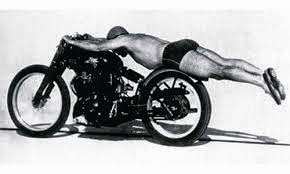
Vincent motorcycle land speed record holder Rollie Free featured in one of the most iconic photographs in motorcycling history wearing a bathing suite at the Bonneville Salt Flats.
At a Vincent Owners' Club dinner in the summer of 1955, Phil Vincent announced that the company could no longer continue in the face of heavy losses and that production of motorcycles would cease almost immediately.In 1955, one week before Christmas, the last Vincent came off the production line and was promptly labeled "The Last”.

Fritz Egli, a specialist frame manufacturer based in Switzerland, produced an Egli-Vincent, and around 100 were produced between 1967 and 1972. Egli-Vincents were subsequently built under license in France by Patrick Godet. JMC Classics also produce new Egli framed Vincents in the UK.

John Mossey, one of the key engineers and designers at JMC Classics, has built up an unparalleled reputation over the last 20 years for his expertise in the restoration of classic motorcycles and development of the new build JMC Egli-Vincents and JMC Norvins.

(JMC Classics was formed in October 2008. Its business goals are “to provide an unparalleled service for the restoration of classic motorcycles and specialist new build projects of the JMC Egli-Vincent and JMC Norvin.” The Norvin looks to me like a Norton Manx with a Vincent engine, but this becomes a bit of a rabbit trail in an article about the '40s and '50s.)

In 1996, a new motorcycle company was formed by three individuals, Rodney Brown (a metallurgical engineer), Terry Prince (a Vincent enthusiast and specialist), and Ron Slender. Brown provided the financial start and along with Prince were the founding directors, with Slender specializing with business development post-production. The company was named after the three, RTV Motorcycles. Its ambition was to produce a modern day classic Vincent motorcycle that could be marketed, in reasonable volumes, worldwide. RTV used a redesigned and modernized version of the Vincent engine, engineered by Prince, with an increased capacity and in an Egli-style frame. The motorcycles were to be built individually by hand. The first factory prototype RTV was built in 1998, other RTV prototypes were in various stages before the company went into voluntary liquidation towards the end of that year.

Vincent Motors USA founder and president, Bernard Li, acquired the Vincent trademark in 1994 and formally launched Vincent Motors USA in 1998, spending about $2 million building prototypes that resemble the original Vincent but utilized modern components like the Honda RC51 V-twin engine. Vincent Motors was based in San Diego. A resurrection of the Vincent name by this organization is now unlikely as the RC51 engine is out of production, and Li was killed in a motorcycle accident in Arizona in 2008.

There’s also a motorcycle produced in Australia bearing the Vincent name. However, the multiple attempts at restoration of the Vincent name have not enjoyed the success of the resuscitated Indian brand, but only time will tell the final chapter.

Until the name is restored, you can always enjoy Richard Thompson, OBE (Order of the British Empire), British songwriter and guitarist's "1952 Vincent Black Lightning” on his 1991 album Rumor and Sigh. Thompson later said, "When I was a kid, that was always the exotic bike, … the one that you went 'ooh, wow.'”

Wow indeed!

Friday, September 5, 2014

Brough SS100

George Brough boldly called his creation the Rolls Royces of motor-cycles. After touring his factory, the car manufacturer agreed the bikes deserved the title and allowed the phrase in advertisements. Brough SS100s were very expensive and guaranteed they would exceed 100 miles per hour — a major feat in that day.

Brough Motorcycles was started by William E. Brough in Nottingham, England in 1902, after some earlier experimentation with motorized tricycles. The Brough Superior company was a separate company created by his son, George Brough. He branched out on his own after World War One, a move that eventually led to the 1938 Brough Superior SS100 motorcycle. George Brough was a racer, designer, and showman.

The first Brough motorcycle had a single cylinder engine hung from the downtube. By 1908 there were a range of models with 2.5 hp and 3.5 hp single cylinder and 5 hp V-twin engines all made by Brough. In 1913 William Brough developed a flat-twin engine in-line with the frame. This 497cc engine had overhead valves and a 2-speed gearbox. By the end of 1914 Brough had replaced all other engines in their bikes, and used the new engine for the models that were planned for 1915.

Originally William Brough's son, George Brough, was a partner in his father's company, but he split from it in 1919 and started his own factory, also in Nottingham. He named his motorcycles "Brough Superior.” Upon hearing the name of the new motorcycle company, his father made the comment, "I suppose that makes mine the Brough Inferior.” William Brough continued to produce motorcycles under the original "Brough" marque until 1926.

Brough Superior motorcycles were expensive, well-finished machines constructed largely from proprietary components, most notably a 60-cubic-inch J.A.P. V-twin engine. Brough Superior motorcycles have always been rare and expensive. Prices for these motorcycles ranged from £130 to £180 in the 1920s and '30s. Since the average weekly salary during that time was £3 per week, only the wealthy were able to afford them.

All Brough Superior motorcycles were high performance and superior quality. Most were custom-built to the customer's needs, and rarely were any two of the same configuration. Each motorcycle was assembled twice. The first assembly was to fit all components. Then the motorcycle was disassembled and all parts painted or plated as needed. Finally, the finished parts were assembled a second time. Every motorcycle was test ridden to ensure that it performed to specification, and was personally certified by George Brough.

An early example was called the SS80, so named for its guaranteed top speed of 80 mph. Switching from flathead to overhead-valve engines led to the SS100 in 1924.

The exemplary engineering and construction for which Brough Superiors were famous can be seen in the leading-link front suspension with driver-adjustable damping, nickel-plated side panels on the fuel tank, foot-operated gearshift, contoured saddlebags, and plunger rear suspension. Though renowned primarily for their fine craftsmanship, Brough Superiors also held many speed records during the 1920s and '30s, culminating in a 1937 run of nearly 170 mph on a modified version.

The Brough Superior SS100 was designed and built by George Brough in 1924. Although every bike was designed to meet specific customer requirements—even the handlebars were individually shaped—sixty-nine SS100s were produced in 1925 and at £170 were advertised by Brough as the "Rolls Royce of Motorcycles". The term was coined by magazine road tester in his review of the bike, and Brough eventually obtained explicit permission to use it after a Rolls-Royce executive toured the Brough Superior factory. All bikes had a guarantee that they were capable of 100 mph. The SS100 (Super Sports) was the first custom motorcycle with components chosen from many different suppliers. The first engine (from 1924 to 1936) was the twin-cam KTOR J.A.P. (made by J. A. Prestwich) V twin and upgraded to a Matchless engine after 1936. Gearboxes were the 4-stud 3-speed from Sturmey-Archer. Brough studied the features of the Harley-Davidson forks and produced his own version to combine light weight with strength that was to become a feature of the SS100 handling.

T. E. Lawrence (known as “Lawrence of Arabia”) bought one of the first SS100s in 1925 having previously owned three Brough SS80’s. He owned a total of eight Brough Superior motorcycles with a ninth on order at the point of his death. The crash that would end Lawrence's life came while riding an SS100 on a narrow road near his cottage by Wareham in 1935. The accident happened because a dip in the road obstructed his view of two boys on bicycles. Swerving to avoid them, Lawrence lost control and was thrown over the handlebars.

He was not wearing a helmet and suffered serious head injuries that left him in a coma; he died after six days in hospital. One of the doctors attending him was the neurosurgeon, Hugh Cairns. He consequently began a long study of what he saw as the unnecessary loss of life by motorcycle dispatch riders through head injuries and his research led to the use of crash helmets by both military and civilian motorcyclists. As a consequence of treating Lawrence, Sir Hugh Cairns ultimately saved the lives of many motorcyclists.

Brough Superior produced many other experimental, show, and racing models. The final model was the “Pendine.” These were built in the early 1930s and had a guaranteed top speed of 110 mph. They were based on the SS100 model but with higher performance modifications to the engine.

A well known racer, Barry Baragwanath, installed a supercharger on one, and it is now known as "Barry's Big Blown Brough." Noel Pope bought the motorcycle and in 1939 set two lap record with it at Brooklands: 106 mph with sidecar, and 124 mph in solo configuration, which exceeded the previous record set in 1935 by Eric Fernihough also on a Brough Superior.

Brough Superior also manufactured sidecars. The sidecars had coach-built bodies, and some carried a spare tire, while others offered two seats for occasional use. The fit and finish of these sidecars were of the highest standard, as were the motorcycles. These sidecars all offered good protection from the elements. Many of the earlier sidecars were built to Brough Superior specification, while later sidecar frames were manufactured in the Brough Superior factory.

Later sidecars were unique in the fact that the frame of the sidecar held fuel. The sidecar frame looped over the top of the sidecar body and had a filler cap at the topmost position. Fuel was pressurized by a hand pump that transferred fuel from the sidecar to the petrol tank on the motorcycle.

George Brough made approximately 85 cars named Brough Superior. Built between 1935 and 1939, they were powered by Hudson engines and had a Hudson chassis. Three models were made, but only two reached production. Early cars did not carry Brough Superior badges as Brough thought the cars sufficiently distinctive in themselves.

During 22 years of production, Brough Superior produced a total of 2,476 motorcycles at a rate of about 100 to just short of 200 a year from 1922 to 1939. In ’39 the factory produced 118, but only 10 in its last year of production, 1940, when production stopped due to the war.

Manufacturing of bikes never resumed after WW II. George Brough was known for his dedication to his vehicles and customers. He, and later Albert Wallis, continued to service Brough Superiors after production ceased, making parts until 1969. In 2013 Brough Superior said it would return to Grand Prix motorcycle racing with a prototype machine for the Moto2 World Championships called the Carbon2, a motorcycle made by California builders "Taylormade" and rebranded as a Brough Superior

"Moto2" is a class in Grand Prix motorcyle racing. "Road Racing World Championship Grand Prix" is the premier championship of motorcycle road racing. It is currently divided into three classes: MotoGP, Moto2, and Moto3. All three classes currently use four-stroke engines. In 2010, 250 cc two-strokes were replaced by the new Moto2 600 cc four-stroke class. In 2012, 125 cc two-strokes were replaced by the Moto3 250 cc four-stroke class with a weight limit of 65 kg with fuel, and the engine capacity for MotoGP increased from 800 cc to 1,000 cc.

Sunday, August 31, 2014

Multiple Dimensions

String theory assumes that all atomic particles at their fundamental core are just vibrating strings. Those strings, sort of like two person jump ropes or the strings on a guitar or violin are vibrating in a standing wave and it is the way they oscillate that determines the characteristics of the particles that we sense. Of course, these strings are very, very small. Much smaller than the tiny atomic particles they produce. So small, in fact, that they have never been observed or measured, only hypothesized.

However, in order for the equations to work out requires more than three dimensions for the strings to vibrate in. Some theories have as many as 11 dimensions to allow all the required degrees of freedom for the strings to produce the essential characteristics. Yet our experience is limited to only three spatial dimensions. (We aren’t counting the time dimension of relativity, just spatial dimensions like up/down, left/right, and in/out.)

Although mathematics has no problem dealing with higher dimensions and the math has been worked out for years to calculate the volume of, say, a six dimensional sphere or 6-ball. But, if there are more than three dimensions, why aren’t we directly aware of them?

One answer is that they are all rolled up in that same tiny area that these strings operate. It is called “Compactification.” Although some very famous and smart scientists such as my hero, Richard Feynman and Roger Penrose have rejected String Theory, largely due to the complete lack of experimental confirmation, others such as Stephen Hawking and my professor, Leonard Susskind, believe String Theory to be an elegant solution to the merging of quantum physics and relativity and a route to unification of the four forces of the universe including gravity which is not included in modern quantum mechanics.

So think back to your high school math classes, especially geometry. Remember that you were taught that a “point” is an object with no dimension and a “line” is an object with only one dimension. Basically a line was what you got when you moved a point. Now imagine a straight line stretched between two points. It has only one dimension: left and right, or East and West, or x and minus x. You can only move in two directions on this line. Sort of like a tight rope stretched between two poles. You can only move East or West, assuming that’s the direction of the line. You can’t move North or South without falling off the line.

From a distance the rope looks like a simple line, but you know that up close it has three dimensions. It is probably like a circle in the N/S and up/down dimensions. Now imagine that, instead of the tight rope walker, you were a tiny ant on the rope. Of course you could go East or West down the rope, but you could also turn ninety degrees and walk North or South. You would wrap around the diameter of the rope and come back to where you started. Fortunately, as an ant, you can walk upside down and make that journey.

Well that’s what Compactification is. It may appear to us in our universe of miles and inches and even tiny areas like the size of an atom or the size of a proton or neutron that the line (tight rope) is one dimensional, but at the tiny, tiny size scale of strings, like the ant, we know the line has other dimensions. Of course, my analogy sticks to three dimensions since that’s all our brains can normally imagine, you go by analogy showing how one dimension can expand to three if you look close enough or magnify it enough or you’re small enough like the ant on the tight rope. So it’s the same idea to reach 6 or 9 or 11 dimensions. We can’t sense them because they are just so small or “compact.”

Don't worry that the ant travels around the rope and comes back to the same place. In theory, if the rope was stretched clear to infinity on both ends, it, too, would just wrap around. Sort of like the surface of the earth. It is a three dimensional sphere, but we experience it as a two dimensional plane. If you travel North or South, East or West, if you go long enough or far enough you'll wrap back around to the same place you started. Most physicist believe the three dimensional universe is the same. Travel far enough in a straight line and you end up back where you started. Mind boggling … isn't it?

That's the essence of String Theory and Supersymmetry. The extra dimensions allow extra modes of vibration that we sense at our higher size as physical properties such as mass or charge or momentum. Although the math is crazy difficult, it is still doable. Getting your mind to imagine more than three dimensions … that is a much tougher issue. Maybe you don’t need to have a mental image as long as the math works. Frankly, I struggle with both.

Saturday, June 21, 2014

Atoms and Atomic Particles

I was just a boy when I first heard of atoms. I’m not sure how old I was. Older than 12 but probably younger than 14. I was sort of a science nerd … even back then. I was mostly interested in electronics at that point in my life. I had a subscription to Popular Electronics, and I was into things like ham radio and building various electronic gadgets.

I may have started with one of Isaac Asimov’s books on chemistry or atoms. I read a lot of Asimov in those days, both his science fiction and his nonfiction stuff, which was excellent and easy to understand.

So I knew about atoms and molecules and that atoms were made up of electrons that orbited around a nucleus and that the nucleus contained positive charged protons and neutral neutrons. I knew that electrons were the particles that made up electricity and that formed chemical bonds and that the nucleus was the place where fission occurred in atom bombs and nuclear power plants.

I knew that electrons were very light relative to the particles in the nucleus (called nucleons). In fact, the proton weighs (an imprecise term when atoms are concerned) about 1,000 times as much as an electron and a neutron weighs just a tiny bit more than a proton.

(Weight really is the result of the force of gravity on a property called “mass.” Weight would be different if gravity was different. For example, things weigh less on the moon. A metric unit for mass is the kilogram or one thousand grams, which has the abbreviation “kg.”)

There is another unit for mass, called an electron volt (eV), that scientists use when talking about small things like protons, neutrons, and electrons. An electron volt is actually a measurement of energy, but scientists can get away with using it to measure mass since mass and energy are related by Einstein's famous equation, E = mc2. So, in terms of MeV (Megaelectron volts, 1 MeV = 1,000,000 eV), the mass is shown in the following table.

Here are the details, just in case you’re into the numbers.

Mass of Atomic Particles

Particle Relative Mass Kilograms MeV
Neutron 1 1.6749286*10-27 939.56563
Proton 0.99862349 1.6726231*10-27 938.27231
Electron 0.00054386734 9.1093897*10-31 0.51099906

I never tried to memorize these numbers other than the fact that the neutron is over 1,000 times heavier than an electron. In fact, it is about 1,800 times as heavy. (Therefore, almost all of the mass of an atom is concentrated in the tiny nucleus and atoms are mostly empty space.)

You will notice, however, in using the convenient eV values that a proton and a neutron weigh in at almost exactly 1 GeV or Giga-Electron Volt. That’s a thousand million which some — at least in England — call a billion. (Here in the US we consider a billion to be a million million, at least for purposes of Federal budgets.)

(Giga is now familiar to most nonscientists because of the size of modern personal computer disk drives have grown from megabytes to gigabytes and even to terabytes.)

Getting back to my story, after studying the mass of the particles, I got an idea. It looked to me like a neutron might be a proton combined with an electron. After all, the plus and minus charges would cancel yielding the neutral charge of the neutron. So I did the math.

Proton = 0.99862349
Electron = 0.00054386734

So I added them:

0.99862349
0.00054386734
=============
0.99916736

Close, but not exactly 1.0. I assumed the missing mass was used up in energy holding them together. At least it didn't add up to more than the mass of the neutron, which I would not be able to explain.

(I didn’t really understand Relativity all that well before Junior High, but that wasn’t a bad guess about mass becoming energy. That's what makes atom bombs go BOOM! The mass of the fission products is slightly less than the original mass and that tiny amount of mass is converted to energy as heat and light — with a c-squared multiplier, and "c" is a very big number. So just a little bit of mass and you get a real big BOOM.)

In fact, at the end of the 19th century, when scientists were just discovering the makeup of the atom, it was supposed that the nucleus contained protons and electrons, with an overabundance of protons supplying the positive charge. Early on they didn’t know much about the nucleus other than the fact it attracted electrons and it was very dense.

Although they were unknown back in the fifties, we now know that protons and neutrons are make up of more elemental particles called “quarks.” Electrons, however, appear to be elemental particles and there’s nothing smaller “inside.” So my guess wasn’t all that crazy.

That is how science is advanced. Someone, maybe a small boy, has some crazy idea — called a “theory.” Then the experimentalists go to work to try to confirm or disprove the theory. My theory was actually disproved in the early twentieth century. But I didn’t know that when I was only 12. I started learning these more complex and detailed facts about atoms when I got to college. My simple view worked all through High School.

Saturday, June 14, 2014

Quake

Hebgen Lake and the damaged and reinforced Hebgen Dam
It was Monday evening, August 17, 1959. I was 12 years old, ready to start Junior High in a few weeks. My parents owned a motel in Lewistown, Montana, and my brother and I had a wonderful large bedroom in the basement under the office. Even though it was not a school night, I was in bed and asleep. A 11:37 PM, I awoke to my bed shaking, and I was certain my brother had crawled across our bedroom and was shaking my bed to tease me. About the same time, my brother shouted out that I should stop shaking his bed. That’s when we realized it was an earthquake. We ran upstairs to my parent’s bedroom where my dad immediately accused us of shaking his bed.
Road washed out Hebgen Lake

There was none of the other signs of an earthquake. Nothing fell off the shelves, furniture didn’t tip over, and no sirens went off. Yet this was a 7.5 magnitude quake on the Richter Scale, and one of the most severe quakes ever recorded in the northern Rockies and the strongest in Montana recorded history. It was centered in the Madison River valley just northwest of the town of West Yellowstone and the west entrance to the great National Park.

Several hours later, around 3 or 4 AM, people started showing up at the motel looking for a room. They had been in lodging in and around Yellowstone Park, and the earthquake and aftershocks had them so worried that they drove several hundred miles north to get out of the region. I think they probably had driven until exhaustion before finding our little town and motel.

Dry Spillway Hebgen Dam

The earth shook, fell, and undulated across the greater Yellowstone area, into Wyoming and Idaho, and the effects were felt as far away as Seattle. The earthquake caused dramatic changes in and outside Yellowstone National Park. The quake caused new geysers to form, and from some hot springs muddy water flowed. One notable example was named Seismic Geyser, due to its origin. It started as a ground crack that formed during the quake that soon turned into a fumarole (steam vent) and over time, matured into a geyser.

An earthquake is the result of a sudden release of energy in the Earth's crust that creates seismic waves. Earthquakes manifest themselves by shaking and sometimes displacement of the ground. Great plates in the Earth shift and move creating destructive vibrations as well as lifting and dropping large sections of land. These “tectonic” plates tend to move along preexisting breaks in the crust called “faults.”

My mom and my grandfather on damaged road

If you drive north out of West Yellowstone on state highway 191, a short ten miles out of West, you’ll come to an intersection and can turn west onto US 287. This highway takes you by the northern side of Hebgen Lake, a body of water formed by Hebgen Dam, which was built in 1914 at the entrance to the Madison Canyon. This was the center of the earthquake.

From there the Madison River, named by Lewis and Clark during their exploration of Montana, flows through the cannon and then north to near the town of Three Forks where it joins the Jefferson River and the Gallatin River to form the headwaters of the Missouri River. From there the Missouri flows north near Helena and through Great Falls where it turns east and flows out of Montana into North Dakota before turning south and eventually meeting the Mississippi in St. Louie.

Road along the lake showing high water mark from Quake Lake

The following Spring after the earthquake, my family drove down to reconnoiter the damage. The area was just recovering. Much of the road was temporary, gravel, and only one lane. We saw the devastation that comes when the Earth twists and shakes.

Now, some fifty-five years later, I recently revisited the site. The area around Hebgen Lake has been restored, and you can not tell anything happened except for some signs telling the tale. As you drive west, however, you soon encounter Quake Lake with its eerie submerged trees. Even after over 50 years, the land has barely healed. The side of the mountain where the slide came down is still naked and rough and giant boulders are strewn around in their final resting place after the '59 shaking. The slide itself looks like a great pile of gravel and earth and only now are small trees starting to take root.

Washed out and collapsed road

During the quake, the landscape surrounding the epicenter fell as much as 20 feet. Tsunami-like waves rose over Hebgen Lake lasting for twelve hours. And though the quake lasted less than a minute, with aftershocks continuing for some time, it took 28 lives and caused the equivalent of $75 million worth of damage in today’s dollars.

Slide

Hebgen Lake is used to store water from the drainage area at the headwaters of the Madison-Missouri river system. Hebgen Lake is about 15 miles long and on its southern end measures up to four miles at its widest point. A man-made lake retained by an earth-fill dam, Hebgen has been called the premier still-water fishing lake in Montana. The Hebgen Dam is a concrete-core earthen embankment dam 85 feet tall and 721 feet long.

Landslide from the distance

New fault scarps as high as 20 feet formed near Hebgen Lake. (A fault scarp is a step like area on the ground surface where one side of a fault has moved vertically with respect to another.) The major fault scarps formed along pre-existing normal faults northeast of Hebgen Lake.

Subsidence occurred over much of an area that was about 15 miles north-south and about twice as long east-west. As a result of the faulting near Hebgen Lake, the bedrock beneath the lake was permanently warped, causing the lake floor to tilt and generate a seiche. Maximum subsidence was 22 feet in Hebgen Lake Basin. About 80 square miles subsided more than 10 feet, and about 300 square miles subsided more than 1 foot. The earth-fill dam sustained significant cracks in its concrete core and spillway, but it continued to be an effective structure.

Landslide

At Hebgen Lake itself considerable damage was caused by waves generated by the quake. These waves, known as seiche, differ from tsunami waves because in a seiche the entire water within a lake continues to slosh back and forth as the earthquake distorts the lake bed. Cabins along the lake shore were lifted off their foundations by the waves and were dumped when the waves receded. The dam itself, though damaged, held, although it was a point of great concern in the first hours after the quake.

Landslide

Much greater damage and loss of life occurred near the west end of the Madison canyon where a great landslide dammed the Madison River creating Quake Lake, a body of water 6 miles long and 200 feet deep. The landslides caused by the quake carried 80 million tons (40 million cubic yards) of rock, mud and debris down into the valley and created hurricane force winds strong enough to toss cars. In Madison Canyon, a family of seven were swept away by the landslide, five of whom perished. Two more fatalities were also reported in nearby Cliff Lake to the south. In Rock Creek, tourists camping there were caught off guard by the quake and landslide, which swept them into the creek.

The landslide caused by the quake blocked the flow of the Madison River. The blockage caused the water to rise and formed a new lake, which was later to be named Quake Lake. Fearing that the pressure caused by the rising water would result in a catastrophic flood, the Army Corps of Engineers began to cut a 250 ft wide and 14 ft deep channel into the slide. By September 10, water began to flow through the channel. To prevent more erosion by the flowing water, the Army Corps cut another 50 ft channel which was completed on October 29.

Boulder that rolled across canyon photographed in 1960

Imagine yourself, camping outside Yellowstone Park, in 1959. Perhaps the park campgrounds were full, or you were camped near the lake for the excellent fishing, or perhaps you had started your journey home after a pleasant visit to the park.

Even though it was a Monday, the eight official campsites at Rock Creek Campground filled early the afternoon of August 17. By evening those who arrived had to settle for “unofficial” sites further up or downriver. Still, the mood was cheerful — it was a beautiful moonlit night.

Same boulder photographed in 2014

At 11:37 PM, the shaking began. Some thought it was marauding bears, but those that looked outside realized something bigger was going on. Trees swayed and cracked, rocks jumped into the air. Loose boulders began to bounce down from above. A few minutes later, came a hellish roar. For those camped closest to the canyon mouth, it was the last sound they ever heard as millions of tons of rocks and debris smashed across their campsites. Just upstream, the roar was accompanied by a hurricane-force wind and a wall of muddy water that swept away vehicles, tents, and people. Nineteen people were buried outright by the slide, their bodies never found. A total of twenty-eight people died as a result of the earthquake. More than two hundred others were eventually rescued. The campers had been savaged by three separate dramatic events: first, the largest earthquake in the Rocky Mountains; shortly after that, an 80-million-ton landslide; and then the rising water.

Landslide 2014

Imagine being trapped here in Madison River Canyon on the night of the earthquake. Dust chokes the air. Aftershocks rattle the ground, and you can hear the crash of boulders as they fall from cliffs above and smash through the forest. To make matters worse, there’s a dam upstream, and it could burst at any moment.

Landslide 2014

That’s the nightmare that faced the survivors of the earthquake. Seeking high ground, drawn by headlights and firelight, many of the refugees converged at what is now called “Refuge Point” — where they found help, comfort, and hope.

After the quake settled down, the dazed campers and others trapped in the canyon began to gather. By 1 am, the first groups had made their way to Refuge Point. They compared experiences: “The highway’s washed out above the dam” … “There’s a mountain of rocks blocking escape to the west” … “The Madison is flooding — I heard people screaming for help” … Carload after carload of frightened and injured people continued to arrive as a thunderstorm rolled above.

Hill side where slide originated 2014

This is the nightmare that faced some 250 women, men, and children in the aftermath of the earthquake. Drawn to the higher ground by headlights and firelight, many of the shaken refugees converged on a small ridge, offering one another companionship and a greater feeling of safety — while they waited for dawn to break and for news from the outside world.

Around noon on the day after the earthquake, a DC-2 carrying Forest Service smokejumpers flew in through the west end of Madison Canyon. People on the ground felt relief and gratitude as they watched the unfurling of orange and white parachutes. The smokejumpers brought rescue gear and hope. For the next several days the smokejumpers worked with the Highway Patrol and other Forest Service rescuers. After helping people evacuate at Refuge Point and the dam, some stayed on for search and rescue efforts at campsites down the canyon, where Earthquake Lake was on the rise.

Hillside 2014

The colossal landslide across Madison Canyon created a rock dam across the Madison River, blocking the river’s swift current. By dawn the next day, a brand-new lake, churning with muddy water and strewn with broken trees, and risen to engulf the campground near the slide.

Over the following weeks, the water rose nine feet per day as increased stream flow (probably triggered by the earthquake) poured down the Madison. Within three weeks the lake was five miles long and had reached a maximum of 190 feet deep. Only the brushy tops of the drowned trees remained to show where forest once covered the canyon floor.

The rapidly rising lake posed an increasing threat: would the water burst through the slide dam and flood the Madison Valley? Engineers constructed a spillway through the slide to relieve some of the pressure and control the flow.

Dead trees in Quake Lake 2014

Since the spillway construction in September 1959 the Madison River has gradually worn the channel across the slide deeper, and the lake level has dropped. The result? A “bathtub ring” of dead trees around the lake’s margin marks the former level of Earthquake Lake. The upper edge of this ring marks the lake’s highest point before the water began to drop. Eventually, as the spillway further erodes, the lake will “drain” and the river will resume its path.

Dead trees in Quake Lake 2014

With the silver-gray tree trunks rising from its waters like dry bones, Earthquake Lake is uncanny-looking. The eerie trees are clues to the lake’s strange and abrupt formation, which began on that night in 1959. In the early morning, when mist rises from the water, the skeletal trees that loom from Earthquake Lake appear ghostly. They’re just a hint of the strange world below, where scattered relics along the lake bottom tell a story of terror and loss: picnic tables, crushed cars, toys, fishing gear … all abandoned during a few tragic hours in August so long ago.

Sign showing original landslide magnitude and Quake Lake

Now, in the mixture of natural beauty, the blue of Hebgen Lake, the green of the surrounding hills, the many cabins and fishing huts that dot the shore are testament to a return to normalcy. It is good to enjoy the beautiful mountains, valleys, and rivers that run through them. But it is also good to remember the powerful forces that built these geological structures. Sometimes nature will display this power without a warning.

[A final hint. If you click on a picture, you will be treated by the Blogspot software to a full size view. Just click on the "x" to close the picture view and return to the blog.]

Friday, June 13, 2014

A Short (Very, Very Short) History of Apple

Steve Wozniak and Steve Jobs develop the original apple — just a circuit board. It was 1976, the start of the personal computer revolution. That success was followed the next year by the Apple II that established the company and was integral to the early success of personal computers.

By 1980, Apple was being run by the new CEO that Jobs was instrumental in hiring from Pepsi — John Sculley. After the poor acceptance of the Apple III, Jobs brought the technology from Xerox PARC to Cupertino and spawned the LISA. However, in corporate in-fighting, he was forced off that project and started his own team that led to the first Apple Mac in 1984.

Although it was successful, Jobs was forced out of the company the next year, largely due to a power struggle with Sculley, and went off and started a computer workstation company: NeXT, and bought a Hollywood computer animation company: Pixar.

In 1996, Steve Jobs was brought back to Apple, which was struggling with too many products and too many versions of the Mac. Apple had experimented with digital cameras and a touch tablet called Newton that was way ahead of its time.

Jobs quickly took charge, eliminated products such as the Newton, reduced the number of the models being sold, stopped selling the MacOS to clone manufacturers, and developed the colorful and transparent plastic cased iMac.

The rest is history: the iPod, the iPhone, the iPad. Each new product revolutionized the industry and started whole new product categories which are now highly competitive. To this day things are kept simple at Apple. Just a couple of models of desktop, laptop, tablets, etc., and new products typically announced once a year or even longer. From one button on the original mac mouse to one button on the iPhone and iPad, Jobs believed in keeping it simple. That led to such ease of use that Apple products typically required no user guide. (Besides, we know from working in product support, that no one reads the manual, so why bother shipping one.)

All this came to my mind as I read of the latest tablets announced by Samsung. Rather than the narrow, focused product catalog that Apple has maintained since Steve rejoined, Samsung goes for the shotgun approach. With a dozen different versions of tablet in their current lineup and new smartphones released ever month or two, it is a different way of marketing. Samsung says they let the market decide. Jobs always thought the market didn’t know what it wanted and so Apple would lead the market, rather than follow it. As Apple drops market share in phones and tablets to this Korean company, I still prefer the crystal clarity of Apple’s vision and await the next product category that Apple will establish.

What will it be? The iWatch? Home automation? Health devices? I can’t guess. We’ll just have to wait for the next chapter in the

H…h…history O…o…of A…a…apple.

Thursday, June 12, 2014

Say Kids, What Time Is It?

I tease the generations that came after we boomers and call them “TV Babies.” It’s a term I got from Donald Fagen. It refers to the kids born after the early '60s that were raised by television. Sesame Street, Barney, the Cartoon Network, 24x7 and hundreds of channels. All those TV Babies grew up watching the television as it babysat them. We were different … in so, so many ways. Just ask a boomer. They’ll tell you just how special it was … and how special they are!

In my day television was not a 24 x 7 mind numbing box with hundreds of channels it has evolved into. In point of fact, I never watched this show as a kid. We didn’t have the typical television in my home town growing up that the rest of the nation enjoyed. I grew up in a little town that was over 100 miles from the nearest TV transmitter and this was before cable, dish, or Internet.

My grandfather had TV. He had a sixty foot tower in the backyard that he would crank up and aim the antenna at Great Falls. These super high towers were not unknown in my hometown, but they were few and far between. Based on the most stable of all geometries, the triangle, the towers were about one foot on a triangular-side and had a criss-cross lattice of support that looked enticingly like a ladder. Often I would fantasize about climbing to the top for the view. The tower was quite a piece of engineering and you would wind it up with a hand crank that doubled its height. Fuzzy black and white signals would then fill the “television tube” on my grandparent’s DuMont receiver.

Back then TV didn’t start until 4:00 PM. Before that you have this fascinating “test pattern” to tune your set to. Adjust the horizontal, the vertical, the contrast and brightness and prepare for evening TV. That was day-time television in my childhood. Starting in 1947, kids would gather around that test pattern waiting for NBC to come on the air with that special question.

But it started before that. Long before Sesame Street and Scooby Doo there was a local radio show in New York City on WNBC, the brainchild of one Bob Smith. It was called the “Triple B Ranch,” and the three B’s were “Big Brother Bob.” One day his writer suggested they add some comedy and asked Bob if he could do some voices. They tried out several and chose a sort of Mortimer Snerd voice (now you have to go back before the boomers to Edgar Bergen for that reference) and so they created this character called Elmer. This was radio, so all there was was a microphone and a script.

Bob would say something like, “Why there’s Elmer. Hi Elmer.” And, in a funny voice, he’d respond “huh, huh, huh, howdy doody bob, yuk, yuk.” After the show kids from the audience would come up and they were disappointed that they couldn’t see “Howdy Doody.”

So that gave Bob and the producer two ideas. First they changed the character name from “Elmer” to “Howdy Doody” since that was a funnier name. And second, they thought if they could make a puppet of Howdy, maybe NBC would be interested in a television show.

The big eared puppet they created had 48 freckles for each of the states at that time. (Yea, you TV Babies only know 50 states. But the boomers were around when there were only 48.) And thus was born, on December 27, 1947, the “Howdy Doody Show” with Buffalo Bob and a cast of zany characters and puppets. (Image that, the Muppets weren’t the first.) There was Clarabell the Clown, Chief Thunderthud — cowabunga, Princess Summerfallwinterspring, the Mayor, the Flub-A-Dub — loved spaghetti and meat balls, Inspector John J. Fadoozle, and many more.

The original actor that played Clarabell, the mute clown that only honked his horn, was Bob Keeshan, who continued in that role until 1952. Keeshan was fired after a salary dispute and later became Captain Kangaroo at CBS. At the end of the final episode, telecast on September 24, 1960, Clarabell (then played by jazz musician Lew Anderson) broke his series-long silence to say the final words of the final broadcast: "Goodbye, kids."

Those were the days of black and white TV and stay-at-home moms. It was the cocoon that I metamorphosed in … me and about 76 million other boomers. And now we’re all knocking on the door of social security. Now we’ve got color TV, HD TV, 3D TV, not to mention video games and the internet. Ah, it was truly a simpler time back then. Telephones went “ring” instead of playing "ringtones" and they weren’t in your pocket. There were no school shootings and about the worst thing that happened was when you skinned your knee in a bicycle accident. It was the best time to grow up.

I don’t think I was ever in that happy crowd gathered around the test pattern at 4:00 PM (or on Saturday morning at 10:00 AM — but who knows what time that would have been in Montana), but I do belong to that generation. We didn’t get TV at home until around 1960 and the most memorable show from watching at my grandparents was The Andy Griffith Show. But I know my bride was a fan. Back in Massachusetts, she and her friends would expectantly wait for the test pattern to change and for the announcer to ask that proverbial question, “Say Kids, What Time Is It?” As a television audience in the millions shouted out the answer, the theme music would start: “It’s Howdy Doody Time, It’s Howdy Doody Time.” She even named her dog Cowabunga.