Friday, July 20, 2012

Lewistown

I was born and raised in Lewistown, Montana. This small community is located in central Montana between the cities of Billings and Great Falls. It is located at the exact geographical center of the state of Montana, and at the turn of the last century was a thriving commercial and manufacturing center of the Judith Basin. It is the county seat of Fergus County and has an impressive county court house located on Main Street.


The current population is over 5,000, but it peaked back in 1920 at around 14,000 and has been dropping ever since. As transportation improved, Lewistown became less important as a commercial hub. Since the 1950’s the loss of manufacturing such as the brick plant or commercial enterprises such as the Eddy’s bakery are typical of trends in the US of consolidation and improved transportation and less dependence on smaller cities.

I recently attended an “All Sixties” high school reunion that included the graduating classes from 1960 to 1969 of both the Fergus County High School and St. Leos Catholic High School. About four hundred former classmates and some spouses attended and it was great fun reconnecting with old childhood friends and memories.

My wife Linda, along with my brother and sister, trekked all over town reliving old adventures and inspecting the places where our youth had been spent. We walked by the big mansions on Boulevard Street and read the historical sign describing the “Silk Stocking” district. This small collection of half a dozen homes represented an earlier time for Lewistown.


The seven large residences that comprise Lewistown’s mansion, hence “silk stocking,” district were built during the city’s period of greatest prosperity, from 1904 to 1919. In this small neighborhood, central Montana’s major entrepreneurs, whose fortunes represent historic area resource development, built their homes. In 1904, J. T. Wunderlin, a partner in the Barnes-King gold mine at Kendall and an organizer of the Empire Bank and Trust of Lewistown, built his home here. Rancher George Wiedeman built his home in 1905, better able to follow his interests in the Montana Hardware Company and the Lewistown Brick and Tile Company. In the following years, homes were also built by Weymouth D. Symmes, owner of Power Mercantile and a Lewistown mayor; by John Waite, pioneer sheep rancher, banker, and state senator; by department store owner E. C. Swietzer; by rancher-businessman Fred Warren; and by banker T. T. Taylor.

Note the variety of styles—Roman Revival, Shingle style, Arts and Crafts, and Georgian. They attest to the exuberance of this special era in Lewistown’s history.

The dates that these homes were built coincide with the dates on most of the large brick and stone buildings that line Main Street. Typical of most western cities and towns, Main Street is lined with three and four story masonry buildings built in the dozen or so years following the turn of the 20th century. In Lewistown, as in many small towns, local stone and brick was used.


Stone buildings constructed by skilled Croatian stonemasons are intrinsic to Lewistown’s unique personality. Here are many fine illustrations of Croatian building traditions imported by immigrants who settled in Lewistown. These Old World artisans accomplished all phases of the masonry work themselves: extracting the stone from Big Spring Quarry, then rough cutting, transporting, shaping, and finally laying each finished piece in place. Simple arched windows, single-piece downsloped windowsills, and walls of graduated coursed cut stone are crafted with the hands of a skilled master.

Lewistown received electric service in1893, but within a decade the demand for more power had increased with the population. Big Spring Creek was an ideal source for hydroelectric power. In 1903, the Citizen’s Electric Company built the main powerhouse, which produced 450 kilowatts of electricity for the city of Lewistown. The Upper Spring Creek Power Plant, in operation until 1928, extends over a deep eddy that was once the outlet for the water that drove the water wheel. Power generating equipment occupied the main floor, while the upper level served as living quarters for the operators.


Around 1900 Lewistown experienced the beginning of a population boom that extended to 1917. When the Catholic population reached a peak in 1915-16, the need for a new Catholic church became critical. The resident pastor, Reverend Victor J. Van den Broeck, and his building committee chose the well-known firm of Link and Haire to design the new church. Work on the new church began in July 1915. Bishop Mathias Lenihan of Great Falls dedicated the new structure on November 12, 1916. The design of St. Leo’s Catholic Church incorporates a blend of Italian Early Christian and Romanesque styling on a Roman cross plan. The campanile, or bell tower, rises to a height of 95 feet. Blind arcading, exterior buttressing, rose windows, and intricate brickwork with terra cotta highlights complement the integrity and nobility of this magnificent building.

In the dark days following the December 7, 1941, attack on Pearl Harbor, Congress appropriated massive defense appropriations. The US Army selected Great Falls, Montana, as the site of a major air base. Concurrent with its construction were satellite airfields at Cut Bank, Glasgow, and Lewistown.

On October 28, 1942, the first Boeing B-17 Flying Fortresses roared over Lewistown’s Main Street with their bomb bays open, buzzed the treetops, and landed at the Lewistown Airfield. Crews trained day and night combining navigation, bombing, and gunnery practice. The men familiarized themselves with all aspects of the B-17 and trained with the top secret Norden bombsight, a computerized aiming device that reportedly could “put bombs in a pickle barrel.”

After one to three months of instruction, aircrews then flew directly to join the air war in Europe. Nearly 1,000 GIs trained at the Lewistown Airfield. They became a welcome part of the community, married local girls, and won the hearts of the townspeople.

Many never came home. B-17s carried 4,000 pounds of bombs and served in every World War II combat zone, but casualties among bomber squadrons were horrific. A single mission over Germany in October 1942 claimed 60 B-17s and 600 lives.


The Lewistown Satellite Airfield was deactivated after eleven months of service. As the US Department of Defense systematically removes “temporary” World War II buildings, this Airfield is a rarity and its intact Norden bombsight storage shelter is the only known identifiable example remaining in the United States.


 Built in 1936, the Lewistown Civic Center was home to dances, basketball games, and dozens of other recreational activities. It was on the dance floor of the Civic Center that my father first met my mother. He was stationed in Lewistown for a short time training at the base flying B-17 bombers. After serving in the air war over Europe based in England and then flying over the Himalayas to China from India in C-46s, he returned to Lewistown to marry my mom. He went to work as an air traffic controller and we lived in Alabama, Florida, and Wyoming before he ultimately settled in Lewistown to raise his family.


He built our first home on Ridgelawn and worked as a partner with my grandfather until 1966. After the death of my grandparents that year, dad sold all of his property and went back to work for the F.A.A. He finally retired from air traffic control in the 90’s.

I've called Colorado home since 1974, but I'm always proud to claim my Montana heritage. After four generations in Lewistown, there is no one left there. We've all moved on to other states. My sister still lives in Montana, but the rest of the family has moved to Colorado, Oregon, and Washington state. But Lewistown will always be home.

Monday, July 9, 2012

Buggy Whips and Our Economy


According to the National Bureau of Economic Research, the U.S. has been in a recession since December 2007. According to “official” measurements, we came out of that recession. But most Americans would not recognize that technicality, and we feel we’ve been stuck in the economic doldrums for at least the last four or five years, if not longer.

Many are calling this the worst recession since the great depression. No doubt the news is bad and all the major economic indicators signal that growth is glacial. The question on most people’s minds is how long will this recession last. It is frustrating to read about all the bad news making headlines everyday and it would be nice to read a positive headline such as, “US economy adds 500,000 jobs.“

Jobs and unemployment is really the key issue to most Americans. Pay stagnation and loss of our usual optimistic view of the future are all symptoms of the malaise. Many are looking for a political solution to the problem. If only the political party that they support could get control and increase / decrease government spending or decrease / increase taxes or enact more / less business regulation, then the problems would be solved. If only the economic stimulus had been larger / smaller or the banks and wall street could be punished / unfettered, then the economy would spring back to life and the great “Middle Class” (that is all anyone talks about in an election year) would reemerge as the marvelous economic engine that it has been in the past.

There is no doubt that the middle class is the key. It is the size and economic power of the middle class in America that has been its economic strength for seventy or more years. We are concerned about the poor, and many complain about the contrast between the “haves” and the “have-nots,” or the difference between worker pay and CEO pay. We talk about raising taxes on the "rich," and blame the 1% or 2% as if it was all their fault. Political campaigns are full of finger pointing and dire predictions, but is this really a political or even an economic problem? To me, that is the question.

I wonder if it isn’t, at its core, a technological problem. Things change. We’ve already witnessed in our recent history sweeping economic and political change driven by technology. Whether it is the industrial revolution driven by steam, or the early twentieth century revolution driven by the automobile, or the current revolution driven by the computer. Technology is causing great change.

Consider the Amish of Pennsylvania. They deny change. In order to maintain a consistent and orderly lifestyle, they refuse change. By keeping it simple and consistent, they protect their society from the impact of change. Along comes the automobile … no need to change, keep the horse and buggy. A society based on agriculture transitions to manufacturing … not for the Amish … keep living off the land. The advantage is that grandpa is not obsolete. He is needed for his skills and knowledge because those skills are still vital.

It is a quaint and effective method to maintain a society, but it doesn’t work for most Americans. As we are reminded regularly, this is a global marketplace and we must compete. Looking for a symbol of obsolescence, it is the buggy whip maker. With the exception of the Amish, the buggy whip maker just has no place to go … to market.

It is sad but true. Only when the buggy whip maker wakes up to reality and changes his or her profession will the problem be solved. I grew up hearing economic explanations that included the poor buggy whip maker. You didn’t want to be one. The underlying idea is that the buggy whip maker’s time has come and gone. Change is needed. The concept is that change is good. It is only those that don’t recognize the need for change and insist on keeping the old ways that will suffer. The poor buggy whip maker!

Now apply that message to our situation today. Most have already noted the loss of manufacturing in the U.S. Often we blame that on outsourcing and exporting jobs to China. Certainly the globalization of industry has a part in the change. But, in fact, that is technology too. Modern transportation and communications, including worldwide computer networks and the Internet are part of that shift in manufacturing. Imagine that a car can be manufactured in Asia, and then transported across the wide Pacific Ocean to the U.S. and sold in competition to our domestic industry. Yet that is what is occurring today. The transportation and communication technologies have made this possible.

But I think the bigger shift is coming through automation. While automobiles used to be assembled by thousands of well paid workers, now we see robots welding and big machines assembling the cars. It is similar in the technology industries. Automation and robots have reduced the number of workers required to assemble everything from televisions to computers to the manufacturing of the wafers and chips themselves.

There are still workers required, but fewer workers, and possibly more important, more highly trained and educated workers. Someone is running the robots. The automation is doing the jobs of a dozen workers, and one highly skilled worker is programming and running the robots. The new jobs are in the robot manufacturing.

Dozens of laborers digging and shoveling on roadways have been replaced by giant machines that smooth, grade, and lay the pavement. Farms are harvested by great machines. Mines are dug by powerful machines. Even the grading of school papers  and counting election results are done by machines.

This country used to have well paid jobs in places like the steel mills and automobile factories. These jobs had good pay and good benefits. They didn’t require much beyond a high school education to perform. Well, that’s today’s buggy whip makers. These good and well paid jobs for relatively untrained workers are gone. Many moved overseas and many were replaced by automation.

Further, the income from these well paying jobs allowed average Americans to become world-class consumers. We bought cars and trucks, boats and RVs, houses and vacations. And that further enriched our economy as the marginal propensity to consume fired a great commercial class selling us those cars and trucks, boats and RVs, houses and vacations. Everything was humming like a speeding locomotive.

Speaking of locomotives, modern trains didn’t require as large of crews to operate. For many years the unions tried to ignore that fact and invented “feather bedding” and “no-work” job positions to protect the workers. But inefficiency never protects anyone. A failure to recognize just who is making buggy whips is bad for our economy.

Early aircraft had large flight crews with pilots and copilots and engineers and navigators. Stewardesses (that we now call flight attendants) had glamorous and well paid jobs, and air travel was comfortable. But then competition … and improvements in technology … came along. Now airlines are wobbly enterprises and passengers no longer even get a hot meal on a flight. Although we may wish to go back to the “good old days,” it really is a technological and economic shift that, like entropy, you just can’t reverse.

Consider the lowly garbage truck worker. At one time there was a driver and possibly several other workers who would fan out in the neighborhood, collecting trash cans, and dumping them by hand (and back) into the truck. There were a lot of injuries and problems with that method. In our municipality, the city gave out large carts on wheels. Now two workers would arrive. One would roll the cart to the truck and connect it to a mechanism that lifted the cart and dumped the contents without effort or injury. A few years later and the trucks and carts were replaced again, this time with large robot arms that pick up the cart at the curb. Now only one worker is required to collect the garbage.

Another trend supported by modern technology is mergers, acquisitions, and consolidation. Small businesses are replaced by giant corporations and coast-to-coast franchises. Although many view Wal-Mart as a company built on the backs of poorly paid workers, in reality the great success of Wal-Mart is more due to modern data processing. Giant computers in Arkansas process the previous day's sales and identify trends, order new goods, and manage a transportation system that carries these goods all across this land. The mom and pop store has been replaced by Wal-Mart, PetSmart, Home Depot, and the restaurants replaced by chains from McDonalds to Red Lobster. The service station attendant has been replaced by the self-service pump. The technology of advertising and leveraging economies of scale aided by the ever present calculating and computing machines has reshaped the commercial landscape.

Consider all the other business areas affected. Offset presses are replaced by digital copiers, libraries are replaced by the Internet, police directing traffic on the corners are replaced by signal lights. Even lawyers are being replaced by web sites. We’ve all seen advances in technology replace the old ways of doing business … if not entirely, then at least partially. And we’ve also seen many businesses fail because they didn’t change with the times.

My grandfather was a grocer in the 30’s and 40’s. He was part of the revolution called “self service.” Prior to that the grocer would reach onto high shelves behind the counter and get down the item requested by the customer. The new way of doing business was to let the customers pick out the item for themselves. Instead of the clerk taking the money and sending it up to the cashier in a small basket, that was replaced by the cash register, or in today’s markets, the laser scanner that the customer uses to check out their own goods … and pay with a little piece of plastic.

Most of us have lived long enough to witness giant leaps and bounds of technology and how it affects our daily lives. That new technology is affecting business too. Who would seek a job today without skills in Microsoft Word or Excel or knowledge of computers in general?

That is my thesis. The current “Great Recession” and particularly the slow job growth has much more to do with a sweeping technological change in the workplace rather than a failure of wall street and banks or the housing market or a political failure due to the poor policies of the Democrats / Republicans.

The solution: obviously it involves education and re-education, job training, better schools, a different attitude of our students today, and about a thousand other things that need to be tried, improved, or emphasized. My point is that as long as we try to boost the buggy whip manufacturing in our country, the greater the great recession will become. Make work, job stimulus, government spending is not going to create new jobs in areas that just don’t match our modern society and technology. Some things must be left in the past. We can’t all become like the Amish and keep our old ways.

You can’t go back. “And, when you can't go back, you have to worry only about the best way of moving forward.”
― Paulo Coelho, The Alchemist

There is a place for government. Transitions of this scope are not going to be easy, and people will need protection from the negative effects of change. I'm not suggesting more government spending nor less. I'm arguing for clear priorities. There are buggy whips in some old government programs too. How can we maximize the investments made by the market and government to truly respond to these changing conditions? Some say the Pentagon is always fighting the last war. Is congress always responding to the last crisis? Is what worked in the Great Depression going to solve the Great Recession? Or is new thinking required? What should be the priorities for government spending in this twenty-first century?

How must businesses respond to these changes? How must American workers respond? Schools? Institutions? Charities? Investors? Tax payers? The news media? The public?

It is a new world, reborn. The future belongs to those that grasp this simple fact of the future -- change! The horse and buggy is gone except for quaint county fairs, museums, and central Pennsylvania. Take a serious look at your skill set. Are you a buggy whip maker? Are you training your children to be buggy whip makers? Do you yearn for the return of the buggy whip industry?

And most important, is the U.S. becoming a country of buggy whip makers? What is the solution? I think the first step in solving the problem is clearly understanding the problem. I think the problem is really one of technological change. The world will change. Will we change with it or be left behind … with a buggy whip in our hand?

Monday, July 2, 2012

Voyages of the Blue Bus: Colorado Circle


Retirement - - - - the Final Frontier. 


These are the voyages of the Blue Bus.
Its continuing mission: to explore strange, new worlds, to seek out new life and new civilizations, to boldly go where we’ve never gone before.

This trip was five days and four nights. Drive time: 30 hours and 44 minutes. Total miles: 1237. Each leg of the trip was kept short to allow lots of time for sightseeing. Shortest leg: 194 miles. Longest leg: 242 miles.

Four mountain passes; highest: Wolf Creek, 10,856 ft. Three National Parks and one National Monument served as stops along our way. We drove by four different ski resorts, some abandoned for the summer and some serving warm weather visitors too.


I had planned a great circle route around the western half of Colorado, traveling clockwise from Longmont, south to Colorado Springs, then west to the four corners region, Mesa Verde, north up to Grand Junction, then further north returning on U.S. 40. Along the way would be national parks, mountains, passes, rivers, trees, wildfires, and enough scenery to write four travelogue books.

Man has followed where nature led. Many of these river canyons now serve as highways through the mountains. Rivers: Arkansas, San Juan, Rio Grande, Animus, Mancos, Uncampahgre, Gunnison, Delores, Yampa, North Platte, and the Cache la Poudre.

We started Tuesday morning headed south on I-25, through Denver, and down to Colorado Springs. The Springs is one of our favorite vacation destinations: the Garden of the Gods, Manitou Springs, the Pike’s Peak Cog Railroad, Seven Falls, Cave of the Winds, even a reconstructed cave dwelling … We’ve had family reunions along the Fountain Creek, visiting with friends, ice skating, and swimming in the hotel pool. All are great memories, and we’ve haunted this town for most of our married lives.


So it was with great sadness that we saw the large wildfires as we approached the city. Just east of the Air Force Academy we watched planes staging for slurry drops on the visible flames just to the west. Our plan was to drive up US 24 to Woodland Park, one of our favorite routes into the high country. However the fire had forced closure of route 24 just west of Manitou. That forced us to an alternative route. We took CO 115 past Fort Carson and down to Cañon City. There we followed the Arkansas River past Royal Gorge and through the Arkansas canyon to Salida for our first night’s stay.

We learned later that only an hour or two after our passing, I-25 was closed near the Air Force Academy due to smoke and ash and the rush of evacuees fleeing the exploding fire. The devastation to man-made and natural structures is sad, but it is a warning of how the climate in the west is changing, and wildfires will likely become more dangerous and devastating with each passing year. Along much of our journey we counted dead trees at a ratio of one in three due to beetle kill. This is just kindling for the next spark or match.


“Salida” means entrance/exit in Spanish and is an appropriate name for this city at the entrance to the Arkansas River canyons. Salida, Colorado, is known as the “Heart of the Rockies” and is the Chaffee County seat. The city anchors the Upper Arkansas River Valley in central Colorado. Although flanked by majestic 14,000-foot snow capped peaks, at just over 7,000 feet in elevation, Salida enjoys a surprisingly mild climate that some refer to as the Banana Belt. At least that’s what the chamber of commerce says. It is a beautiful little town and like many in Colorado, makes much of its living off tourists and fly fishing.

The town, like numerous Colorado communities of the period, was a creation of the railroad company and its associates. Unlike many other Colorado towns, however, Salida remained essentially a creature of the Denver & Rio Grande. While other industries, the usual mix of mining, quarrying, smelting, agriculture and retail trade—along with the usual ‘related’ trades of salooning, gambling and prostitution—were practiced at various times and magnitudes in Salida, it was the railroad that defined the community. We hope to return some day and ride the train from Salida to Royal Gorge following a slightly different path than the roadway.


I arose early the next morning, before 5 AM. Linda was still asleep, so I went out for a walk. The temperature was a nippy 50 degrees, and I quickly returned for my hoody. I walked a couple of miles up the highway and ended at the big Wal-Mart before turning around and returning to wake Linda and prepare for the day.

We had a nice cold breakfast at the hotel, mixed with juice and hot coffee. We then loaded up for day two of our adventure. However, we didn’t get far as the GPS failed to boot up. It just hung at the start screen. I had purchased this GPS just one year earlier when another satellite navigator failed on the second day of our family trip to Texas. So that was two TomTom GPS boxes failing in one year.


We returned to the Wal-Mart and purchased a Garmin. As judge Milian on People’s Court says so often, “The cheap turns out expensive.” When our first TomTom failed last year, we switched to software on my iPad. That worked well with Linda’s brother Chuck doing the navigating, but the iPad X-Motion app wasn’t really a good GPS solution for me. It was too information rich to glance at while driving, and didn’t fit on the dash. It worked well with a co-pilot assisting, but Linda didn’t really fit that technical role. The iPad app did, however, report on altitude. I found that very interesting, especially when touring the vertical geography of Colorado, and I had often mentioned to Linda how I wish our GPS could do that.


Soon we had the new Garmin GPS installed on the windshield and were headed for Mesa Verde. As I explored the interface on the new navigation tool, I quickly learned it had an “elevation” display. So the rest of the trip I would tell Linda, “now we’re at 7500 feet” or “we’re just over 9,000 feet.” So far I’m very happy with the Garmin, and I don’t recommend TomTom products to my friends any more. Garmin may cost a little more, but I’ve concluded that it is well worth it.

From Salida we traveled up and over the continental divide, crossing at Wolf Creek Pass, a 10,856-foot elevation and home to the small Wolf Creek Ski Area. The view from the top of the pass is awesome as you reckon over the snaking West Fork of the San Juan River. We continued down, past Chimney Rock, to the beautiful city of Durango. A stop for lunch in one of Durango’s shady parks, and we were off to Mancos.


There were several tiny fires on the hillside at Mancos and we spoke to some Forest Service firefighters at a little gas station. The fires were on too steep of a hillside for access, and they were watching them in hopes they would quickly burn out. If not, they planned to request a helicopter water drop. The morning news had warned of three large fires in the area and the sky was not the usual Colorado blue due to clouds and smoke. We continued on to the entrance of Mesa Verde and began our climb to the 7,000-foot elevation of the mesa and our rest for the next two nights at the Far View Inn in the park. Upon leaving the park two days later, we could see smoke from nearby Mancos, and I conclude the first had not gone out. During our drive we saw several helicopters dipping water out of rivers and rushing to two different fires we saw along the way.


After checking in at the Far View Inn in Mesa Verde and the obligatory visit to the gift shop, we went to the Metate Room for some fine dining. Their Corn Chowder with a southwestern flair and spice was delicious. Corn Chowder is my favorite soup, and I always sample it when offered. I enjoyed a stuffed chicken breast entrée with spicy mashed potatoes and vegetables, and I quickly became as stuffed as the namesake meal, and had to decline any desert. My petite dining partner settled for just an appetizer. It was elegant dining at its best and their wine list was very complete, although mostly California vintages and I have become a fan of Oregon wines. Still the Riesling was both sparking and cool on the hot and dusty plateau.

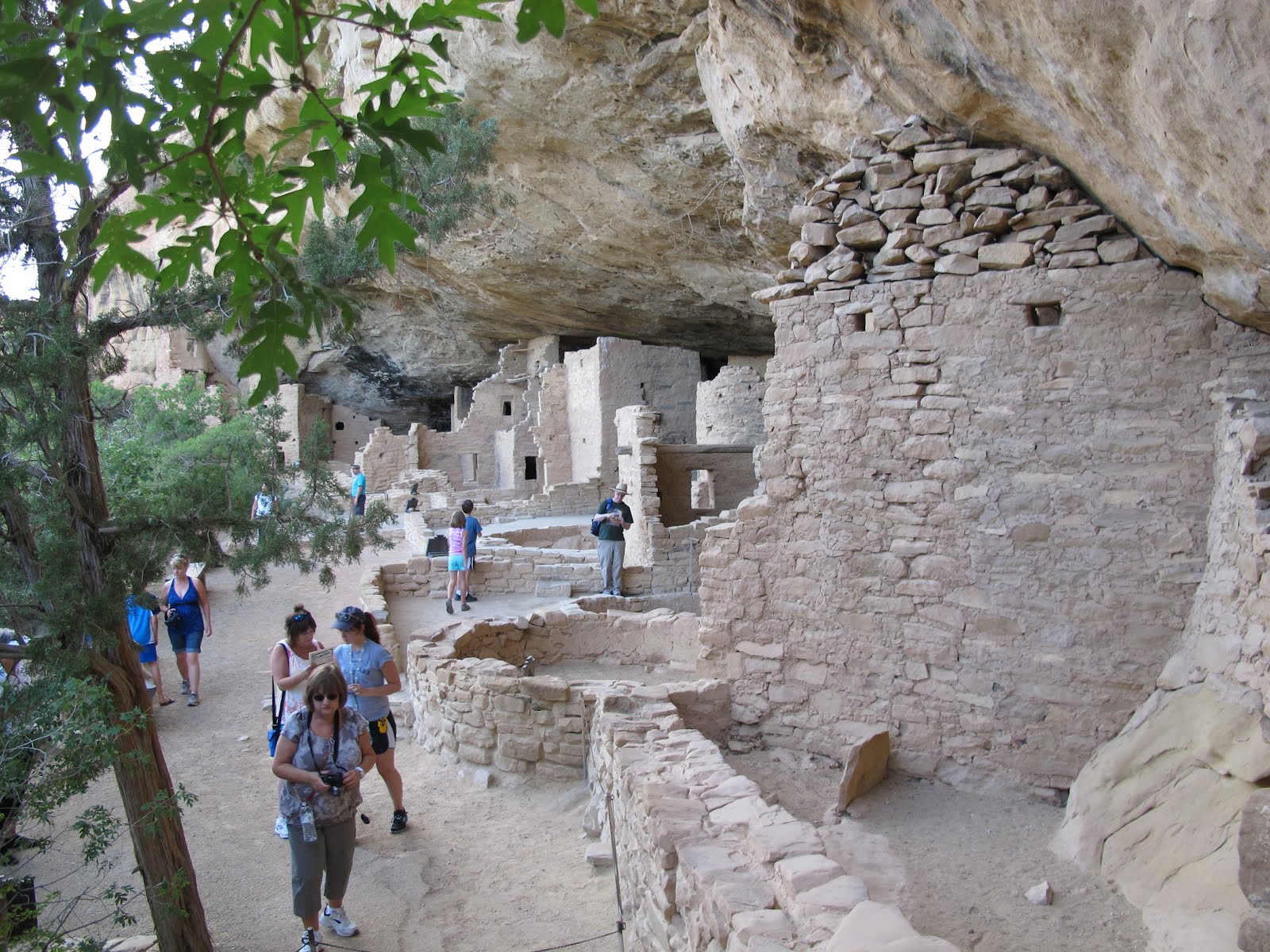
We purchased tickets for two guided tours … inexpensive ($3 per) and the only way to see some of the best cliff dwellings. The next morning, after a simple breakfast at the Terrace Café we headed toward Chapin Mesa, a 20-minute drive, where we visited the Spruce Tree House on a self guided tour. The Spruce Tree House is the best preserved of all the cliff dwellings in the park. You hike down a quarter mile trail loosing about 100 feet of elevation that you later recover in a windy climb back up a snaking asphalt trail. A park ranger answered questions and the shady visit in the cool of the morning air was very refreshing.


Later that morning we visited various pit homes on the top of the mesa before viewing the Sun Temple, the most elaborate construction in the park. Then it was time for our 11:00 AM tour of the famous Cliff Palace. We climbed down dozens of stairs, some cut between narrow boulders that would not allow any “wide loads.” The ranger leading the tour had warned us that it required a person with no heart, lung, or knee conditions to survive the 130 feet of steps, path, and ladders; and if you collapsed on the tour, the ambulance ride to Cortez was $4,000. Or you could take the scenic flight-for-life helicopter ride. That one was $14,000. Apparently ObamaCare had not reached the four corners region yet.


We chose the morning for this tour since the cliff dwelling was in the cool shade. Our guide explained life for the Ancestral Puebloans. These ancient peoples are sometimes called the Anasazi, but that is actually a Navajo word meaning “Enemy Ancestors.” So the A.P. name is preferred among the P.C. These people lived in the four corners area and up on the mesa from 750 A.D. until they quickly left Mesa Verde some time around 1250 A.D. for reasons still really unknown. They abandoned these marvelous cliff dwellings and they have survived to this day, a testament of these early people’s technical skills.

We focused on the Indian’s diet and nutritional needs as well as the hard life they lived farming corn on the top of the mesa and climbing up and down the vertical canyon walls to their homes.


We returned to our inn for lunch and then drove the windy forty-five minute journey to the less visited Wetherhill mesa where we toured the Long House and viewed other ancient dwellings including the Kodak House named because Wetherhill’s early exploring party stored their camera film in on of the rooms and the name stuck. Our tour guide for the Long House was very informative and the 90-minute tour added much to my knowledge of these early Indian cultures.

Later on our journey, I remarked to Linda how these trips just increase my thirst for knowledge. There is so much to learn: geology and geography, the flora and fauna, ancient history and modern history, about mountains and rivers and valleys. I could spend several lifetimes in books and school learning of the things I see. Travel is the ultimate pleasure for the mind and body, and an opportunity to enjoy time with loved ones in isolation and away from the daily habits. I’m already planning the next trip and it will be in just a few short days.

After that long day of tramping and sweating in the sun and heat, we returned to our rooms in the early evening and had a simple snack at the cafeteria before retiring for a well-earned rest. The Inn at Far View has no televisions, and I found the Internet access so busy I could not log in. Since the night sky was relatively cloudless, I pursued one of my goals for the trip.


That goal was to photograph the Milky Way. That’s our own galaxy, and it presents a band of barely visible stars across the sky, but the ever-present lights of civilization usually obscure the view. Here on top of the mesa, away from cities and people, the view should be better. I knew it was not a good date for galaxy viewing since the moon was in half lighted state, but I spent over an hour on our balcony accustoming my eyes to the low light and looking just below and to the left of Sagittarius trying to view the reclusive astronomical sight. It was not to be. 

Perhaps in the middle of July while visiting Montana I can get on top of the Judith Mountain at the location of the dismantled 694th Radar Squadron base near Lewistown. The 15th of July will be a dark moon, and, if the Montana skies cooperate, I’ll capture that elusive view yet.

Although Linda and I were comfortably tired after scrambling up and down slopes all day, we spent a quiet hour of hand-holding on the balcony watching a lighting storm march across the horizon and enjoying the peace and solitude from the Far View Inn.


On Friday morning we packed up and headed down off the mesa, driving over to Cortez to fill the tank of car and body, scrape off some bugs, fill the ice chest with cool drinks, and head up the San Juan Skyway. On our return from Las Vegas a week previous, we took U.S. 550 over some of the most beautiful and awe inspiring mountain roads in all of Colorado. This time we chose to follow the Delores river and Colorado 145 up to Telluride. 

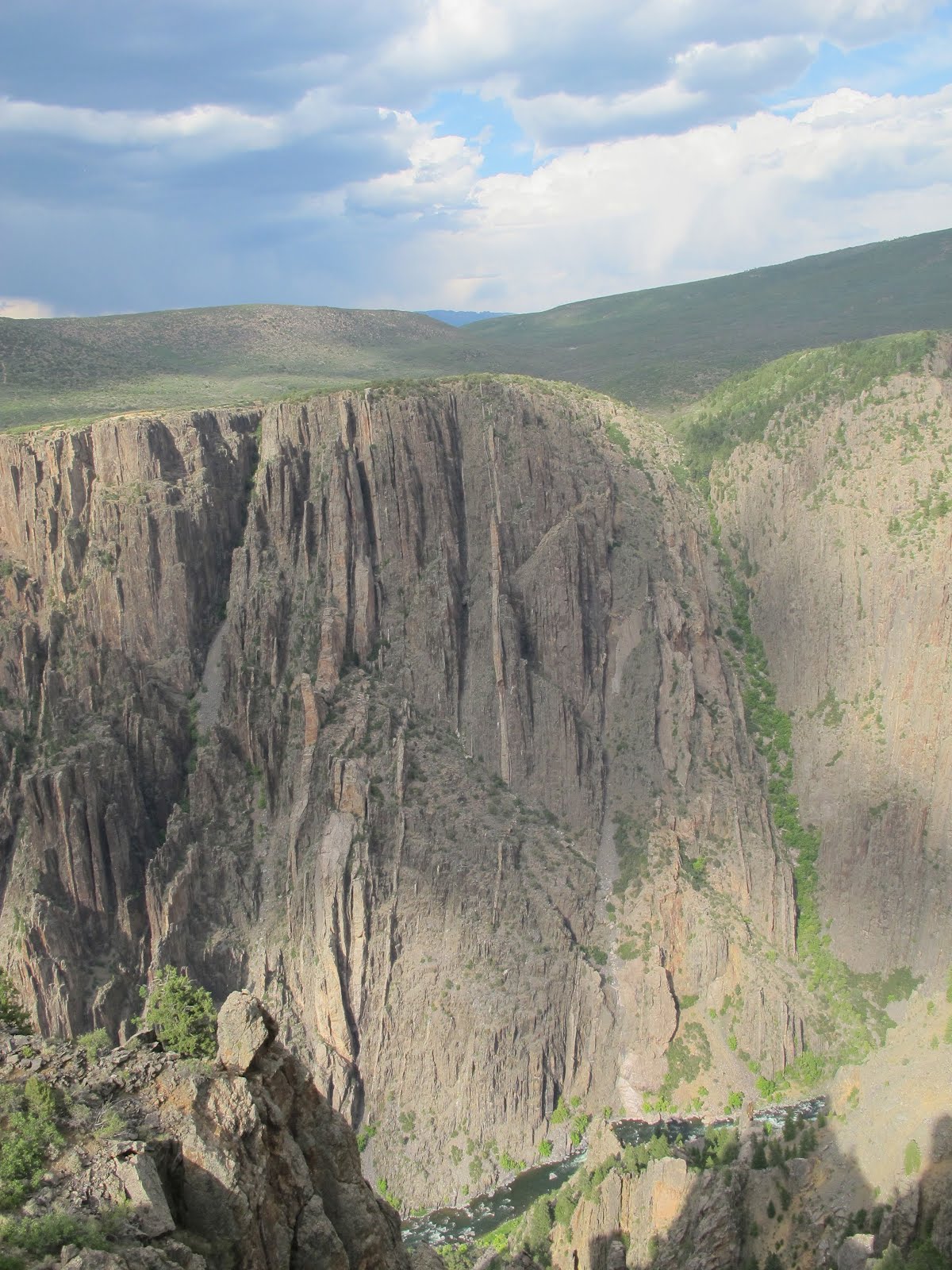
After lunch in a shady park in the former mining and now yuppie ski town, we continued north to Montrose. A short, late afternoon side trip to the Black Canyon of the Gunnison National Park where we viewed Colorado’s miniature Grand Canyon, it was on to our evening rendezvous with our great friend and Godson, Brenden, at his motel in Grand Junction.

We enjoyed a meal and conversation at the local Chili’s and then spent the night. We intended to stay at our friend’s motel, but he had double-booked some rooms and it was “no vacancy,” so we stayed at the Ramada Inn instead. I did some tech-support work, installing his printer and working on his motel’s wireless system before we called it an evening.


On Saturday morning we returned to Brenden’s for goodbyes, pictures, and a check on the wireless operation. We then headed up to the Colorado National Monument for a drive through more Colorado canyon land. After a couple of hours in that national parkland, we headed west on I-70 following the Colorado River to Rifle. There we turned north on Colorado 13. I don’t think we’ve ever driven that road before, and the change in scenery and geography lent itself to our enjoyment of the ranch land spread out between the bluffs. We reached Craig and turned east on US 40 for Hayden and our goal of Steamboat Springs.


We arrive early at Steamboat and checked into a lodge. From there it was on to downtown for a leisurely stroll and some fine mountain pizza at Beau Jo’s. We then walked the town until fatigue drew us back to the most comfortable bed we had enjoyed on the whole trip.

Sunday morning I arose early, but with reluctance, since we had to get back to Longmont in time for me to do my homeless outreach volunteer time. I work with HOPE driving an outreach van and providing meals and clothing to people in need. This trip was bookended between my HOPE shift on the previous Monday night and my shift on Sunday. We’ve been providing nearly one hundred meals to people on the streets, but that story is for another time.

To get back to Longmont from Steamboat Springs, there are only three ways “through the mountains.” You can go south to I-70 and cross over there. You can take Trail Ridge Road through Rocky Mountain National Park. Or you can drive the Poudre Canyon coming out near Ft. Collins.

I thought the drive through the Park might be very slow since it was a Sunday and the traffic can be like rush hour, and I had a deadline with my HOPE shift starting at 5:30 PM. I knew the fire north of Ft. Collins was in mop-up, and so we chose the highway 14 route through the Poudre Canyon.


There were many signs of the fire and also warnings not to stop. They didn’t want to take a chance on a new fire starting. We were looking for a place to stop and picnic, and we passed over a dozen beautiful picnic areas and campgrounds, but all were closed. There were police and soldiers guarding the side roads and blackened hillsides all around. 

Fortunately, most of the man-made structures and homes along the river had survived. We saw one burned down house on the entire trip, but the heart of the fire was 10 miles north of this canyon in the Red Feathers region where over one hundred homes and cabins were lost.

We finally found a sunny picnic stop at the end of the canyon; ate lunch; and arrive home around 2:00 PM.


Although we didn’t go through Rocky Mountain National Park, part of Colorado Highway 14 is actually in the park, so technically I went to three national parks on this trip, plus a national monument. We had intended to go north from Grand Junction and visit Dinosaur National Monument too, but I modified the route and we’ll have to visit Dinosaur on another day. I’m also looking at a trip through Utah that would visit five national parks -- six if we go down to the Grand Canyon.

One advantage of being an old dude, is I have a card giving me free entrance to any national park and monument. That sort of makes up for the sore bones from the walking up and down mountain trails.


So that is the end of one of the most enjoyable and relaxing trips Linda and I have taken in the blue bus. She performed perfectly on this trip … the bus, not Linda, although she (Linda) was fine too. The peace and quiet and beauty of nature combined with the companionship of my beloved sweetheart is a great joy of retirement. This morning I got nervous when Linda had to go to the store for milk. Being retired means never having to leave her side.

During my HOPE tour last night, my partner who is a young engineer at Seagate, asked me if I was having a hard time with retirement. He said he had heard some people have difficulty adjusting and just don’t know what to do with all the free time. I told him I wasn’t having any problems, and we were busier than when I was working. But retirement allows me to spend all my time with Linda, and that is a blessing above all others. We will happily continue our touring until the wheels fall off the blue bus. So, until next time, I bid you gentle readers au-revoir, and see you next time.

Monday, June 25, 2012

Battery Problems

My favorite computer — my Mac Air — has a battery problem. It requires recharging every few days! Why can’t it get the Energizer bunny and just keep on playing? There may be some lap top, somewhere, out there, with longer battery life than my little Mac, but I doubt it. I just have too high of expectations.

I’m even becoming tired of charging my iPad, which I have to do more than twice a month!! This is ridiculous. These devices should take a lickin’ and just keep on tickin’.

The problem, as I’ve been able to conclude, is batteries. While the electronics and computer industry as a whole has improved devices during my lifetime, like from the Flintstones to the Jetsons, yet batteries are still somewhere in the ‘50’s with doo-woop. What gives?

Now people want electric cars. I understand the issue of economics and economics. I once drove an electric car from Denver to San Francisco on seventeen cents worth of electricity.

Unfortunately, the extension cord cost $243,184 … (rim shot).

Again with the batteries. Quit fooling around American Industry. Give us a better battery before the Chinese do!!!

The simple answer: Battery development is hard, slow work. Throwing loads of money at it will help, but it will not make it happen overnight, as so many electric car proponents have predicted. There are no specific moving parts in a battery, but it's one of the most complicated things to develop, in terms of all the things happening inside. You've got multiple materials trying to come together in one place. It's volatile. And there are a lot of opportunities for things to go wrong.

It's a matter of thermodynamics. There aren't any things you can just grab off the shelf whenever you want higher energy.

Most of the battery experts say it's unfair to compare the rapid development of electronics to that of batteries. Electronics have been using the same material (silicon) for more than a half-century. To reduce the feature sizes of their chips, semiconductor manufacturers keep improving their chemical deposition processes and photo-lithography techniques. Their efforts are essentially a triumph of manufacturing.

In contrast, battery makers are constantly searching for new materials, combining them, testing them, and then waiting for the results. It's a physical sciences challenge. And it's limited by nature. You're always working with something new, like a cobalt oxide one day and a manganese oxide the next. You can do anything you want to those materials, but you aren't ever going to get any more energy out of them than the thermodynamics allow.

Outside the prescribed boundaries of the battery industry, the general public blames some entity — auto companies or oil executives — for suppressing a technology that could change the world. To this day, there's no shortage of individuals who are convinced that GM or Ford has a cheap, high-energy battery wrapped in oily rags in a basement somewhere.

The truth, though, is much more boring. Battery development is just hard, slow work. It requires some of that STEAMD stuff, and that stuff is in short supply. Anyone want to major in batteries in college?

Sunday, June 24, 2012

The Name Game

I changed the name of my blog today. It used to be called “A Pirate Looks at 60,” a Jimmy Buffett reference. The name didn’t really fit except possibly the age part. Suddenly, today, the right name became obvious to me, and thank you Google for making it so easy to change.

I started blogging on this site in 2009. Prior to that I wrote a lot of long essays on Facebook using the FB “Notes.” I had several goals in mind for the blog. As I wrote in my first blog, “Getting Started:"

“I don't know if what I have to say will be of any interest to anyone but my wife, and I can see her yawning now, so that may not even be true. Still it is fun to write it even if no-one ever reads it.”

“I have a particular perspective on life. You may agree or disagree with what I write. I read in the local paper today, in a letter to the editor, a Tom Waits quote, "If both of us think exactly the same thing, then one of us is unnecessary." That's good. I like that. So welcome to my opinions, and feel free to disagree and call me a jerk. I won't take it personally.”

I didn’t know what to name the blog. Since introspection and a source material for a memoir were on my mind, and since retirement was on the horizon and it was a time in a man’s life when he thinks back over the road he has trod, then the “Pirate” quote seemed appropriate.

I’ve been a fan of that Buffett song for many, many years, and we played it in about every jam band I’ve ever played with, so it worked. It was only later that I learned that Jimmy himself had titled his autobiography “A Pirate Looks at 50.” So it wasn’t really as personal as I would like. I never really thought it worked for me.

I also wrote in that first blog:

“I love music and science and technology and family and nature. So I expect to write about all of those topics and more. I've spent a lot of years in education teaching at a private technical school, a state college, and as an IBM instructor. So some of my posts may be tutorials. They won't be on the exam, and everyone gets an 'A,' so hang in there.”

Over these last four years my writing has covered those topics as promised and even a bit more. There has been a couple of attempts at fiction short stories, a song, and even a comedy routine.

I often spoke of the acronym “STEM” which stands for Science, Technology, Engineering, and Math. Those are the core subjects of my life and studies. You mostly see that acronym in reference to education or possibly career choices during this time of great unemployment.

But time has past and my view has shifted yet again. I am still a big fan of STEM, but I also have come to realize more and more how important Art and Design are, especially when coupled with STEM.

The final turning point was when I read Steve Job’s recent biography by Walter Isaacson. I had so enjoyed his book on Einstein, and still need to write more about that topic, but in the Jobs story I realized fully the integration with those two concepts.

Sometimes they are considered disjoint, but I view them as integral. A new acronym began to appear in my writing: “STEAMD.” That includes Art and Design with STEM. I didn’t invent this new acronym. Others are realizing what I now understand.

Suddenly, this morning, it dawned on me that that was the appropriate title for my blog: "STEAMD." That is, Science, Technology, Engineering, Art, Mathematics, and Design. Certainly STEAMD is a short phrase.

I hope my writing has improved. Certainly practice is good for any Art, be it guitar or singing or painting or writing. Oddly my photography and video work has received more comment, awards, and even some monetary remuneration. So far my writing has been amateur in every sense of the word. I do have a goal of publishing.

This, of course, is published, but I mean in the more common sense of the word. Plus, a little remuneration would boost my spirits and my bank account too. Of course, I could set up a PayPal account and you all could just donate. Perhaps you could bribe me to keep quiet. In any case, it’s all good.

“I don't know if I'm talking to anyone, or just myself. But enjoy what I write if that is possible and add your comments. I love questions and talking, so keep those cards and letters coming.” That was one of the last paragraphs in my first blog.

I have not had much luck with that. I know people are reading my writing, but I get damn few comments. Wish I could get more. I would love to converse on these topics, but – if you gentle readers don’t write back – then it is a monolog that you’ll get.

As I closed the original post, “I don't think I qualify as a Pirate since I'm a chronic rule follower, but it is fun to pretend.” Now I don’t have to pretend any more.

Saturday, June 23, 2012

The Decade of Music


Some of my age (there are relatively few that are older) will remember a little television show called “This Was the Week that Was,” or TWTWTW or TW3. This British come American show hosted by David Frost has nothing to do with what I’m about to write about. But it could give me a title as I discuss the “Decade that Wasn’t a Decade.”

This is the period, in my not so humble opinion, which was the most prolific and groundbreaking era of popular music and Rock and Roll. The period is the ten years from 1965 to 1975. Not a decade by usual expression, but it is on the bi-decal five year milestones. Actually, it would probably be more accurate to say 1963 to 1973. Yea, that’s the ticket. This is about 1963 to 1973.

This was the era — dare I say “decade” — in which popular music took the greatest turn for the better, a musical explosion, and we’re still benefitting from that most productive musical time.

I don’t have much to say. Either you know this music or you’re deaf. These are the songs that made the songs that made us what we are today — song-wise that is.

A simple list of the artists with top albums during those years will suffice to make my point.

1963

The Beatles
James Brown
Bob Dylan
Beach Boys
Stevie Wonder
4 Seasons
Rick Nelson
Roy Orbison
Martha and the Vandellas
The Surfaris
The Tymes
Peter Paul and Mary
Jimmy Gilmer and the Fireballs
Trini Lopez
The Rooftop Singers
Nino Tempo and April Stevens
Lesley Gore
Little Peggy March

1964

The Beatles
John Coltrane
Muddy Waters
The Ronettes
Beach Boys
Johnny Cash
Sam Cooke
The Kingsmen
Bob Dylan
The Supremes
The Animals
Dionne Warwick
The Rolling Stones
The Drifters
Jan and Dean
Manfred Mann
Dusty Springfield
The Wailers
4 Seasons
Louis Armstrong
Dean Martin
Peter and Gordon
Joan Baez

1965

The Beatles
Otis Redding
B.B. King
Bob Dylan
The Byrds
The Rolling Stones
Beach Boys
Yardbirds
The Paul Butterfield Blues Band
James Brown
Marvin Gaye
Tom Jones
The Lovin’ Spoonful
The Miracles
Roy Orbison
Righteous Brothers
The Shangri-Las
The Temptations
The Zombies
Herb Alpert
Them
Smokey Robinson and the Miracles
Little Anthony and the Imperials
Freddie and the Dreamers
Mel Carter
The Impressions
Ramsey Lewis
Barry McGuire
Martha and the Vandellas
Sam the Sham and the Pharaohs
Sonny and Cher
Shirley Bassey
Four Tops
Billy Joe Royal
Wilson Pickett
The McCoys
Gary Lewis and the Playboys
Tom Jones
Wayne Fontana and the Mindbenders

1966

The Beatles
Beach Boys
Cream
The Mama’s and the Papa’s
John Mayall
Simon and Garfunkel
Bob Dylan
The Rolling Stones
Mothers of Invention
Otis Redding
The Yardbirds
The Who
The Lovin’ Spoonful
The Monkees
Otis Redding
Sam and Dave
Nancy Sinatra
Dusty Springfield
The Supremes
The Association
The Byrds
James Brown
The Statler Brothers
Frank Sinatra
Sam the Sham and the Pharaohs
Paul Revere and the Raiders
Donovan
The 4 Seasons
The Cyrkle
Tommy James and the Shondells
Righteous Brothers
The Supremes
Simon and Garfunkel
Percy Sledge
Johnny Rivers
Petula Clark

1967

The Beatles
The Doors
Aretha Franklin
The Velvet Underground
Jimi Hendrix
Moby Grape
Cream
The Byrds
Jefferson Airplane
Pink Floyd
Buffalo Springfield
Blood, Sweat and Tears
Bob Dylan
Otis Redding
Merle Haggard
Albert King
The Rolling Stones
The Bee Gees
Ray Charles
Herman’s Hermits
Franki Valli
The Royal Guardsmen
The Monkees
The Mama’s and the Pappa’s
The 5th Dimension
Arthur Conley
Gladys Knight and the Pips
Paul Mauriat
Elvis Presley
Dion Warwick
The Association
The Box Tops
The Cowsills
The Left Banke
Van Morrison
Sam and Dave
Jackie Wilson
Beach Boys
Glen Campbell
Bobbie Gentrie
Lulu
The Music Explosion
The Buckinghams
Spncer Davis Group

1968

The Beatles
Johnny Cash
Van Morrison
The Band
Love
Jimi Hendrix
The Zombies
Aretha Franklin
The Who
The Byrds
Dr. John
Otis Redding
The Flying Burrito Brothers
Cream
Simon and Garfunkel
The Kinks
The Grateful Dead
The Velvet Underground
The Mothers of Invention
Big Brother and the Holding Company
The Moody Blues
The Monkees
Marvin Gaye
The Doors
Creedence Clearwater Revival
Glen Campbell
The Supremes
Steppenwolf
Herb Alpert
The Box Tops
Mason Williams
Sly and the Family Stone
Tommy James and the Shondells
Marin Gaye
The Delfonics
Archie Bell and the Drells
Simon and Garfunkel
Hugh Masekela
Bobby Goldsboro
Dion
Dionne Warwick
O.C. Smith
Hugo Montenegro
Richard Harris
Gary Puckett and the Union Gap
The Isley Brothers
The Irish Rovers

1969

The Beatles
Elvis Presley
Led Zeppelin
Dusty Springfield
Captain Beefheart and His Magic Band
The Band
The Rolling Stones
Creedence Clearwater Revival
The Who
Sly and the Family Stone
Santana
The Stooges
Quicksilver Messenger Service
Neil Young with Crazy Horse
The Grateful Dead
Crosby, Stills, Nash and Young
Nick Drake
MC5
The Velvet Underground
Jefferson Airplane
The Archies
Johnny Cash
Frank Sinatra
Bob Dylan
Mary Hopkin
Joni Mitchell
The Temptations
Stevie Wonder
Zager and Evans
The 5th Dimension
Classics IV
The Edwin Hawkins Singers
The Young Rascals
The Ventures
Tammy Whynette
Henry Mancini
James Brown
Jay and the Americans
The Supremes
Tommy Roe
Tommy James and the Shondells
Blood, Sweat and Tears


1970

The Beatles
George Harrison
Simon and Garfunkel
The Grateful Dead
Van Morrison
Crosby, Stills, Nash and Young
John Lennon
Neil Young with Crazy Horse
James Taylor
The Velvet Underground
Derek and the Dominos
Carpenters
The Stooges
Santana
Black Sabbath
The Meters
Nick Drake
Creedence Clearwater Revival
Randy Newman
Beach Boys
MC5
Elton John
Neil Diamond
Led Zeppelin
The Jackson 5
Three Dog Night
Stevie Wonder
The 5th Dimension
Chicago
Eric Clapton
Dionne Warwick
B.J. Thomas
The Jaggerz
Robert Flack
Allman Brothers Band
Bread
James Brown
Ike and Tina Turner
Edwin Star
Joni Mitchell
The Kinks
Merle Haggard
Dawn
Nitty Gritty Dirt Band
The Supremes
Ray Stevens
B.B. King
Norman Greenbaum

1971

Led Zeppelin
Carole King
The Who
Black Sabbath
Marvin Gaye
John Lennon
Joni Mitchell
The Rolling Stones
Cat Stevens
Jethro Tull
Allman Brothers Band
Janis Joplin
Sly and the Family Stone
T. Rex
Rod Stewart
Dolly Parton
The Doors
John Prine
Alice Cooper
Elton John
Funkadelic
James Brown
John Denver
James Taylor
Don McLean
The Osmonds
Isaac Hayes
Carpenters
Van Moorison
Jean Knight
Johnny Cash
Aretha Franklin
Neil Diamond
Bee Gees
Chi-Lites
Cher
The New Seekers
Richie Havens
Tom Jones
Ocean
Joan Baez
The Temptations
Melanie
Paul and Linda McCartney
Carly Simon
Crosby, Stills, Nash and Young
Nilsson
Diana Ross
Donny Osmond

1972

David Bowie
Neil Young with Crazy Horse
Stevie Wonder
Curtis Mayfield
The Rolling Stones
Todd Rundgren
Lou Reed
Proessor Longhair
Steely Dan
Al Green
O’Jays
Nick Drake
Randy Newman
Elton John
Eagles
Dr. John
Big Star
War
Mott the Joople
Three Dog Night
Harry Chapin
Mac Davis
Loggins and Messina
Hollies
Michael Jackson
Yes
The Temptations
Deep Purple
Chuck Berry
The Hillside Singers
Chi-Lites
Gilbert O’Sullivan
Carenters
Bobby Vinton
The Moody Blues
Sammy Davis, Jr.
The Staple Singers
John Denver
Johnny Cash
Billy Preston
Edgar Winter Group
Carly Simon
Paul Simon
Bread
Alic Cooper
Billy Paul
America
The 5th Dimension
Lobo
Neal Diamond
Seals and Crofts
Bill Withers
Luther Ingram
Chicago
Michael Jackson


1973

Pink Floyd
Led Zeppelin
Paul and Linda McCartney
Elton John
Lynyrd Skynyrd
Al Green
Marvin Gaye
Grand Funk (no longer a railroad)
Stevie Wonder
Bob Marley and the Wailers
The Stooges
Bruce Springsteen
Sly and the Family Stone
New York Dolls
The Who
Paul Simon
David Bowie
Lou Reed
Mott the Hoople
Toots and Maytals
Roxy Music
ZZ Top
Jackson Browne
Maria Muldaur
George Harrison
Al Wilson
The Stylists
Allman Brothers Band
The Isley Brothers
The Spinners
Stories
Electric Light Orchestra
Gilbert O’Sulivan
Vicki Lawrence
Jim Croce
The Doobie Brothers
Stealers Wheel
Mike Oldfield
Carpenters
Ringo Starr
Deodato
The Jackson 5
Aerosmith
Dawn
Diana Ross
Donny Osmond
Tower Of Power
Charlie Rich
Gladys Knight and the Pips
Bob Dylan
Elton John
Eagles
Helen Reddy
Rick Derringer
Barry White
Brownsville Station
Cher
Steve Miller Band
Kool and the Gang

I rest my case.

Bed Time Story


I suppose that most of you don’t have any problem going to bed. You pull back the covers. Climb into bed. And then pull the covers over you. Normally, neither do I, have trouble climbing into bed, that is. But last night it was rather warm. So I had the window open and the ceiling fan running, and I decided to just lay on top of the covers while I read before going to sleep.

I have one of those electronic reading devices. I won’t mention its brand because these corporations get too much advertising most of the time anyway, at least in my opinion. So I just lay on top of the covers in my pajamas which my wife will tell you I don’t wear which is why I just call my underwear “pajamas.” After a while, I got sleepy, and fell asleep uncovered.

Later that night I awoke. It had cooled off outside, and I was now chilled and ready to get under the covers. Rather than get out of bed, pull back the covers, climb back into the bed, and then pull the covers over me, I tried an alternative method.

I rolled all the way over to one side, at least until I ran into the still body of my wife. That is, she’s still my wife, and she wasn’t moving. That’s how she likes to sleep, and I’ve learned not to argue with her. Especially when she is asleep.

Then I rolled the covers over, but just until they met my body. They were at sort of a forty-five degree angle to the head of the bed, although it was dark so I can’t be sure of exactly what angle they were at – geometrically speaking.

After that I rolled, over the roll of covers, arriving on the uncovered side of the bed, which was my intention. There still wasn’t room for all of my body, but I was able to get my legs into the covers sort of like putting a letter into an envelope. From that position, I was able to maneuver the rest of the covers over me, and quickly fell back asleep.

This morning, I mentioned this to my cousin who lives in the basement. I rent him and twelve members of Cirque de Solei an illegal apartment in the basement. It’s a small room, so they sleep in a chest of drawers. Not only does that solve the problem of no space for a bed, but, if one of them snores, they just close his drawer.

Now these renters are trampoline performers. We don’t have a trampoline here for them to practice on, so they just jump on the bed. The ceilings are rather low in the basement, so I let them use my bed since we have cathedral ceilings. They do have to watch out for the ceiling fan.

There used to be thirteen of them before the terrible accident, but I don’t really want to talk about that. Besides, I’m sure you read about it. It was in all the papers. The ceiling fan wobbles a little bit now, but otherwise things have returned to normal.

Anyway, they decided that would be a good stunt to add to their act. They would all start bouncing together and then, while in the air, they would reach down and pull back the covers. I’m sure you can figure out the rest.

They practiced it for a while, and I think they got the hang of it. I may try that the next time I am in a similar predicament.

Now I had better stop writing because it is almost time for breakfast. I don’t want to be late, because we don’t have enough chairs at the table for everyone, and the last person has to stand through breakfast. I used to fool them by playing the Star Spangled Banner on my harmonica, and when they stood up, I’d grab an open chair.

But then someone put soap in my harmonica, and all I can play is “I’m Forever Blowing Bubbles,” a song I don’t really know how to play anyway. So I’ll close now, as I can smell the toast burning in the toaster, so breakfast must nearly be ready.