My recent trip allowed me the opportunity to compare and
contrast. Like an electronics store with dozens of TVs running side-by-side, my
visit to Nevada gave me the chance to consider contrasts in STEAMD … that’s
Science, Technology, Engineering, Art, Mathematics, and Design. As the sights
were filtered through my personal paradigms, I pondered on their existence, timelessness,
context, and purpose. What did these artifacts tell me about human kind and our
progress on this planet? How did I react to these visions?Saturday, June 16, 2012
A Study in Contrasts
My recent trip allowed me the opportunity to compare and
contrast. Like an electronics store with dozens of TVs running side-by-side, my
visit to Nevada gave me the chance to consider contrasts in STEAMD … that’s
Science, Technology, Engineering, Art, Mathematics, and Design. As the sights
were filtered through my personal paradigms, I pondered on their existence, timelessness,
context, and purpose. What did these artifacts tell me about human kind and our
progress on this planet? How did I react to these visions?Sunday, June 10, 2012
Lear and Foathing in Las Vegas
I’m on the way to pick up Linda’s dad. He has an early flight out. The trip, at least the Vegas part, is winding down, even if the town is not. We’ve been here ten days now. Walked the streets; seen the sights; paid the prices. Kids are pretty warn out from hardy partying, pool, nightclub, and amusement park. I don’t think they can stand much more fun. Tonight, Fremont street, the zip line, that’s all that’s left, in them and me.
After dropping grandpa off at the airport, I head west. Want to get the sun rise over the strip. Predawn light, good for pictures. Catch the tower at the Stratosphere in the morning sun. McDonald’s for coffee and breakfast sausage. Even the McDonald’s is special here. Harley motif decorations. The glitz and the glitter. The five star casino hotels, like little cities. The giant parking structures. Plenty of room ... on the fourth level. Parking is free and easy ... well, free anyway. Got to get those bodies into the shops.
Circular / spiral escalator ... Caesar's has it. An entire lake with dancing water show ... Bellagio has it. Pirate ship ... Treasure Island. Pyramid ... Luxor. Volcano ... I don’t know; lost track. Amusement park ... Circus Circus ... or, Stratosphere, if you can stand the height. Also roller coasting at NY, NY. The slot machines lost their arms, but not their songs. A cacophony of dinging music as you cruise the aisles.
Limousines and taxi cabs mix with cars from California. Convertibles, sedans, mini vans and trucks. Flashing red and blue lights as the well policed city deals with the crowds. Bicycle, motorcycle, squad car, and patty wagon are all on the prowl. The town is waking up as the 6:00 A.M. shift heads for work and the all-night-party heads for home or hotel. McDonald’s is full of party crowd and day workers. Some tired from early rising and some tired and headed for bed. The rhythm of a great city. An adult Disneyland. A city of great hotels and architecture that amazes, all a driving economic engine blooming in the desert. Given power and water and dollars, the desert blooms.
A stop at the Welcome to Vegas sign for pictures. One more cruise down the strip. Reservations in Grand Canyon on the rim. Now we’ll see how nature does it. Enough jangling bells and singing gambling machines. No more broadway shows on the strip. Enough parking structures. No more air conditioned expanses. Exchange the mini skirt and hot pants for longer attire. Replace the lights with stars. The trip continues.
Grand Canyon (Grand River renamed “Colorado”), four corners, Mesa Verdi, Durango, Montrose, the beautiful view (buena vista) then home. Time to recoup and regroup, refinance and reload, restore and recharge. Then off to the next stop. North, South, West, not East. Those are the directions. Point the nose and drive, drive, drive.
Not loathing, but just warn out by bright lights and glitter. Even the pool is no longer restful. Off for moonlight and starlight on the canyon, the mountains and valleys, enough of Las Vegas. Enough gonzo.
Parked on the third floor. Yellow Chevy with two asleep in the front. No hotel? No money? Does it matter? Viva Las Vegas! One more day. Then it's pack our bags and head back north. Those mountains are beckoning.
Saturday, June 9, 2012
Love
Art is about interpretation. With art we view the world through the eyes of the artist. The perspective is often revealing, and, as we add our personal experience to the artist’s view, we arrive at the ultimate object of art. Art lets us see life differently. It is this new view that is the goal. Through the eyes (and ears) of the artist our world and our view of the world is enriched.Much art is visual. Here, in this desert oasis, art has arisen like a mirage. There is fine art here. Monet at the Bellagio, Georgia O’Keeffe too. Expressionism and the painting with light. That is classical fine art.
There is the architecture. Like some Disney dream gone wild there is the New York skyline reproduced in a hotel form. There’s Paris, Las Vegas and Caesar's Rome with Egyptian pyramids and the far east of Mandalay all reproduced with electric light and giant video screens. There are statues and fountains and all the wonders one expects of a Europe, but done here on the sun baked desert in a scale not seen anywhere else.
The desert has bloomed art with the sole intent of separating people from their money. Can Las Vegas be considered an artist’s town? Yes, that is the question.
But on to more art. It is not all visual. The art of my generation and those generations that followed is music. Stronger than the classics from previous centuries, our music fills our lives from boom boxes to massive subwoofers hidden in car trunks to portable music constantly providing a sound track for our lives through tiny buds in our ears.
There are certain musicians who have shaped the consciousness of generations and whose stories are told and retold in our conscious and subconscious minds. Melodies and tunes that are always there just below the surface.
Few musicians have had the power and influence of the quartet from Liverpool. Their music has played throughout my life. It’s been interpreted and reinterpreted and simplified and orchestrated and has become background elevator music. Their skill and talent has been recognized by musicians and listeners all over the world.
Their music is especially cherished by those of us who grew up with it as it was revealed. I associate with most Beatles songs an event in my life that occurred with the latest hit as a background. Whether it was Eight Days a Week, our theme song for the state basketball tournaments, or Sgt. Peppers that I first heard while living in Libby, Montana with friends working in the saw mill. Or The Letter while I was in boot camp. (All right, that was the Boxtops, not the Beatles.) Or the White Album that came out while I was stationed at Lowry Air Force Base. Then the final Beatle’s songs as they struggled with their own artistic strife that eventually broke them apart.
These are songs I’ve heard and listened and felt so many times. They are as much a part of me as my blood and my bones … maybe not as much as my hair. (Inside joke.)
Now I’ve experienced the Beatles reinterpreted in dance and light show and acrobatics as only Cirque du Soleil can do. The Cirque is no stranger to Vegas. There must be at least five different circuses here, including an Elvis interpretation. But none of the others touch me at my core like the Beatles.
Some of the theme I didn’t like … they portrayed post war Britain as if this was Tommy or The Wall. I never heard that in the Beatles. But as they moved to the psychedelic generation, their vision meshed with my deep held memories.
I never cried with a Beatles song before (okay, maybe a few times — Norwegian Wood), but by the end I had tears in my eyes. What a wonderful way to finalize the concert.
But before I describe that, let me explain my journey. I mentioned the Sgt. Peppers album. Well I first heard it when a close friend bought it back in ’67, and we played it in our little trailer in Libby. I expected something special since Rubber Soul and Revolver showed how much the Beatles were changing. Just as Brian Wilson was blown away by Strawberry Fields, I recognized something different, something special, something that had not happened before in the changing Beatles’ perspective.
But Sgt. P, that was an experience. Was this even rock and roll? Or was this just skiffle music taken to the ultimate. Other rockers were exploring the blues, but the Beatles were on another planet. These were stories. How many times have we heard these songs since used to fill a story line and provide a background to a video. These songs played in the head … way back in the drive-in movie part of the brain.
So it is no surprise that some forty years later I again was introduced to something new and Beatle by that same friend when he sent me a CD of “Love.” For those that don’t know … and shame on you … George Martin and his son went back to the studio to remix the Beatles’ catalog. With the permission of the surviving Beatles and the Beatle heirs and the sponsorship of Cirque du Soleil, they created a remix and mash-up of the Beatles’ creations that was, at once, new and fresh, yet nostalgic and tied to the original.
For we hard-core Beatles fans it was like a new Beatles record, but also our old friends and memories in there too. We would point and exclaim, “Look how they’ve put that together!”
From that moment I knew I had to see the thing. Ron beat me to it, visiting the desert a few weeks back and he “enjoyed the show.” With that prelude I arrived here in the desert with one goal in mind. I had tickets in the front row … well, the front section anyway … and I was ready for some Beatles magic.
Cirque did not disappoint. I can’t put it in words. Hell, Hemingway couldn’t put it in words, and I’m no Hemingway. (On that I get complete agreement.)
I started to describe the perfect ending … the last three songs. I don’t think I'm giving away the plot or anything … it is so obvious.
First (or nearly last) they played Day in the Life. The epic half John Lennon and half Paul McCartney song. It’s not just one song … it’s several. D. A. Pennebaker in his “History of Rock and Roll” declared Day in the Life the number one all time rock and roll song. That was in the 70’s, but I’m here to tell you it has kept the crown. No other song embodies the great depth and hight that rock songs can obtain. We’re not talking a couple of guitars and a set of drums. This is orchestra for the mind.
So, naturally it starts the final set. Then into Sargent Peppers. That song provides the drama and theatrics for any Beatles recreation (along with some images of yellow subs).
These natural codas from the greatest album of all time are an appropriate conclusion. The lights go out. The audience is on its feet. The applause is deafening.
But what rock show doesn’t have an encore. The applause continues. The actors return to the stage. Now for the real final song. Well, of course (sound of hand slapping forehead) it is All We Need is Love. The whole thing is called “Love.” It’s a no-brainer.
A little rock and roll. Some travel back to where it all started (She Loves You — yeah, yeah), and mental visuals of all the world singing for peace. Could music truly end the war? That was the question, but no-one waited around for the answer.
Lucky the theater was dark and no-one could see my tears. Thanks for taking me back. Thanks George and Giles. And thanks Ron.
Monday, June 4, 2012
Unintended Consequences
My regular readers know I’ve written before about the importance of understanding technology. We live in a complex world surrounded by technology and all the benefits that modern science has given us. It is our responsibility to understand that world in order to make proper decisions about the future. That is the essence of a democracy. We are all responsible. That is why public schools are so important. We are self governed, and that requires knowledge and experience in order to make the right decisions.
In this complicated world, I often wonder what people are thinking and how they are making those decisions. For example, consider the current situation with fracking. Fracking or Hydraulic Fracturing is a process using high pressure water and additives to fracture rock deep underground in order to release natural gas and oil. Some consider it an efficient and effective way to expand our energy reserves, lowering prices for gasoline, and reducing our dependence on foreign oil. Others argue that it is a dangerous method that can pollute the environment and even cause earthquakes. What is the right decision? How do we balance technology and its ability to do good for society with the dark side of industrialization and damage to our environment?
Here’s another example: In order to save energy and reduce the need for oil and coal, Compact Fluorescent Lights or CFLs have been developed. They are even being mandated by law. But the CFLs contain mercury, a very poisonous substance. In fact, certain environmental laws had to be modified allowing an exception for the mercury content in the bulbs. “It is for the greater good,” we’re told, and, “they will be disposed of properly.” That makes me wonder how many CFLs are just dumped into the trash? And what about the manufacturing facilities in China; are they environmentally safe? Is the benefit of energy savings in the replacement of incandescent bulbs with CFLs worth the risk to the environment?Life in this modern world requires us to continually make these kinds of decisions about trade-offs and consequences.
Let me tell you a cautionary tale about a couple of inventions that were intended to make our lives better. This story is about a chemist and engineer you may have never heard of, but you have likely heard of his inventions. His name is Thomas Midgley, Jr., and he worked for General Motors (GM) at the start of the last century. Back then, the automobile was just becoming an important part of American life, and one of the problems was the amount of power produced by the gasoline engine. In order to improve the efficiency of the automobile engine, the compression ratio was increased. That’s how much the gasoline and air mixture is compressed before being ignited by the spark plug.
Simple physics indicates that the higher pressure fuel mixture will return more energy upon ignition. But there is a problem. The goal is to have a rapid, but smooth burning of the combustible mixture. Unfortunately, with low octane fuels, the mixture may explode suddenly during compression. This ill timed and premature explosion can cause damage to the mechanism. This problem is called “knocking” due to the sound produced. Diesel engines make a value out of this compression caused explosion and run on low octane “diesel fuel,” but gasoline engines are intended to fire when the spark plug fires and knocking is a problem. This led to a quest for methods to increase the octane of gasoline.
Midgley was working with a team of scientists at GM trying to find ways to increase the octane and reduce knocking. He developed the tetraethyllead additive for gasoline. Now lead is a strong neurotoxin and cumulative poison, and, even in 1921, people knew that. Conveniently, General Motors left the “lead” out of the name and marketed this additive as “Ethyl.” Not satisfied with the rate of adoption of the new additive, the Ethyl Corporation was founded by GM and Standard Oil of New Jersey (ESSO) to literally “sell” the general public on the advantage of this additive. The production of the additive was managed by the DuPont chemical company. Some of us with gray hair may remember those cute little advertisements for “Ethyl.”
However, as I stated, lead is a poison and using the additive increased greatly the amount of lead in the atmosphere. Lead pollution has increased by over 625 times previous levels in the past century due partly to pollution by leaded fuel. This even affected the inventor. Although the Ethyl Corp. denied the health risk, in 1923, Midgley took a prolonged vacation to cure himself of lead poisoning.Ironically, some historians believe that poisoning from the lead water pipes was one of the causes of the decline and fall of the Roman Empire. Here we were repeating the process, although not all lead in the environment was from Ethyl. Back then lead was used in everything from ammunition to paint to food cans. However, the EPA has ruled that leaded gasoline is the primary cause of the increased amount in the atmosphere.
Some would argue that Ethyl was a necessary evil, and that it did support the expansion of our automobile industry and even contributed to winning the second world war. However, there were other choices to increase octane ratings of gasoline, and Ethyl may have been more of a successful product due to advertising and the backing of industrial giants such as General Motors, DuPont, and Standard Oil (now known as ExxonMobile.)
Eventually we realized that we were steadily poisoning the entire human race. The levels of lead in the atmosphere sky rocketed after the introduction of the Ethyl additive, and, finally, in 1986, it was banned from gasoline in the United States. A recent U.N. report predicts that all use of leaded gasoline in the world will end by next year. Fortunately, the lead in our atmosphere has dropped considerably since we stopped using lead compounds in gasoline.The next part of the story doesn’t have so happy of an ending. I am not trying to portray Midgley as a monster or a bad man. Like many scientists his goal was to make things better for society. However, this man did seem to have a particularly bad record in that regard. After inventing the Ethyl additive, Midgley turned to refrigerants.
Keeping things like food and medicine cool is certainly a benefit to mankind, and the invention of the refrigerator was a wonderful device. However, early refrigerators used gasses that were very dangerous.
At that time air conditioning and refrigeration systems used chemicals such as ammonia, chloromethane, sulphur dioxide, and propane. These materials were poisonous and could catch fire and explode. In one instance in the 1920’s a refrigerator at a hospital leaked a poisonous cloud and killed over 100 people.Frigidaire, a division of General Motors, was a leading manufacturer of these cooling systems, and so they assigned Midgley to search for a refrigerant that was non-toxic and non-flammable.
The team searched for a material which is both volatile, which is required for a refrigerant, but also chemically inert. They eventually settled on the concept of combining fluorine into a hydrocarbon. Even though these compounds contained highly reactive elements such as chlorine and fluorine, Madgley assumed they would not be toxic, believing that the stability of the carbon–fluorine bond would be sufficient to prevent the release of hydrogen fluoride or other potential breakdown products.
Midgley developed a family of gasses called “dichlorofluoromethane,” the first chlorofluorocarbon (CFC), which they named "Freon." This compound is more commonly referred to today as "Freon 21", or "R 21".
These materials soon replaced the dangerous substances used in refrigerants at that time, and they were later used as propellants in aerosol cans, to create foams and plastics, as solvents and degreasers, and in asthma inhalers. Midgley was awarded a medal by the Society of Chemical Industry in 1937 for this work.Due to the widespread use of CFCs and leakage into the atmosphere of coolants, the amount of CFCs in the air increased rapidly after introduction of Freon. Eventually scientists learned that the gas was reacting with sunlight at high altitudes and producing chlorine gas which combined with the ozone in the upper atmosphere, causing holes in the ozone layer. That increased the amount of ultra-violet light penetrating the atmosphere, which increased further the chlorine release from the CFCs.
The ozone layer provided protection from high energy rays from the sun, and loss of this layer can lead to skin cancers and also contributes to global warming. Finally, by 1974, production of CFCs was halted. However, the high level of stability of these materials means that the amount remaining in the atmosphere will last for around another 100 years. It will take some time before we can recover from this unintended consequence.
So we are left with a tale of a brilliant scientists who, twice, developed what he hoped would be a boon for mankind, only we later discovered they were both very bad for the environment and our health.The final ironic twist to the story is the fact that Midgley, a victim of polio who was severely disabled as the result of the disease, had developed a set of pulleys and ropes to assist him in rising out of bed. One morning he became entangled in ropes and was strangled and died at the age of 55.
There are lessons to be learned from this story of technology and business, and it has application in our world today. Right now there are thousands of “Midgley’s” working in the laboratories and development centers all around the world. What will be the next great invention? What will be its unintended consequences?
This cautionary tale is not taught in most history classes, and few people today even know who Midgley was. That is very sad to me. Those that don’t know history, are bound to repeat it.
Friday, April 20, 2012
Some Old Cheathams
"New Prospect Church is located about 200 yards north of Highway 195, two miles east of Haleyville. The church was organized in the fall of 1824."
"New Prospect is the oldest Baptist church in Winston County and believed to be the third oldest Baptist Church in the state of Alabama. The church is 50 years older than the Clear Creek Association, which was started in 1874."
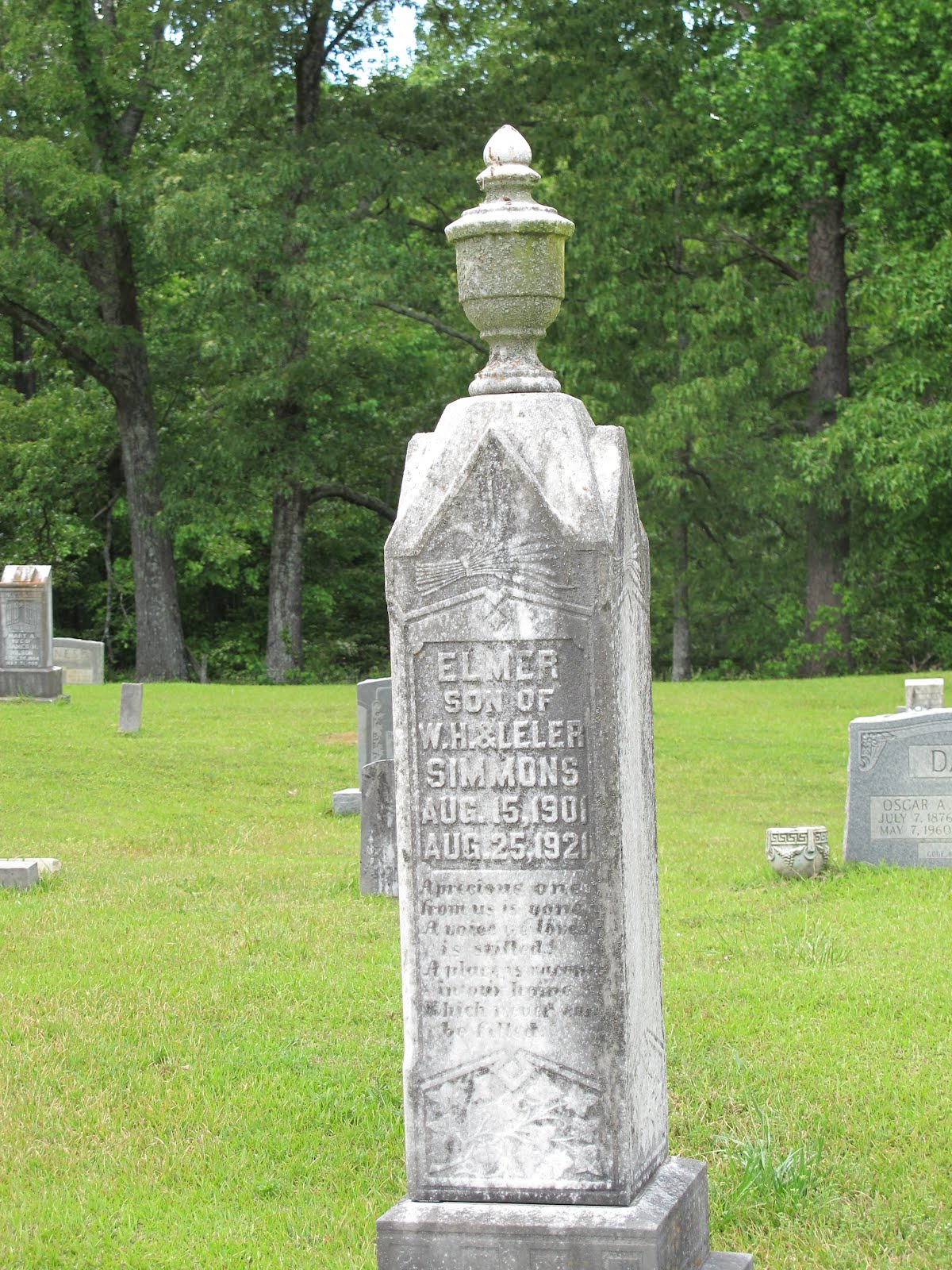
Behind the church is an ancient cemetery, at least ancient by my standards. Here is one grave marker we found. Note that is not the original marker, but a recent addition by the Alabama Historical Society. I assume the information came from earlier markers and historical records.
Here's another old marker -- updated.
Some of the old headstones were well worn and hard to read. Some had been replaced by new markers.
Also buried in this holy ground are my dad's grandparents, my great grandparents. My grandpa's sister and his brother married the brother and the sister of my grandma. So my dad had "double uncles" and "double aunts." So this is a common resting place for a lot of the family going back several generations.
In addition, there a several of my great grandparents, uncles, aunts, and even great, great grandparents -- Stanley and Wilson.
This is my dad's only sister and only younger sibling. She died while her brothers were at war.
My dad's sister and his parents are buried in another graveyard a few miles away.
A lot of history, and a lot more photographs.
Saturday, April 7, 2012
Forces -- Part One
There are now known to be four fundamental physical “forces,” although, at the beginning of this century, only two were known. What I mean by forces is the scientific term that implies a push or a pull. In physics, a force is any influence that causes an object to undergo a certain change, in either its speed or direction of motion, or geometrical construction.
In other words, a force is that which can cause an object with mass to change its velocity (which includes to begin moving from a state of rest), that is, to accelerate, or which can cause a flexible object to deform. Force can also be described by intuitive concepts such as a push or pull. A force has both magnitude and direction, making it a vector quantity. Newton’s second law, F = ma, was originally formulated in slightly different, but equivalent terms: the original version states that the net force acting upon an object is equal to the rate at which its momentum changes. (Momentum is a quantity equal to mass times velocity.)
As I stated, there are four “fundamental” forces known in nature. These are forces that act at a distance. They should not be confused with forces that occur with contact such as: frictional force, tension force, normal force, air (or fluid) resistance, applied force, or spring force (and there are others).
Historically, the first fundamental force to be understood is the force of gravity, and we credit Sir Isaac Newton (1642-1727) with its discovery. Prior to Newton’s time, the focus had been on understanding the motion of the planets and stars. For thousands of years, humankind was misdirected by assuming the earth was the center of all this motion. Although many give a religious reason for this incorrect understanding, it was really more the case that people sensed that the earth didn’t move. After all, it was well known that motion produced various pushes and pulls (acceleration) and it was obvious to the observers that the earth was standing still.
That’s not the first time that observations have been in error. Among Newton’s many discoveries and explanations of the laws of force were an understanding of how it would appear that the earth was stationary even though it is undergoing all kinds of motion from rotation on its axis to revolution around the sun to motion as part of the galaxy.
Using Tycho Brahe’s (1546-1601) extremely accurate and complete observations of the motion of Mars and other planets, Johannes Kepler (1571-1630) developed mathematical laws that described the motions within the solar system, correctly placing the sun at the center of this system with the planets revolving around the sun, and the earth’s moon revolving around the earth.
What Newton did was to develop a set of laws that described both gravity and rules for motion. These laws or formulas, when solved, predicted exactly the motions that Kepler had discovered. (There was a small amount of error when Newton’s laws were applied to Mercury, the innermost planet of the solar system. We’ll return to that small error later in this story.)
This is Newton’s “Universal Law of Gravitation.”
G is a constant that makes the units work out right. It is a fundamental characteristic of our universe.
There were several conceptual breakthroughs included in Newton’s work. It is said that he was watching an apple fall out of a tree when he had his great a-ha moment. He realized that the apple fell to earth because the earth had an attraction for the apple: gravity. But he also realized the apple attracted the earth! Everything that has mass attracts everything else that has mass. Of course, since the earth’s mass is so much greater than the apple’s, the apple falls to earth, although you could argue the earth moves too, but just the tiniest little bit.
Further, he looked at the moon, and realized that it too was falling, just like the apple. It is just that the moon had a linear velocity that caused it to “fall” around the earth. From this comes orbital mechanics and an explanation of how masses can revolve around each other.
Writing this as an equation, he calculated the “force of gravity.” It is actually the weakest of the four fundamental forces, but the first to be discovered because it is a prime element in the motion of the planets and stars. It literally holds the macro universe together. “Macro,” in this sense, means “large” or “what we see.” Certainly the universe is large. The range or active distance of gravity is infinite, however, the force decreases with distance as the square of the distance.
That means that at twice the distance, the force is one over two squared or one-fourth the effect. We say that the force of gravity is proportional to the inverse of the distance squared. You can see that in the “r” value in the denominator of the equation for the force of gravity. This fact can be deduced easily with simple solid geometry. As the distance from a point increases, the surface of the sphere increases as the square of the distance. This “spreading” out of the force weakens its effect on a given mass.
Newton also developed three laws that deal with motion and contact forces. He had to invent a new form of mathematics called “The Calculus” to perform the calculations, and he is considered one of the greatest physicists and mathematicians of all time. He also did work with light and optics, which is a good segue to our second force.
All through the seventeenth and eighteenth and nineteenth centuries discoveries were made regarding electricity and magnetism. Even our Benjamin Franklin had a hand developing electrical principles during the time of the American Revolution. Grade schoolers are taught Franklin’s experiments with kites and lightning, an experiment in which we’re lucky one of our founding fathers didn’t experience an early end to his existence.
The big breakthrough occurred when James Clerk Maxwell (1831-1879) combined some of the equations found earlier by these pioneers and added a little bit of his own simply to make the set of equations symmetrical. These are now known as Maxwell’s equations and they predicted the existence of a force, now known as electro-magnetic force, as well as the existence of waves we now call radio waves and light. Experimental proof of the existence of radio waves would be delayed several years, and radio is a major part of the “Second Scientific Revolution” that begins with the new century.
Maxwell’s equations combined the known attractive force of magnetic materials and the electrostatic attraction demonstrated when a plastic comb is rubbed and then attracts small bits of paper. Unlike the force of gravity, which is always an attractive force, that is it draws masses together, the electro-magnetic force can be an attraction or drawing together as well as a repulsion or pushing apart.
In terms of the electrostatic force, we know there are two polarities, positive and negative, that we are familiar with from electrical circuits and batteries. We know that like charges repel. Two positive charges will repel each other as will two negative charges. But unlike charges attract.
There is a similar situation with magnetism where the two polarities are called “north” and “south” after the earth’s magnetic poles, and, again, like poles repel and unlike pole attract.
The electro-magnetic force is much, much stronger than the force of gravity. Think of how the comb can pick up pieces of paper held on the desk by the gravity created by the mass of the entire earth. All that gravitation force overcome by a small comb. Or consider a magnet able to pick up large weights and lift them against gravity. Obviously, gravity is the lesser of the two forces.
We also know that the electro-magnetic force extends to infinity, but decreases by the square of the distance, exactly like gravity. There are many similarities between the two forces, and the existence of “gravitational waves” similar to radio waves has been hypothesized. Although gravitational radiation has not been directly detected, there is indirect evidence for its existence.
For example, the 1993 Nobel Prize in Physics was awarded for measurements of the Hulse-Taylor binary system which suggests gravitational waves are more than mathematical anomalies. Various gravitational wave detectors exist. However, they remain unsuccessful in detecting such phenomena.
It was very near the end of the nineteenth century when a pair of experimenters by the names of Albert Michelson and Edward Morley. The Michelson–Morley experiment was performed in 1887 in the United States. Its results are generally considered to be the first strong evidence against the theory of a luminiferous aether (ether). The result of the experiment was to establish the speed of electromagnetic waves — light if you will — as a fixed speed often called the “speed of light.”
The most immediate effect at the time was to put an end to the Vortex theory, which said that atoms were vortices in the ether. So that would beg the question, “just what are atoms.” For the answer, we must move into the twentieth century. The experiment has been referred to as "the moving-off point for the theoretical aspects of the Second Scientific Revolution."
And this is what I really intend to speak on, the “Second Scientific Revolution” and a young man that led that revolution. So now the stage is set. Two of the fundamental forces of nature are known and can be calculated and put to use. What happens next, at the beginning of the twentieth century, will reshape every aspect of life on this planet. This is exciting.
• F is the force between the masses,
• G is the gravitational constant,
• m1 is the first mass,
• m2 is the second mass, and
• r is the distance between the centers of the masses.
Saturday, March 10, 2012
Pinky and the Floyd
Two successive nights, Pink Floyd music, concerts, people dancing in the aisles, and
that strange smelling smoke wafting through the auditorium. What an experience. It is
a very special treat to see a band that has musicians you actually know personally.
One of the band’s drummers (actually “percussionist") is the son of one of my best
friends (and fellow musician) from high school. He lives in Great Falls now, but was
in Bozeman for the concert. I was also asked by the mother of the bass player to take
photos. One of the keyboard players went to school with my nephew. So it was a nice
connection to the band and music. Linda and I, my sister, and my old friend Ron Fleming
watched the show on the second night from the balcony, so I even got two different points
of view for the performance. (The first night we were about five rows back on the main floor.)
Pink Floyd is one of my favorite bands. I started listening to them with Atom Heart Mother back in the late sixties. (I especially am fond of Rick Wright, the keyboardist from the original British band.) There are two albums I played so much I actually bought another copy to replace the worn out originals: Dark Side and Tumbleweed Connection.
Pinky has two talented keyboardist, “Pinky” (Joe Kirtchner) who plays a “Keytar” (look it up) and Chris Cundy on a Hammond B3. Don't you just love the Hammond backing the guitar licks? The Floyd consists of ten musicians in all, two backup singers, two guitars, two drummers, two keyboards, bass, and a saxophone/acoustic guitar player. Of course, the real Pink Floyd usually had about two backup musicians for each original member when they toured, so it is expected it will take a lot of musicians to duplicate their music.
A special treat both nights was the appearance of Dave Walker, now a local resident. This British veteran of Savoy Brown and Black Sabbath did some vocals and also played the important role of “Pink” in the Wall drama. Add in the Bozeman High School Choir, four “party girls,” and a video show that would make Gilmour and Waters proud, and you had a very professional performance by a hometown band with super talent.
The band members are all professional musicians — no “day jobs.” Almost all perform regularly with various smaller bands in the area, and several teach music at local stores. They gather regularly as “Pinky and the Floyd,” and this series of concerts was the pinnacle of their efforts as they learned every song from the Wall to do the Thursday night performance. Last night was sweeter with the entire Dark Side performed along with many favorites from several PF albums and a reprise of some key Wall selections. The sound system was exceptional, the band was on target all night, no technical glitches — which is saying a lot since this was a very high tech performance with lights and fog. A great time was had by all in an audience that spanned the ages. The usual, friendly concert crowd as old rockers (including yours truly) enjoyed their memories while young kids and couples made new memories of their own.
Get on Google and check out Pinky, and Pink, and Mr. Walker, and add some history and knowledge to my short note. Then dig out your old PF albums — no cheating with CDs — gotta be vinyl. Smoke ‘em if you got ‘em and have a psychedelic trip back to the seventies. Pink Floyd! Pinky and the Floyd!! An honest and talented tribute.