Monday, June 4, 2012

Unintended Consequences

Definitions: Unintended — not deliberate or planned. Consequences — Something that logically or naturally follows from an action or condition; the relation of a result to its cause; a logical conclusion or inference.

My regular readers know I’ve written before about the importance of understanding technology. We live in a complex world surrounded by technology and all the benefits that modern science has given us. It is our responsibility to understand that world in order to make proper decisions about the future. That is the essence of a democracy. We are all responsible. That is why public schools are so important. We are self governed, and that requires knowledge and experience in order to make the right decisions.

In this complicated world, I often wonder what people are thinking and how they are making those decisions. For example, consider the current situation with fracking. Fracking or Hydraulic Fracturing is a process using high pressure water and additives to fracture rock deep underground in order to release natural gas and oil. Some consider it an efficient and effective way to expand our energy reserves, lowering prices for gasoline, and reducing our dependence on foreign oil. Others argue that it is a dangerous method that can pollute the environment and even cause earthquakes. What is the right decision? How do we balance technology and its ability to do good for society with the dark side of industrialization and damage to our environment?

Here’s another example: In order to save energy and reduce the need for oil and coal, Compact Fluorescent Lights or CFLs have been developed. They are even being mandated by law. But the CFLs contain mercury, a very poisonous substance. In fact, certain environmental laws had to be modified allowing an exception for the mercury content in the bulbs. “It is for the greater good,” we’re told, and, “they will be disposed of properly.” That makes me wonder how many CFLs are just dumped into the trash? And what about the manufacturing facilities in China; are they environmentally safe? Is the benefit of energy savings in the replacement of incandescent bulbs with CFLs worth the risk to the environment?

Life in this modern world requires us to continually make these kinds of decisions about trade-offs and consequences.

Let me tell you a cautionary tale about a couple of inventions that were intended to make our lives better. This story is about a chemist and engineer you may have never heard of, but you have likely heard of his inventions. His name is Thomas Midgley, Jr., and he worked for General Motors (GM) at the start of the last century. Back then, the automobile was just becoming an important part of American life, and one of the problems was the amount of power produced by the gasoline engine. In order to improve the efficiency of the automobile engine, the compression ratio was increased. That’s how much the gasoline and air mixture is compressed before being ignited by the spark plug.

Simple physics indicates that the higher pressure fuel mixture will return more energy upon ignition. But there is a problem. The goal is to have a rapid, but smooth burning of the combustible mixture. Unfortunately, with low octane fuels, the mixture may explode suddenly during compression. This ill timed and premature explosion can cause damage to the mechanism. This problem is called “knocking” due to the sound produced.

Diesel engines make a value out of this compression caused explosion and run on low octane “diesel fuel,” but gasoline engines are intended to fire when the spark plug fires and knocking is a problem. This led to a quest for methods to increase the octane of gasoline.

Midgley was working with a team of scientists at GM trying to find ways to increase the octane and reduce knocking. He developed the tetraethyllead additive for gasoline. Now lead is a strong neurotoxin and cumulative poison, and, even in 1921, people knew that. Conveniently, General Motors left the “lead” out of the name and marketed this additive as “Ethyl.” Not satisfied with the rate of adoption of the new additive, the Ethyl Corporation was founded by GM and Standard Oil of New Jersey (ESSO) to literally “sell” the general public on the advantage of this additive. The production of the additive was managed by the DuPont chemical company. Some of us with gray hair may remember those cute little advertisements for “Ethyl.”

However, as I stated, lead is a poison and using the additive increased greatly the amount of lead in the atmosphere. Lead pollution has increased by over 625 times previous levels in the past century due partly to pollution by leaded fuel. This even affected the inventor. Although the Ethyl Corp. denied the health risk, in 1923, Midgley took a prolonged vacation to cure himself of lead poisoning.

Ironically, some historians believe that poisoning from the lead water pipes was one of the causes of the decline and fall of the Roman Empire. Here we were repeating the process, although not all lead in the environment was from Ethyl. Back then lead was used in everything from ammunition to paint to food cans. However, the EPA has ruled that leaded gasoline is the primary cause of the increased amount in the atmosphere.

Some would argue that Ethyl was a necessary evil, and that it did support the expansion of our automobile industry and even contributed to winning the second world war. However, there were other choices to increase octane ratings of gasoline, and Ethyl may have been more of a successful product due to advertising and the backing of industrial giants such as General Motors, DuPont, and Standard Oil (now known as ExxonMobile.)

Eventually we realized that we were steadily poisoning the entire human race. The levels of lead in the atmosphere sky rocketed after the introduction of the Ethyl additive, and, finally, in 1986, it was banned from gasoline in the United States. A recent U.N. report predicts that all use of leaded gasoline in the world will end by next year. Fortunately, the lead in our atmosphere has dropped considerably since we stopped using lead compounds in gasoline.

The next part of the story doesn’t have so happy of an ending. I am not trying to portray Midgley as a monster or a bad man. Like many scientists his goal was to make things better for society. However, this man did seem to have a particularly bad record in that regard. After inventing the Ethyl additive, Midgley turned to refrigerants.

Keeping things like food and medicine cool is certainly a benefit to mankind, and the invention of the refrigerator was a wonderful device. However, early refrigerators used gasses that were very dangerous.

At that time air conditioning and refrigeration systems used chemicals such as ammonia, chloromethane, sulphur dioxide, and propane. These materials were poisonous and could catch fire and explode. In one instance in the 1920’s a refrigerator at a hospital leaked a poisonous cloud and killed over 100 people.

Frigidaire, a division of General Motors, was a leading manufacturer of these cooling systems, and so they assigned Midgley to search for a refrigerant that was non-toxic and non-flammable.

The team searched for a material which is both volatile, which is required for a refrigerant, but also chemically inert. They eventually settled on the concept of combining fluorine into a hydrocarbon. Even though these compounds contained highly reactive elements such as chlorine and fluorine, Madgley assumed they would not be toxic, believing that the stability of the carbon–fluorine bond would be sufficient to prevent the release of hydrogen fluoride or other potential breakdown products.

Midgley developed a family of gasses called “dichlorofluoromethane,” the first chlorofluorocarbon (CFC), which they named "Freon." This compound is more commonly referred to today as "Freon 21", or "R 21".

These materials soon replaced the dangerous substances used in refrigerants at that time, and they were later used as propellants in aerosol cans, to create foams and plastics, as solvents and degreasers, and in asthma inhalers. Midgley was awarded a medal by the Society of Chemical Industry in 1937 for this work.

Due to the widespread use of CFCs and leakage into the atmosphere of coolants, the amount of CFCs in the air increased rapidly after introduction of Freon. Eventually scientists learned that the gas was reacting with sunlight at high altitudes and producing chlorine gas which combined with the ozone in the upper atmosphere, causing holes in the ozone layer. That increased the amount of ultra-violet light penetrating the atmosphere, which increased further the chlorine release from the CFCs.

The ozone layer provided protection from high energy rays from the sun, and loss of this layer can lead to skin cancers and also contributes to global warming. Finally, by 1974, production of CFCs was halted. However, the high level of stability of these materials means that the amount remaining in the atmosphere will last for around another 100 years. It will take some time before we can recover from this unintended consequence.

So we are left with a tale of a brilliant scientists who, twice, developed what he hoped would be a boon for mankind, only we later discovered they were both very bad for the environment and our health.

The final ironic twist to the story is the fact that Midgley, a victim of polio who was severely disabled as the result of the disease, had developed a set of pulleys and ropes to assist him in rising out of bed. One morning he became entangled in ropes and  was strangled and died at the age of 55.

There are lessons to be learned from this story of technology and business, and it has application in our world today. Right now there are thousands of “Midgley’s” working in the laboratories and development centers all around the world. What will be the next great invention? What will be its unintended consequences?

This cautionary tale is not taught in most history classes, and few people today even know who Midgley was. That is very sad to me. Those that don’t know history, are bound to repeat it.

Friday, April 20, 2012

Some Old Cheathams

Yesterday we visited the New Prospect Baptist Church in Haleyville, Alabama. In the words of my cousin, Joyce Farris, the family historian and archivist:

"New Prospect Church is located about 200 yards north of Highway 195, two miles east of Haleyville. The church was organized in the fall of 1824."

"New Prospect is the oldest Baptist church in Winston County and believed to be the third oldest Baptist Church in the state of Alabama. The church is 50 years older than the Clear Creek Association, which was started in 1874."

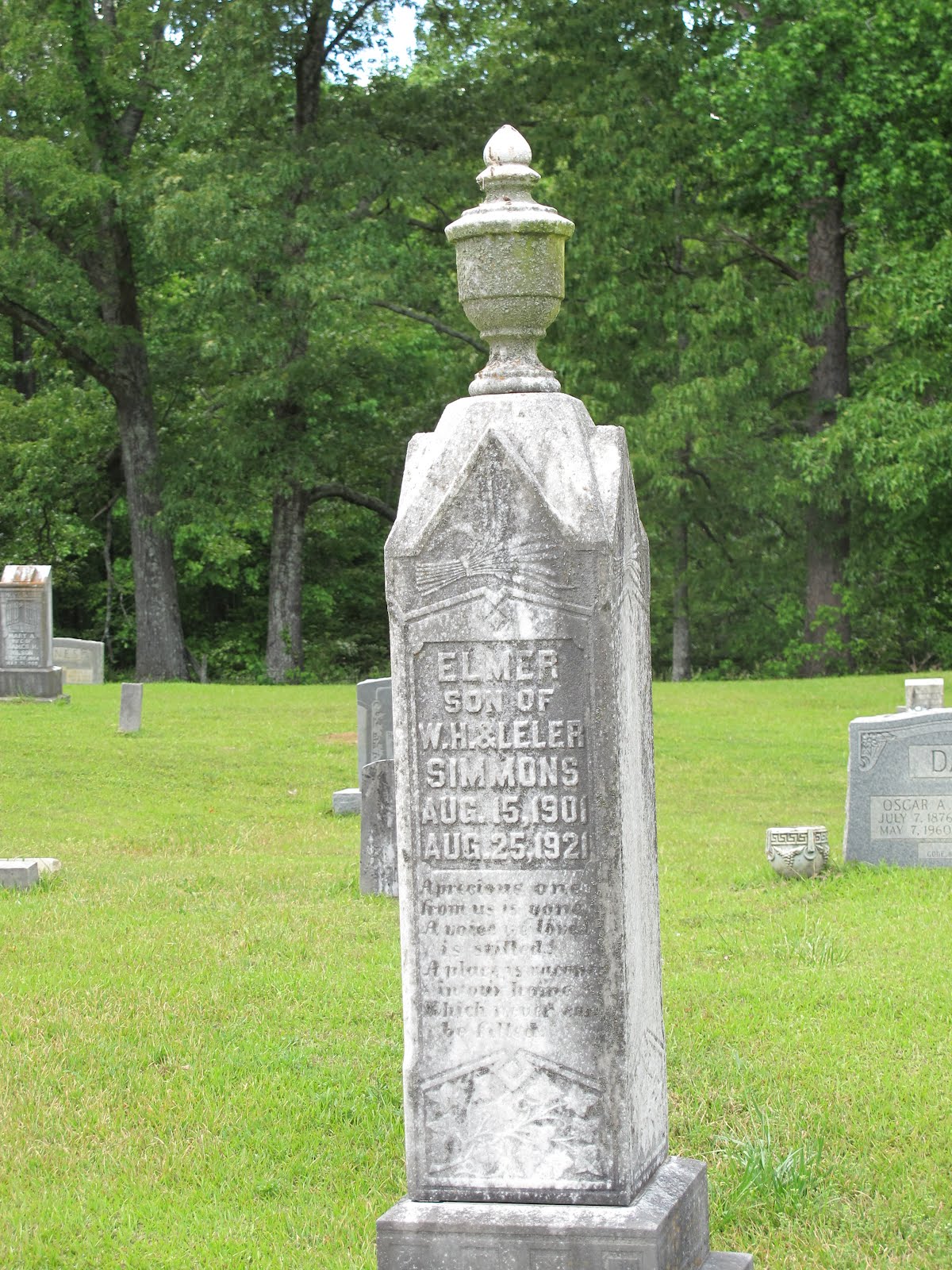
Behind the church is an ancient cemetery, at least ancient by my standards. Here is one grave marker we found. Note that is not the original marker, but a recent addition by the Alabama Historical Society. I assume the information came from earlier markers and historical records.


Here's another old marker -- updated.


Some of the old headstones were well worn and hard to read. Some had been replaced by new markers.


Also buried in this holy ground are my dad's grandparents, my great grandparents. My grandpa's sister and his brother married the brother and the sister of my grandma. So my dad had "double uncles" and "double aunts." So this is a common resting place for a lot of the family going back several generations.


In addition, there a several of my great grandparents, uncles, aunts, and even great, great grandparents -- Stanley and Wilson.


This is my dad's only sister and only younger sibling. She died while her brothers were at war.


My dad's sister and his parents are buried in another graveyard a few miles away.


A lot of history, and a lot more photographs.

Saturday, April 7, 2012

Forces -- Part One

I want to write about the start of the twentieth century. It was an interesting time, the dawn of a new era. The twentieth century would demonstrate war at its worst and most global. The century would firmly establish the United States as a world power. And this century would contain the scientific and technological advances that would challenge the imaginations of even the writers of science fiction, the new genre that was born with the new century. This is often called “the Second Scientific Revolution,” and it continues to this day. I want to talk about some fundamental laws of the physical universe and how they came to be discovered and established at the beginning of this new century.

There are now known to be four fundamental physical “forces,” although, at the beginning of this century, only two were known. What I mean by forces is the scientific term that implies a push or a pull. In physics, a force is any influence that causes an object to undergo a certain change, in either its speed or direction of motion, or geometrical construction.

In other words, a force is that which can cause an object with mass to change its velocity (which includes to begin moving from a state of rest), that is, to accelerate, or which can cause a flexible object to deform. Force can also be described by intuitive concepts such as a push or pull. A force has both magnitude and direction, making it a vector quantity. Newton’s second law, F = ma, was originally formulated in slightly different, but equivalent terms: the original version states that the net force acting upon an object is equal to the rate at which its momentum changes. (Momentum is a quantity equal to mass times velocity.)

As I stated, there are four “fundamental” forces known in nature. These are forces that act at a distance. They should not be confused with forces that occur with contact such as: frictional force, tension force, normal force, air (or fluid) resistance, applied force, or spring force (and there are others).

Historically, the first fundamental force to be understood is the force of gravity, and we credit Sir Isaac Newton (1642-1727) with its discovery. Prior to Newton’s time, the focus had been on understanding the motion of the planets and stars. For thousands of years, humankind was misdirected by assuming the earth was the center of all this motion. Although many give a religious reason for this incorrect understanding, it was really more the case that people sensed that the earth didn’t move. After all, it was well known that motion produced various pushes and pulls (acceleration) and it was obvious to the observers that the earth was standing still.

That’s not the first time that observations have been in error. Among Newton’s many discoveries and explanations of the laws of force were an understanding of how it would appear that the earth was stationary even though it is undergoing all kinds of motion from rotation on its axis to revolution around the sun to motion as part of the galaxy.

Using Tycho Brahe’s (1546-1601) extremely accurate and complete observations of the motion of Mars and other planets, Johannes Kepler (1571-1630) developed mathematical laws that described the motions within the solar system, correctly placing the sun at the center of this system with the planets revolving around the sun, and the earth’s moon revolving around the earth.

What Newton did was to develop a set of laws that described both gravity and rules for motion. These laws or formulas, when solved, predicted exactly the motions that Kepler had discovered. (There was a small amount of error when Newton’s laws were applied to Mercury, the innermost planet of the solar system. We’ll return to that small error later in this story.)

This is Newton’s “Universal Law of Gravitation.”

where:
• F is the force between the masses,
• G is the gravitational constant,
• m1 is the first mass,
• m2 is the second mass, and
• r is the distance between the centers of the masses.

G is a constant that makes the units work out right. It is a fundamental characteristic of our universe.

There were several conceptual breakthroughs included in Newton’s work. It is said that he was watching an apple fall out of a tree when he had his great a-ha moment. He realized that the apple fell to earth because the earth had an attraction for the apple: gravity. But he also realized the apple attracted the earth! Everything that has mass attracts everything else that has mass. Of course, since the earth’s mass is so much greater than the apple’s, the apple falls to earth, although you could argue the earth moves too, but just the tiniest little bit.

Further, he looked at the moon, and realized that it too was falling, just like the apple. It is just that the moon had a linear velocity that caused it to “fall” around the earth. From this comes orbital mechanics and an explanation of how masses can revolve around each other.

Writing this as an equation, he calculated the “force of gravity.” It is actually the weakest of the four fundamental forces, but the first to be discovered because it is a prime element in the motion of the planets and stars. It literally holds the macro universe together. “Macro,” in this sense, means “large” or “what we see.” Certainly the universe is large. The range or active distance of gravity is infinite, however, the force decreases with distance as the square of the distance.

That means that at twice the distance, the force is one over two squared or one-fourth the effect. We say that the force of gravity is proportional to the inverse of the distance squared. You can see that in the “r” value in the denominator of the equation for the force of gravity. This fact can be deduced easily with simple solid geometry. As the distance from a point increases, the surface of the sphere increases as the square of the distance. This “spreading” out of the force weakens its effect on a given mass.

Newton also developed three laws that deal with motion and contact forces. He had to invent a new form of mathematics called “The Calculus” to perform the calculations, and he is considered one of the greatest physicists and mathematicians of all time. He also did work with light and optics, which is a good segue to our second force.

All through the seventeenth and eighteenth and nineteenth centuries discoveries were made regarding electricity and magnetism. Even our Benjamin Franklin had a hand developing electrical principles during the time of the American Revolution. Grade schoolers are taught Franklin’s experiments with kites and lightning, an experiment in which we’re lucky one of our founding fathers didn’t experience an early end to his existence.

The big breakthrough occurred when James Clerk Maxwell (1831-1879) combined some of the equations found earlier by these pioneers and added a little bit of his own simply to make the set of equations symmetrical. These are now known as Maxwell’s equations and they predicted the existence of a force, now known as electro-magnetic force, as well as the existence of waves we now call radio waves and light. Experimental proof of the existence of radio waves would be delayed several years, and radio is a major part of the “Second Scientific Revolution” that begins with the new century.

Maxwell’s equations combined the known attractive force of magnetic materials and the electrostatic attraction demonstrated when a plastic comb is rubbed and then attracts small bits of paper. Unlike the force of gravity, which is always an attractive force, that is it draws masses together, the electro-magnetic force can be an attraction or drawing together as well as a repulsion or pushing apart.

In terms of the electrostatic force, we know there are two polarities, positive and negative, that we are familiar with from electrical circuits and batteries. We know that like charges repel. Two positive charges will repel each other as will two negative charges. But unlike charges attract.

There is a similar situation with magnetism where the two polarities are called “north” and “south” after the earth’s magnetic poles, and, again, like poles repel and unlike pole attract.

The electro-magnetic force is much, much stronger than the force of gravity. Think of how the comb can pick up pieces of paper held on the desk by the gravity created by the mass of the entire earth. All that gravitation force overcome by a small comb. Or consider a magnet able to pick up large weights and lift them against gravity. Obviously, gravity is the lesser of the two forces.

We also know that the electro-magnetic force extends to infinity, but decreases by the square of the distance, exactly like gravity. There are many similarities between the two forces, and the existence of “gravitational waves” similar to radio waves has been hypothesized. Although gravitational radiation has not been directly detected, there is indirect evidence for its existence.

For example, the 1993 Nobel Prize in Physics was awarded for measurements of the Hulse-Taylor binary system which suggests gravitational waves are more than mathematical anomalies. Various gravitational wave detectors exist. However, they remain unsuccessful in detecting such phenomena.

It was very near the end of the nineteenth century when a pair of experimenters by the names of Albert Michelson and Edward Morley. The Michelson–Morley experiment was performed in 1887 in the United States. Its results are generally considered to be the first strong evidence against the theory of a luminiferous aether (ether). The result of the experiment was to establish the speed of electromagnetic waves — light if you will — as a fixed speed often called the “speed of light.”

The most immediate effect at the time was to put an end to the Vortex theory, which said that atoms were vortices in the ether. So that would beg the question, “just what are atoms.” For the answer, we must move into the twentieth century. The experiment has been referred to as "the moving-off point for the theoretical aspects of the Second Scientific Revolution."

And this is what I really intend to speak on, the “Second Scientific Revolution” and a young man that led that revolution. So now the stage is set. Two of the fundamental forces of nature are known and can be calculated and put to use. What happens next, at the beginning of the twentieth century, will reshape every aspect of life on this planet. This is exciting.

Saturday, March 10, 2012

Pinky and the Floyd

Two successive nights, Pink Floyd music, concerts, people dancing in the aisles, and that strange smelling smoke wafting through the auditorium. What an experience. It is a very special treat to see a band that has musicians you actually know personally. One of the band’s drummers (actually “percussionist") is the son of one of my best friends (and fellow musician) from high school. He lives in Great Falls now, but was in Bozeman for the concert. I was also asked by the mother of the bass player to take photos. One of the keyboard players went to school with my nephew. So it was a nice connection to the band and music. Linda and I, my sister, and my old friend Ron Fleming watched the show on the second night from the balcony, so I even got two different points of view for the performance. (The first night we were about five rows back on the main floor.)

Pink Floyd is one of my favorite bands. I started listening to them with Atom Heart Mother back in the late sixties. (I especially am fond of Rick Wright, the keyboardist from the original British band.) There are two albums I played so much I actually bought another copy to replace the worn out originals: Dark Side and Tumbleweed Connection.

Pinky has two talented keyboardist, “Pinky” (Joe Kirtchner) who plays a “Keytar” (look it up) and Chris Cundy on a Hammond B3. Don't you just love the Hammond backing the guitar licks? The Floyd consists of ten musicians in all, two backup singers, two guitars, two drummers, two keyboards, bass, and a saxophone/acoustic guitar player. Of course, the real Pink Floyd usually had about two backup musicians for each original member when they toured, so it is expected it will take a lot of musicians to duplicate their music.

A special treat both nights was the appearance of Dave Walker, now a local resident. This British veteran of Savoy Brown and Black Sabbath did some vocals and also played the important role of “Pink” in the Wall drama. Add in the Bozeman High School Choir, four “party girls,” and a video show that would make Gilmour and Waters proud, and you had a very professional performance by a hometown band with super talent.

The band members are all professional musicians — no “day jobs.” Almost all perform regularly with various smaller bands in the area, and several teach music at local stores. They gather regularly as “Pinky and the Floyd,” and this series of concerts was the pinnacle of their efforts as they learned every song from the Wall to do the Thursday night performance. Last night was sweeter with the entire Dark Side performed along with many favorites from several PF albums and a reprise of some key Wall selections. The sound system was exceptional, the band was on target all night, no technical glitches — which is saying a lot since this was a very high tech performance with lights and fog. A great time was had by all in an audience that spanned the ages. The usual, friendly concert crowd as old rockers (including yours truly) enjoyed their memories while young kids and couples made new memories of their own.

Get on Google and check out Pinky, and Pink, and Mr. Walker, and add some history and knowledge to my short note. Then dig out your old PF albums — no cheating with CDs — gotta be vinyl. Smoke ‘em if you got ‘em and have a psychedelic trip back to the seventies. Pink Floyd! Pinky and the Floyd!! An honest and talented tribute.

Tuesday, December 20, 2011

Changing Times, Aspen, and the Beta (β) Billionaires

Our story begins with the US Army’s 10th Mountain Division. Influenced by the 1939 success of Finnish troops in warfare against invading Soviet units and by concern over escalating hostilities across Europe, the Army turned their attention to the status of military preparedness for winter warfare.

The US created the Mountain Training Center at Camp Carson, Colorado, but a national search for a suitable location for winter / mountain training led to the development of a site in the Rocky Mountains close to Leadville, Colorado. That became Camp Hale, and the 10th Mountain Division became the alpine combat arm of the US military.

These soldiers learned to fight on snow and were a part of the Infantry in World War II. These soldiers trained to fight and survive under the most brutal mountain conditions, fighting with skis and snowshoes, and sleeping in the snow without tents. After the war, many of these outdoor types returned to Colorado and the Ft. Hale area. The returning soldiers and skiers were instrumental in the development of the ski industry in the former mining towns of Aspen and Vail and elsewhere in Colorado.

Times were different back then. Skis were long and made of wood. Skiing was not the industry it is today, and the Denver airport was not clogged with winter ski enthusiasts from the first snowfall to the last.

Also, in the past, there were very rich people. In those days they were called “Millionaires,” but in today’s inflated economy they are better referred to as “Billionaires.” After all, it isn’t that hard to gather up over a million in assets in our inflated economy. Most upper-middle class members have that much in their homes and retirement plans.

But something else has changed in this rich class. You see the old time rich were very conservative. They typically got their money from businesses that created, built, mined, or manufactured something – or else they inherited it from parents who did that. Today’s rich are different. First they are more likely to have amassed their fortune in the financial markets, wheeling and dealing, but not really producing anything. Second, they are far from conservative. Now I’m not referring to their politics, but rather their spending habits.

In his book, “The High-Beta Rich,” Robert Frank, he explains that the term “beta” is a measurement used in stock investing. It is a measure of a stock’s price volatility relative to the market as a whole. That can be a good thing when the market goes up. But it is a bad thing when the market goes down. Investing in high beta stocks is risky. The rewards can be high, but the losses can be pretty high too.

For those who want to learn more about beta and other metrics used in wise investing, I recommend you check out “Value Line.” That is the stock market information source I use. By the way, the last two big downturns in stock values, when others were reporting losses of 20-40%, I did much better than that because my investment strategy is to go with low beta stocks. I did loose money at times, but typically made it back in a short time due to my conservative investment strategy. That greatly improved the long-term performance of my investments even during the last ten years of declining stocks, but that is another story for another day. Today I am using the concept in the same way Mr. Frank used it in his book. Modern day Billionaires, at least a lot of them, ride a roller coaster of risk.

Which brings me to Aspen. This tiny tony town tucked up in the Colorado Rockies is a favorite destination resort for the rich. Many of these beta billionaires have invested in Aspen purchasing large homes (although mansions is a much more descriptive name than the humble term “home”). We’re talking houses with swimming pools, movie theaters, even bowling alleys – and ten bedrooms and 14 baths!

This purchasing drove house prices in Aspen to stratospheric levels. The median price of a house in Aspen was around $6 million before the recent collapse in home values. Now remember what the term median means; half of the houses in Aspen cost over $6 million prior to 2008. Also realize that most of those homes were only occupied two to four weeks out of the year. These weren’t second homes; they were fourth or sixth or tenth homes!

This created an unusual dynamic in Aspen. Fur stores were as common as t-shirt stores in most resort communities. Imported wines and world-class chefs were found in a myriad of eateries. And the people that worked in those stores and restaurants? They had to live 50 to 100 miles away in Glenwood Springs or Rifle because they couldn’t afford rents in Aspen. On the positive side, there was considerable support for charities and non-profits from these rich visitors, and the local tax base was substantial. That paid for snowplows and libraries and concerts and more.

But all that changed when the housing market collapsed. The current median price for houses in Aspen is around $1 million, still pretty pricey; but a tremendous drop in home value, a much larger decline than what the rest of the US experienced. Maybe the billionaires can afford it, but the local shops and restaurants as well as non-profits and tax base have all suffered greatly due to this precipitous loss in value.

I like Aspen. I go there on occasion, and I’ve been involved with the Aspen Institute since the early ‘80’s when I was the chairman of the local library board and attended meetings on literacy. The annual International Design Conference attracted everyone from Eliot Noyes, design director at IBM to George Nelson, lead designer at Herman Miller to Apple founder Steve Jobs.

I’ve even skied there, but – truth be told – it is not my favorite ski resort. I much prefer Vail as a destination resort, or Copper or Breckenridge, or even Winter Park. And I’m much more likely to be found skiing at the non-resort Loveland or Eldora or, when it was around, the old Hidden Valley (later renamed Ski Estes Park) in RMNP.

It is fun to go to Aspen because it is good skiing, and you never know whom you might run into on the slopes. (In the case of my skiing ability, I mean “run into” literally.) But when the hamburgers went over $15 each at my favorite watering hole, I said the heck with Aspen. Besides, it was about the farthest to go ski, and I started skiing closer and closer to home. In fact, these days, I typically limit my skiing to sliding down our driveway while attempting to shovel it.

I am not crying for the poor billionaires who lost their shirt and extra pair of pants in the Aspen real estate market, but I think this little story is just another sign of our times. I don’t know for sure if the rich keep getting richer, but I guarantee that the poor are getting poorer. Trust me, a million dollars just doesn’t go as far today as it used to. Why, at this rate, I’m going to be forced to buy a USED Mercedes.

Friday, December 16, 2011

The Calling

I believe everyone has a “calling,” something that completes their life, a mission, a joy, a place where they fit. It doesn’t have to have a religious connotation, although for some the calling is to the ministry. It isn’t just about a job, or a vocation, or a career, even an avocation — although it is a happy life when one’s calling is one’s vocation.

It is sort of the answer to “What do you want to be when you grow up?” I always felt lucky that I knew the answer to that question at such an early age. Some keep asking it well into middle life — and that may be the cause of the infamous “mid-life crisis.” Some figure it out half way through a career, and the brave amongst those will change their life in accordance. (I think of a long ago friend, J.D. Thorne, and the story he told me about his father.)

I suppose there can be more than one calling in life. I also assume people can be very happy with a life-long job and pursue their calling more as a hobby or a sideline or even what they do upon retirement. But I really think it is a single, primary, focused thing in most people’s lives, and the happiest people are those that have heard their “calling” and responded.

At a very early age I knew I wanted to be a scientist. I changed minds over the years on just what kind of scientist going from astronomer to geologist to electronics engineer, and I have echoed that behavior throughout my career going from technician to engineer to scientist to programmer to tester to statistician. But I don’t think that is really my calling. As I explore my path in life I think my calling is to be a teacher.

I worked in that field in a formal manner during different parts of my career teaching in the Navy, at Electronics Technical Institute, and at Metropolitan State College. I spent 14 years as an instructor in IBM’s Technical Education organization. But, in addition to that, I’ve taught as a side-line, a “second job,” a hobby, and just a way to spend time. Now that I’ve retired, I even consider my writing as “teaching.” I think of all the other things I’ve learned and done were just information and experiences for me to share with others — to teach.

I have many priorities and hold many truths to be self-evident. I’m a believer in Jesus Christ and His sacrifice on the cross. I believe in a Creator and that there is a plan for this world and my life. I believe in family and think that is the most important thing in life. To some, their calling is undoubtedly their family. I think this is especially true of mothers, and that is what makes them so special.

I think of a dear friend in New Orleans who has followed his calling in music, but also in his desire to care for others less fortunate. He shares my strong belief in our Savior. I think of my brother-in-law, also strong in the faith, who has raised a fine family of loving children with the help and support of his wife. Those children are a blessing to one another and all those that know them.

I think about my father whose love for his wife was epic in its width and depth — reminds me of lyrics to a song — and music is his love too. I think of my dear wife whose love of others drives her every day to give and care for others, even at the expense of herself.

I won’t go on listing the people in my life since it would be too long and I would forget someone.

Think about your life. Think about your family. Think about the path your life has taken. This is a time of year for all to recollect and recount their blessings, even those that don’t worship the Savior we celebrate. It is a natural and human and, I believe, God given thing to do at this time of year. God bless you all, and may your calling be clear and your path be straight. Some wander and some find their way. May you find your way and “God bless us all.” — Tiny Tim.

Saturday, November 26, 2011

Mathematics of the Calendar

Here is a note from Facebook that a friend posted. I responded with the answer in two comments. I’m saving the entire “conversation” here in my Notes to keep it intact. I edited my response somewhat to make it more clear (hopefully) and more complete.

I’m constantly the teacher imparting new knowledge. Please enjoy this analysis.

Thanksgiving day on the 28th of November 1901-2126
by Chuck Short on Friday, November 25, 2011 at 7:39am
Things I need to know, please....

A: Days Thanksgiving (US) has been and will be on November 28

B: Why the 11 year cycle, why the 6 year cycle in contrast to the 11 year cycle, and why is the cycle 12 years in 2109?

C: This has only occurred 3 times in my lifetime, and won't happen again until 2013, and then again 6 years later in 2019..

D: How would leap years figure into these cycles?

Year Compared to year 2013 Since last
1895 118 years before

1901 112 years before + 6 years
1907 106 years before + 6 years
1918 95 years before + 11 years
1929 84 years before + 11 years
1935 78 years before + 6 years
1946 67 years before + 11 years
1957 56 years before + 11 years
1963 50 years before + 6 years
1974 39 years before + 11 years
1985 28 years before + 11 years
1991 22 years before + 6 years
2002 11 years before + 11 years
2013 selected year + 11 years 49
2019 6 years after + 6 years 55
2030 17 years after + 11 years 66
2041 28 years after + 11 years 77
2047 34 years after + 6 years 83
2058 45 years after + 11 years 94
2069 56 years after + 11 years 105
2075 62 years after + 6 years 111
2086 73 years after + 11 years
2097 84 years after + 11 years
2109 96 years after + 12 years
2115 102 years after + 6 years
2126 113 years after + 11 years

And I know that Thanksgiving didn't become the last Thursday in November until the 40s. and longevity or getting old jokes are simply not welcome, so don't do it, I will simply never speak to you again, no matter who you are. Period. Thanks!!!
Comment:

OK. You asked!

Well, that question really takes me back: 1966, Montana School of Mines, my first programming class, IBM 1401 – programming with punch cards using FORTRAN IV.

The class assignment was to list all of the dates for Thanksgiving until the “turn of the century.” So that was all the Thanksgiving days from 1967 until 2000.

In those days you wrote a program on a “coding sheet” which looks like a crossword puzzle all full of lines of squares. Then the program is copied on a punch card machine producing the program on cards. You then submit the cards at the window in the computer center and they run it on the mainframe computer. An hour or so later you would pick up your output which was a giant “fan-folded” paper with green bar background and see what mistakes you had made. Repeat this process until program runs. It could take days if the program was complex. As I recall it took me two days to get the program to run correctly.

The mathematics involved is called “modulo arithmetic” or “clock arithmetic.” Since the days of the week repeat on a seven day cycle, it is much like a clock that goes from 1 to 12 and then starts over at 1. The concept of modulo arithmetic is tied to division and using the REMAINDER. In the case of clocks you divide by 12 and the remainder gives the “answer.” With the days of the week, you divide by 7 and use the remainder.

So, let’s start with an easier question, what day of the week does Christmas, Dec. 25, fall on in a given year. Let’s start with last year. In 2010, Christmas was on a Saturday. Now, take 365 days in a year and divide by 7. You get 52 and a remainder of 1. So add the 1 to Saturday and you get Sunday. Yes, Christmas, this year, will be on a Sunday.

(Mathematically we way 365 div 7 = 52 and 365 mod 7 = 1. See, “mod” is just the remainder [and “div” is the quotient part as a whole number]. )

So, what about next year? Will Christmas be on a Monday? Uhhhh … no! It will be on Tuesday. WHAT! You forgot, next year is a leap year and the number of days in 2012 will be 366. Divide that by 7 and you get remainder of 2. Add 2 days to Sunday and you get Tuesday. So the cycle of days of Christmas is a simple +1, +1, +1, +2, +1, +1, +1, +2, …

So let’s start this cycle and see how long it takes to repeat.

Start with 2012 when Christmas is on Tuesday:
So, in 2013, Wednesday (+1),
2014, Thursday (+1),
2015, Friday (+1),
2016, leap year, Sunday (+2),
2017, Monday (+1)
2018, Tuesday (+1) — aha, we’ve circled back to Tuesday where we started in 2012. But is this really the complete cycle?

NO. Keep going:
2019, Wednesday (+1),
2020, Friday (+2).

So the first cycle went Tue., Wed., Thur., Fri., Sun., Mon.; and the second cycle is starting out Tue., Wed., Fri.! Note the pattern is varying. In fact, the total pattern is 4 x 7 or 28 years in length.

So why are the patterns in your Thanksgiving calculation following cycles of 6 and 11 years. Well, Thanksgiving is a little more complicated than Christmas because the cycle “sort of” resets itself periodically because it must always be the FOURTH Thursday of the Month.

Now it is more complicated figuring a holiday like Thanksgiving which is the fourth Thursday of the month of November, but the math is similar. So, if you apply all the rules and modulo arithmetic, you get the crazy chart you noted. That is where the cycle you noted come from. As Thanksgiving “rolls” off the end of November in the 28 year cycle, it gets “reset” with a minus 7. The math for that is a little more complicated and I won’t repeat it here.

By the way, your calendar went past the next century, 2100, so you have to make the “skip the leap year” calculation. What is the “skip the leap year calculation?” you ask.

Leap year is skipped in any year even divisible by 100. That is every century year such as 1900 and 2100. Note that 100 is divisible by 4, so it should be a leap year, but the leap year is skipped every 100 years to keep the calendar in sync. Now comes the big kicker. What about 2000? I think it was a leap year! That’s right!!

2000 was evenly divisible by 100, yet it WAS a leap year. You don’t skip the leap year in any year evenly divisible by 400. Now, check if you’ve got this figured out: Add a day to the year every 4 years (since the earth takes about 365 ¼ days to orbit the sun). But, skip the leap year every 100 years, BUT don’t skip it every 400 years. Wheww, I’m out of breath.

Once you have conquered the calculations for Thanksgiving (or Memorial Day or Labor Day), you are ready to calculate Easter which has a seasonal variation too. I’ll save that as an exercise left for the reader.

So there you have it, using only fifth grade math.

Comment 2, EXERCISE:

Ok, here is the part left as an exercise for the reader. Why the 6 and 11 year cyclic patterns? Recall from my last comment that the effect of there being 365 days in a non-leap year is to “advance” the day of a week of a given date, such as Christmas, by one day a year. And that a leap year, occurring every four years, advances the day by two. You also may have noted the earlier series of “Tue., Wed., Thur., Fri., Sun., Mon.” has six terms. That is a powerful hint. But what about the eleven year cycle?

Start with the fact that Thanksgiving is the fourth Thursday of November. Let’s convert that to a given date like the Christmas example by focusing on Nov. 1. If Nov. 1 is a Friday, then the first Thursday of November is six days later, Nov. 7. And the second Thur. is Nov. 14, and the third Thursday is Nov. 21, and the fourth Thur. is the Nov. 28 you are focused on. Note that Nov. 28 is the latest that Thanksgiving can ever be.

For comparison, assume Nov. 1 was on Thur. Then the second Thur. of the month would be Nov. 8, the third Nov. 15, and the fourth would be Nov. 22 – the earliest date that Thanksgiving ever falls on.

Now, again, consider the “progression” over the years of a given date as to its day of the week which is the series 1,1,1,2,1,1,1,2, … Now assume in a particular Nov. is a leap year (and therefore Nov. is “after” the extra day in February). That means the progression would start at the first 1 (of the 1,1,1,2 repeating series). Further, assume that Nov. 1 is a Friday. As we already saw, that would mean that Nov. 28 would be Thanksgiving that year.

Now the following year Nov. 1 is Sat. The year after that it is a Sun. The year after that it is a Mon. The next year is a leap year so it jumps to Wed. The year after that it is a Thur. and the year after that it is back to a Friday. Count those up. It cycled through the days of the week of which there are seven, but it skipped one day in the cycle. There is your six day cycle.

The 11 day cycle occurs when the leap year causes a skip over the Nov. 1 = Friday part. So now it has to cycle through “two weeks” or fourteen days of the week, but during that period it goes through three leap years, so subtract 3 from 14 and you get 11. (If you write out the series you’ll note one leap year in the first few years, one leap year that skipped over the Nov. 1 = Friday, and one leap year in the series of six after that. To make that clear, and as an exercise left to the reader, which term of the series would you start on to “skip over” the Nov. 1 = Friday? Is it 1(1), 1(2), 1(3), or 2(4)?)

I explained that non-mathematically without formulas and words can be … well … sort of wordy, but I think you see what is driving the two repeat numbers of 6 and 11. By the way, the one time you got 12 for the cycle time was 2109 and that’s because that period or cycle included the non-leap year of 2100. There by losing one +2 in the series and so it took one more day.

By the way, the first step to analyzing these kinds of things mathematically is exactly what you did. Write out several terms of the series and look for patterns. This ability to recognize and analyze patterns that is so common in mathematics and with mathematicians is one reason so many mathematicians are also musicians. After all, music is all about the patterns too. The scales(major, minor, Devonian, etc.) and the chord structure (major, minor, diminished, seventh) and the chord rotation (I, IV, I, V,IV, I).

In fact, when I was teaching programming and training programmers, we always selected the musicians and the mathematicians because they had these basic gifts or skills that also made them good programmers.